
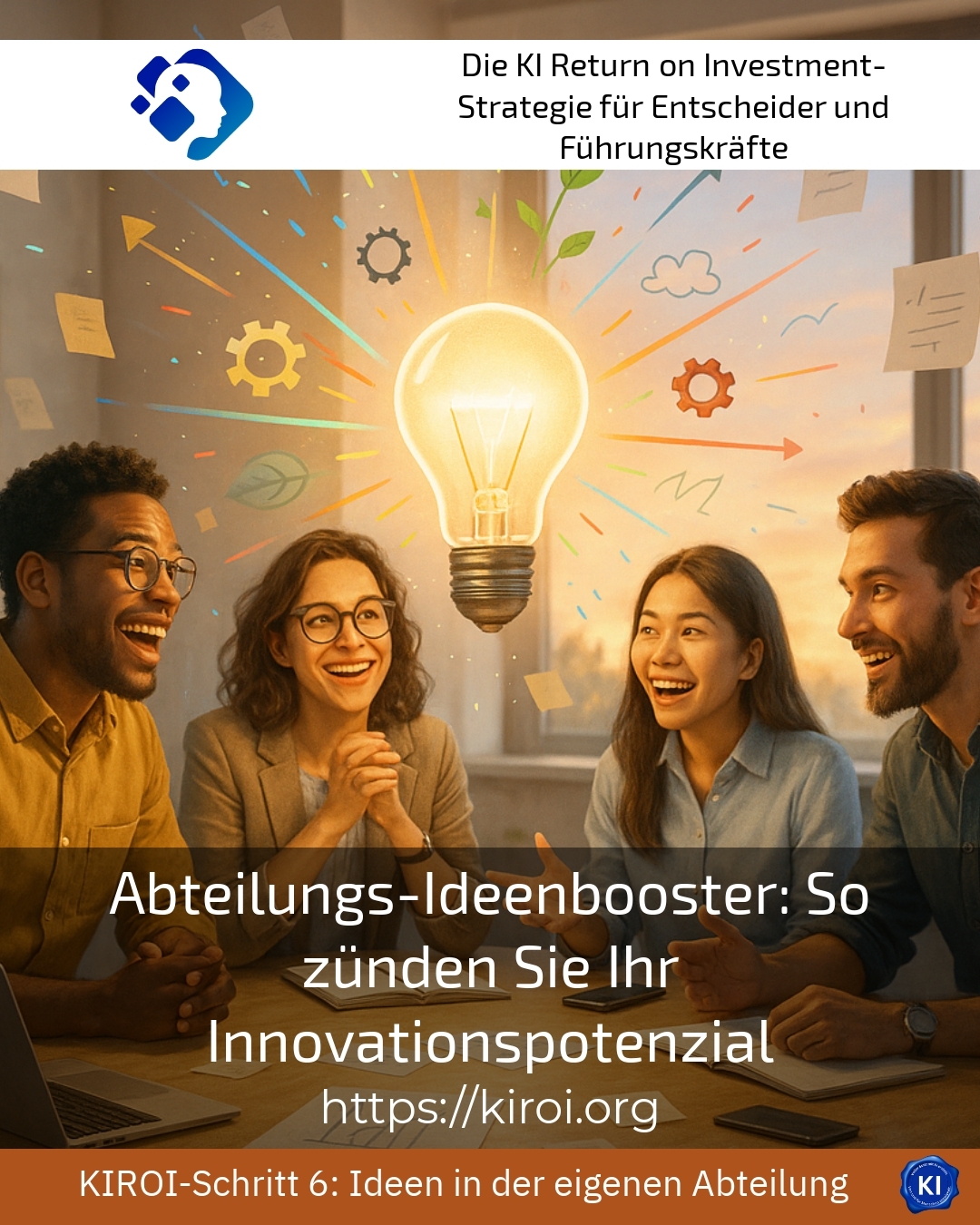
Do you know the feeling when creative energy in your team becomes almost palpable? The moment when breakthrough ideas, which can transform your company, suddenly emerge is priceless. However, these magical moments rarely happen by chance, as they require systematic preparation and the right framework. A Departmental Idea Booster can provide exactly the initial spark that frees teams from their usual way of thinking. In this article, you will learn how to awaken and sustainably harness hidden innovative forces within your organisation.
Why traditional creative methods often reach their limits
Many companies have relied on tried-and-tested brainstorming sessions for years. They gather their employees in a room and hope for innovative flashes of genius. However, the results often fall short of expectations. The reason lies in human psychology and group dynamics. Dominant personalities often take the lead in such sessions. Introverted team members hold back their potentially brilliant ideas. This creates blind spots that prevent innovation.
This phenomenon is particularly evident in the automotive industry. Engineering teams spend hours discussing technical optimisations to internal combustion engines, overlooking disruptive trends like electromobility or autonomous driving. Similarly, retail marketing departments focus on traditional advertising measures, leaving the potential of social commerce or influencer marketing untapped. We observe comparable patterns in the healthcare sector with the digitalisation of patient processes.
The Departmental Idea Booster as a Catalyst for Innovation
A structured approach to idea generation fundamentally differs from spontaneous creativity sessions. It combines proven innovation methods with digital tools and psychological insights. The aim is to encourage every single employee to participate actively. Hierarchical barriers are systematically dismantled and cross-functional collaboration is fostered.
Financial services providers use such approaches, for example, to develop new customer services. They break down traditional silos between IT, sales, and compliance. In the manufacturing sector, cross-departmental idea workshops lead to innovative production processes. Logistics companies optimise their supply chains with input from all hierarchical levels. These examples show the enormous potential of systematic idea promotion.
Best practice with a AIROI customer
A medium-sized mechanical engineering company with around 450 employees faced the challenge of accelerating its product development. The previous innovation cycles averaged 18 months, which was significantly too long compared to the competition. As part of a transruption coaching process, we implemented a structured departmental idea booster that involved all specialist areas. Initially, we conducted anonymous idea collection sessions to also include more hesitant employees. Subsequently, mixed teams from production, development, and customer service evaluated the submitted proposals. The result permanently surprised even the most sceptical management level. Within just three months, 47 concrete improvement suggestions for existing product lines were generated. Twelve of these were directly implemented and resulted in measurable efficiency gains. Particularly noteworthy was the increased motivation of the workforce, who now saw themselves as an active part of the innovation process. The lead time for new product ideas was reduced by an average of 35 percent.
Psychological Safety as a Foundation for Creative Processes
Without a climate of trust, even the best methods will be ineffective. Employees must feel safe to voice even unconventional ideas. The fear of criticism or rejection demonstrably inhibits creative thinking [1]. Leaders play a crucial role model function in the organisation. They must actively demonstrate that mistakes are viewed as learning opportunities.
In the insurance sector, progressive companies establish so-called innovation labs for new products. There, teams are allowed to test new concepts without fear of repercussions. Technology giants, such as those in the software sector, use hackathons as protected innovation spaces. Pharmaceutical companies set up interdisciplinary research groups that operate outside the regular hierarchy. These examples illustrate how psychological safety favours innovation.
Digital tools to support the departmental idea booster process
Modern technologies significantly expand the possibilities for systematic idea generation. Collaboration platforms enable asynchronous cooperation across time zones. Artificial intelligence can identify idea clusters and reveal connections [2]. Visualisation tools make complex concepts understandable for all stakeholders.
For example, telecommunications companies rely on digital idea management systems with gamification elements. Employees collect points for submitted suggestions and their further development by colleagues. Energy providers use virtual reality environments for collaborative innovation workshops. Media companies are experimenting with AI-powered creativity tools for content development. These digital approaches sensibly complement traditional methods.
Best practice with a AIROI customer
An internationally operating trading group with branches in twelve countries was struggling with fragmented innovation processes. Each national subsidiary developed its own solutions for identical challenges, leading to enormous waste of resources. Through transruption coaching, we supported the introduction of a global innovation platform over a six-month period. The platform enabled the real-time exchange of ideas across all locations. Employees could submit, rate, and collaboratively develop suggestions, regardless of their physical location. An intelligent algorithm identified similar ideas and suggested mergers to leverage synergies. The community management team moderated the process and ensured the quality of discussions. Within the first year, three market-ready product innovations emerged from the internal community. The return on investment exceeded initial expectations threefold, which profoundly impressed management. The cultural shift towards a more open innovation culture throughout the company proved to be particularly valuable.
Structured methods for idea evaluation and prioritisation
Generating ideas is only the first step in the innovation process. The systematic evaluation and prioritisation of suggestions is equally important. Without clear criteria, promising concepts can get bogged down in organisational bureaucracy. A transparent selection process also increases acceptance among all stakeholders.
For example, chemical companies use Stage-Gate models to gradually refine innovations. Each stage requires defined criteria to be met before further resources are invested. Banks rely on business case calculations with standardised assumptions and key figures. Consumer goods manufacturers test promising concepts in controlled market environments before rollout. These structured approaches significantly reduce the risk of misinvestments.
The Role of Leadership in the Departmental Idea Booster
Leaders must actively promote and embody innovation. Lip service to creativity remains ineffective when day-to-day business dominates. Dedicated time and resources are needed for innovation activities in the daily routine. Furthermore, leaders must be prepared to relinquish control and allow for experimentation.
In the construction industry, progressive companies are establishing innovation budgets for each department. Team leaders are empowered to decide independently how these funds are used. Hotel chains are authorising their on-site employees to make independent service improvements. Transport companies are rewarding drivers for submitted optimisation suggestions for route planning. These examples show how decentralised innovation promotion can work.
Cultural anchoring of innovation routines
One-off innovation workshops quickly fizzle out without being firmly embedded in the corporate culture [3]. Regular formats and rituals are needed to make creative thinking a habit. Set time slots for brainstorming and visible success stories both help in this regard. Integrating this into target agreements and performance reviews further reinforces the effect.
Publishers hold monthly pitch sessions for new publication formats and digital products. Hospitals are establishing interdisciplinary case conferences for process optimisation in patient care. Industrial companies are setting up innovation labs that can work continuously on future topics. These continuous approaches clearly distinguish successful innovators from opportunistic inventors.
Best practice with a AIROI customer
A service company in the professional services sector wanted to fundamentally modernise its consulting approaches. The previous methods, some dating back to the company's early years, no longer met current market demands. As part of our transruptions coaching support, we developed a multi-stage innovation programme for all consulting teams. First, we jointly analysed existing working methods and systematically identified potential for improvement. Subsequently, we formed cross-functional working groups, each tasked with revising and modernising a specific method area. Each group received an innovation budget and six weeks to develop concepts in a protected environment. The results were presented and discussed at a company-wide innovation conference. External experts evaluated the proposals and provided valuable feedback from their market perspective. The company subsequently implemented five completely new consulting products, which are among their most successful today. The cultural shift towards continuous improvement is at least as valuable as the concrete results.
My AIROI Analysis
The systematic promotion of innovation in organisations requires far more than occasional creativity workshops. Successful companies understand that the departmental idea booster is an interplay of culture, methodology and technology. Psychological safety plays a fundamental role in this, which is often underestimated. Employees must dare to share even unrefined ideas without fearing negative consequences.
From my consulting practice, I know that many organisations already possess enormous innovation potential. However, this potential often remains untapped because the right framework conditions are missing. The combination of digital tools and personal support yields the best results in practice. It is crucial to involve all hierarchical levels and specialist departments, excluding no one.
Transruptions coaching can effectively support and inspire organisations on this journey. It assists in the development of suitable formats and the cultural embedding of innovation routines. Clients often report surprising insights gained from an external perspective on entrenched processes. Investing in systematic innovation promotion typically pays off multiple times over. It not only strengthens competitiveness but also sustainably enhances employee retention and employer attractiveness.
Further links from the text above:
[1] Harvard Business Review – Psychological Safety
[2] McKinsey – Top Trends in Tech
[3] Forbes – Innovation Insights
For more information and if you have any questions, please contact Contact us or read more blog posts on the topic Artificial intelligence here.








 Deutsch
  English (UK)