
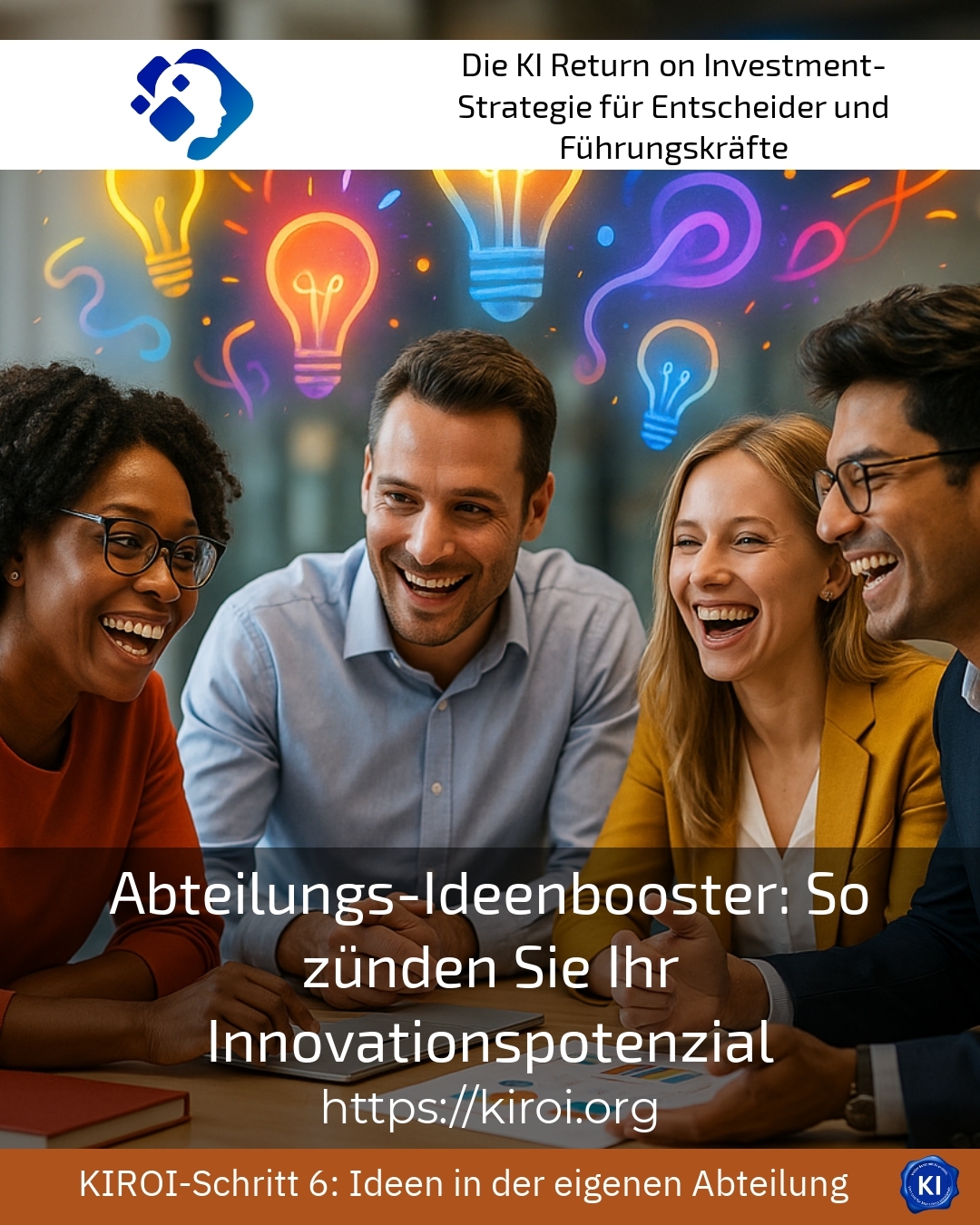
Imagine your department transforming into a bubbling spring of groundbreaking ideas. The Departmental Idea Booster This acts as a powerful catalyst for hidden creative energies. Many leaders report that their teams possess unimagined potential. These dormant resources are just waiting to be awakened. In this post, you'll learn how to systematically ignite innovative power. Transruption coaching will accompany you as a reliable partner on this exciting journey.
Why the departmental idea-booster has become indispensable today
The modern world of work demands fresh impetus and creative approaches to solutions. Traditional ways of thinking are increasingly encountering their natural limits. Companies from a wide variety of sectors are currently experiencing fundamental changes to their business models. This shift is particularly evident in the field of management consulting. Clients often approach us with rigid structures. They are looking for ways to fundamentally overhaul their internal processes.
For instance, a medium-sized consulting firm faced the challenge of stagnating project ideas. Employees felt trapped and demotivated by routine processes. Another example is an auditing firm with similar problems. Partners noticed a lack of innovative service concepts and that competitors were pulling ahead. A strategy consultancy also struggled with a lack of creativity in its analysis teams. These situations highlight the urgent need for systematic idea promotion within departments.
Studies show that innovation-friendly departments achieve significantly better results [1]. Research also demonstrates positive effects on employee satisfaction [2]. Transruption coaching supports teams in putting these findings into practice.
Understanding the departmental idea booster as a strategic tool
Innovation rarely arises by chance or spontaneous flashes of inspiration from single geniuses. Rather, creative thinking needs fertile ground and deliberate nurturing. Departmental Idea Booster creates exactly this kind of supportive environment for your team. It combines tried-and-tested methods with modern approaches to fostering creativity.
In management consulting, we often encounter high-potential teams. However, these teams frequently operate under conditions unfavourable to creativity. A specific example comes from an IT consultancy with twenty employees, where rigid hierarchies blocked the free flow of ideas between different levels. In contrast, a recruitment consultancy struggled with the excessive specialisation of its consulting teams. Experts rarely communicated across disciplines, missing out on valuable synergies. Particularly interesting was also the case of a financial consultancy with an innovation-averse meeting culture.
Best practice with a AIROI customer
An established management consultancy specialising in restructuring projects approached us with an urgent concern. Management had for some time been noticing a gradual decline in innovation within its operational teams. New consulting approaches were rarely being developed, and competitiveness was noticeably suffering as a result. Within the framework of transruption coaching, we first developed a detailed analysis of the existing idea culture. This revealed that informal communication channels had almost completely dried up. Consultants were working in isolation on their projects and rarely sharing ideas. We subsequently implemented structured creativity formats with weekly impulse sessions, each lasting thirty minutes. Additionally, we established a digital idea board for asynchronous inspiration and feedback. After four months, the teams reported a significantly improved atmosphere for creative thinking. Specifically, three new consulting products were developed, which are now successfully offered on the market. Employee satisfaction increased measurably, and staff turnover noticeably decreased.
Methods for activating your departmental idea booster
Various techniques can systematically unlock your department's creative potential. The selection of suitable methods depends on individual factors. Transruption coaching will support you in identifying appropriate approaches for your situation.
In the field of strategy consulting, for example, regular perspective-shifting exercises are proving effective. In these, consultants consciously adopt the viewpoint of their clients or competitors. A process consultancy successfully used the method of a creative pause between analysis phases. Employees were given dedicated time slots for unstructured thinking and reflection. The introduction of interdisciplinary tandem work proved particularly effective in a technology consultancy. Experts from different specialist areas engaged in intensive exchange about their working methods [3].
Recognising and constructively overcoming obstacles
On the path to greater innovation, teams typically encounter various hurdles. However, these obstacles can be overcome with the right approach. Transruption coaching provides valuable impetus for practical implementation.
A common blockage is the so-called expert trap in specialised consulting teams. Long-serving experts sometimes develop thought patterns that can hinder new ideas. Another obstacle is seen in the overloaded calendars of consulting projects. Constant utilisation leaves little room for creative experimentation and development. The fear of making mistakes also inhibits the willingness to innovate in many departments. Clients frequently report a distinct problem with the error culture in their teams.
An organisational consultancy solved this problem by introducing explicit experimentation zones where employees were expressly allowed to try new things and also to fail. A digital consultancy established monthly learning formats on failed projects and their lessons. A compliance consultancy's risk aversion was gradually reduced through small pilot projects [4].
The departmental idea booster in daily practice
Theoretical knowledge alone is not enough for sustainable change. Integrating creative impulses into everyday work requires deliberate design. Transruption coaching supports this with tried-and-tested approaches and continuous guidance.
One example demonstrates a communications consultancy with very different creative levels within the team. There, we introduced differentiated formats for different employee types. Introverted team members were given asynchronous participation opportunities via digital platforms. Extroverted individuals, on the other hand, benefited from lively in-person brainstorming sessions. A sustainability consultancy integrated creative elements directly into its client projects. The consultants developed innovative solutions together with their clients on site. The initiative of a marketing consultancy to network with startups was also particularly successful [5].
Best practice with a AIROI customer
An internationally active management consultancy was looking for ways to strengthen its innovation culture. The various locations worked relatively independently of each other and exchanged few ideas. Transruptions coaching developed a cross-location programme for creative networking. We started with virtual idea cafés, where employees from different countries came together. These short formats lasted only forty-five minutes each and took place every two weeks. Participants were given varying creative tasks to work on. Additionally, we implemented a buddy system between experienced and newer consultants from different locations. These tandems regularly exchanged ideas about their project approaches and challenges. After six months, a lively network of creative minds had been established. Cross-location collaboration on client projects increased significantly and enriched both sides. Several innovative service concepts emerged directly from these newly forged connections between the locations.
Leaders as catalysts for the departmental idea booster
The role of leadership in fostering a culture of innovation can hardly be overstated. Managers significantly shape the creative atmosphere in their departments through their behaviour. They can both inspire and unintentionally block creative impulses.
In management consulting practice, we encounter different leadership styles with varying effects. A partner at a strategy consultancy fundamentally and consciously changed his communication style. He began by asking the younger team members for their ideas first in meetings. This gave fresh perspectives more space and appreciation within the team. A department head at a process consultancy established regular creative breaks for her team. These protected time slots were explicitly free from operational tasks and project pressure. The managing director of a small boutique consultancy led by creative example himself. He openly shared his unfinished ideas and invited constructive development [6].
Ensuring the sustainability of innovation culture
Short-term creative bursts quickly fizzle out without appropriate structures for consolidation. The long-term establishment of an innovation-friendly culture requires a systematic approach. Transruption coaching supports organisations on this demanding journey over extended periods.
A transformation consultancy secured its innovation culture by anchoring it in key performance indicators. In addition to classic performance indicators, creativity metrics were also regularly collected and discussed. An HR consultancy integrated innovation capability into its personnel development programmes and promotion criteria. New employees are introduced to creative methods and ways of thinking from the outset. The establishment of an internal innovation lab had a particularly lasting impact on a logistics consultancy. There, employees can work on new ideas independently of their regular projects.
My AIROI Analysis
Engaging with systematic idea promotion within departments reveals fundamental insights for modern organisations. Innovation cannot be forced, but the conditions for it can be deliberately shaped. The numerous examples from the consulting industry clearly show that creative potential lies dormant in almost every team. These resources are simply waiting for appropriate stimuli and supportive structures to unfold.
From my perspective, the key lies in combining several approaches simultaneously. Individual measures rarely achieve their full effect without a coherent overall concept. The leadership level must embody and actively support innovation through their own behaviour. At the same time, employees need protected spaces and dedicated time for creative work.
Best practice examples illustrate that sustainable change requires time and patience. Quick successes are possible, but cultural transformation takes months. Transruption coaching can effectively support and structure this process. Investing in systematic idea promotion pays off many times over, based on experience. More satisfied employees, innovative products, and increased competitiveness are typical outcomes. The consulting industry impressively demonstrates how even knowledge-intensive service providers can benefit from such approaches.
Further links from the text above:
[1] Harvard Business Review – Innovation Research
[2] Gallup Workplace Insights – Employee Satisfaction and Innovation
[3] McKinsey Insights – Creativity in Organisations
[4] BCG – Innovation Strategy and Delivery
[5] Forbes Innovation – Trends and Best Practices
[6] MIT Sloan Management Review – Leading Innovation
For more information and if you have any questions, please contact Contact us or read more blog posts on the topic Artificial intelligence here.







 Deutsch
  English (UK)