
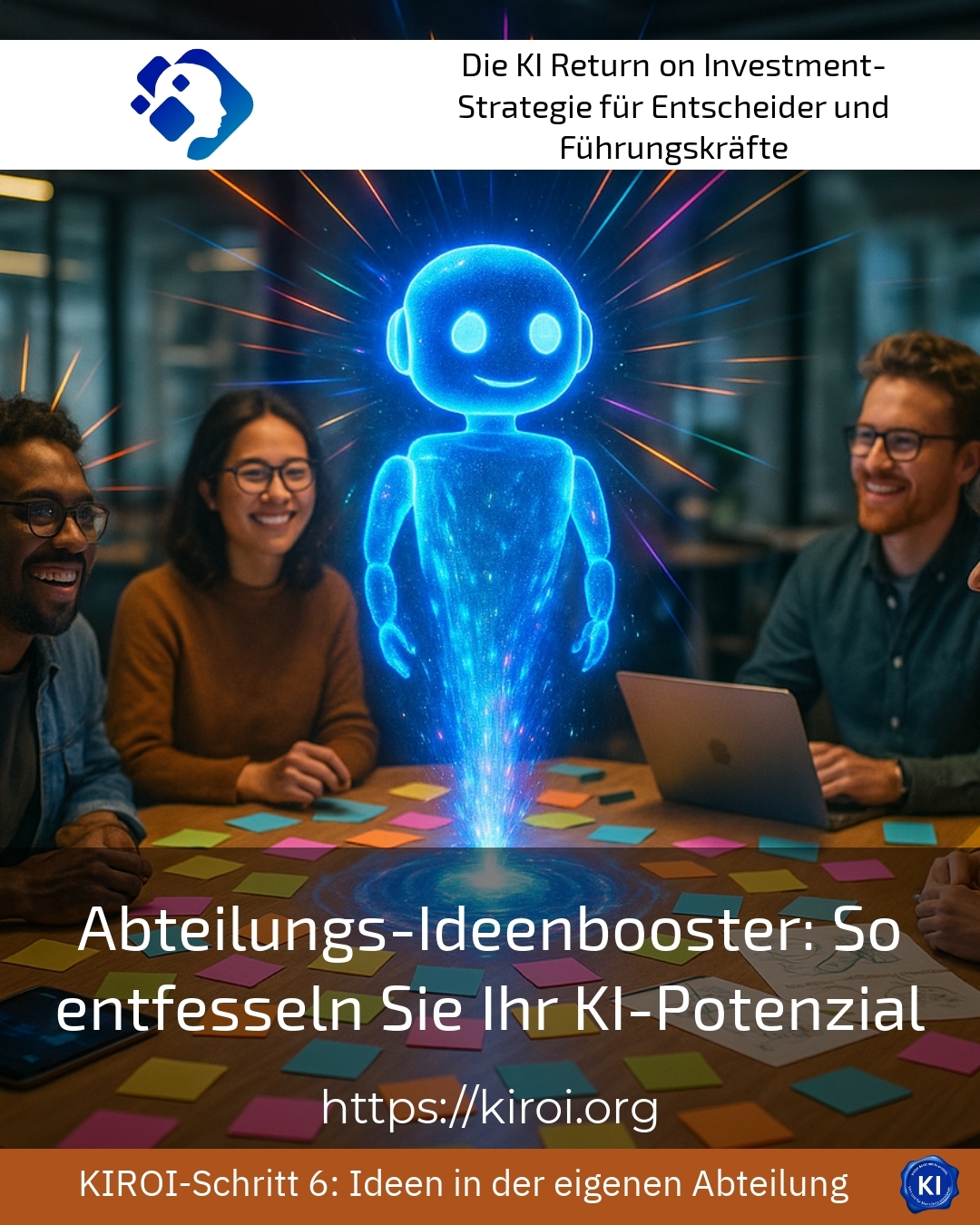
Imagine your department transforming into an ideas forge, constantly generating innovative concepts while saving resources. The Departmental Idea Booster offers precisely this opportunity by combining your teams' creative potential with intelligent technologies. Many managers report facing similar challenges before venturing down new paths. They were looking for ways to systematically boost their departments' innovative capacity. The good news is: there are proven strategies that can support you in this. In this article, you will learn how to unlock untapped potential and drive sustainable change.
Why the departmental idea booster is more important than ever
The world of work is undergoing fundamental changes that affect all industries and company sizes. Traditional brainstorming methods often reach their limits. Teams work decentrally, and the flood of information is constantly increasing. At the same time, customers expect ever faster innovation cycles and tailor-made solutions. In this environment, many organisations are looking for new impulses for their creative processes.
A concrete example from the financial sector impressively illustrates this dynamic. Today, banks must not only meet regulatory requirements but also create digital customer experiences. Product development departments are faced with the task of reacting more quickly to market changes. Intelligent systems can support the analysis of customer needs and the suggestion of product ideas. Another example can be found in healthcare, where research teams evaluate medical data. Algorithmic approaches there help to recognise patterns and develop new therapeutic approaches. This development is also clearly evident in retail. Marketing departments use data-driven insights to generate and refine campaign ideas.
The challenges of modern innovation work
Clients frequently report similar hurdles on their journey towards greater innovation. The daily workload leaves little room for creative experimentation. Established processes and hierarchies slow down new ideas. Furthermore, there is often a lack of knowledge on how to intelligently apply smart technologies. I regularly encounter these issues when supporting transformation projects.
In the manufacturing sector, for example, I'm observing that engineering teams have valuable ideas, but these are not systematically captured. Logistics companies struggle with integrating real-time data into their planning processes. Insurance companies, in turn, are looking for ways to process claims more efficiently while simultaneously developing new product categories. All these situations share a common denominator: the potential for improvement exists, but structured methods for unlocking it are lacking.
The department's idea booster as a strategic tool
A systematic approach to idea generation goes far beyond spontaneous creativity techniques. It combines human intuition with technological support in a way that enables sustainable results. The focus here is not on automation, but on the enhancement of human capabilities. Teams receive impulses that they might not have developed through their own efforts.
This approach is particularly impressive in the automotive industry. Development departments use simulations to evaluate design variants more quickly. This allows them to test more concepts in a shorter time and pursue the most promising ones. Pharmaceutical companies also benefit from data-driven methods in the early research phase. They identify potential active ingredients more efficiently and reduce costly failed attempts. In the field of renewable energies, intelligent analyses help to optimise locations for new plants.
Best practice with a AIROI customer
A medium-sized mechanical engineering company approached me with a specific challenge. While the design department regularly generated new ideas for product improvements, these often got lost in day-to-day operations. There was a lack of a system to collect, evaluate, and convert suggestions into structured development projects. As part of the support provided by transruptions-coaching, we jointly developed a multi-stage process. First, we introduced a digital idea management system that all employees could use. We then integrated intelligent evaluation criteria based on historical success data. Over time, the system learned which ideas had particularly high chances of being implemented. After six months, the management reported a significant increase in implemented improvement suggestions. Employees felt heard and became more actively involved. It was particularly noteworthy that cross-departmental ideas also increased. For example, sales provided valuable impetus for product development. This networking had been missing before and only emerged with the new system. The company was thus able to increase its innovation speed while simultaneously boosting employee satisfaction.
Practical steps to activate the department idea booster
The path to an innovation-promoting departmental culture begins with an honest assessment of the current situation. What methods for idea generation already exist? Where are the biggest bottlenecks in the creative process? These questions form the basis for all further steps. Only when you understand where you stand can you formulate meaningful goals.
In the field of business consulting, I have seen teams transform their analytical methods. They used intelligent tools to identify market trends more quickly and develop strategic recommendations. Media companies, in turn, relied on algorithmic support for topic selection for editorial content. Creative control always remained with humans. In the education sector, new concepts for personalised learning offers emerged. Educators received suggestions on how to adapt their courses to individual learning styles.
Cultural prerequisites for sustainable success
Technology alone does not create an innovation culture. Human factors play an equally important role. Leaders must create space for experimentation and view mistakes as learning opportunities. Employees need time and encouragement to try out new tools. Without these cultural foundations, even the best technical solutions will fizzle out ineffectively.
A telecommunications company illustrates this connection clearly. They initially introduced innovative analysis tools without adequately preparing their teams. Acceptance remained low, and the hoped-for improvements did not materialise. Only when management invested in accompanying training and cultural work did the tide turn. I observed similar patterns in the hospitality industry with the introduction of reservation systems with intelligent features. There too, it took time and patience until the workforce recognised the benefits. Utility companies wanting to optimise their network maintenance went through comparable learning curves.
Best practice with a AIROI customer
A marketing agency approached me with the wish to redesign their creative processes. Employees felt overwhelmed by routine tasks and had little capacity for strategic creative work. As part of our collaboration, we first identified time-consuming activities that could be automated. These included, for example, competitor research and the creation of trend reports. We implemented intelligent systems that took over these tasks and presented the results clearly. The teams invested the time saved in creative workshops and client projects. A weekly format that we developed together proved to be particularly valuable. There, the systems presented current trends and inspirations from various industries. The employees used these impulses as a starting point for their own ideas. After a few months, the team leaders reported a significantly increased level of creativity. Clients praised the more innovative concepts and faster response times. The agency successfully positioned itself as an innovation partner and won new contracts. This success was not solely based on technology, but on the intelligent combination of human creativity and intelligent support.
Achieve measurable successes through the departmental idea booster
The effectiveness of innovation initiatives can certainly be quantified if you choose the right metrics. The number of ideas submitted is an initial indicator. However, the implementation rate, meaning the proportion of suggestions that are actually realised, is even more insightful. The time from idea to market launch also deserves attention.
Software companies often measure the number of new features per quarter and their intensity of use. Retail companies track how quickly they can respond to customer feedback with assortment adjustments. In the field of professional services, the number of newly developed consulting products often counts. These metrics make it possible to visualise progress and justify investments.
Transruptions Coaching as support on the journey
The introduction of new methods and technologies presents organisations with complex challenges that extend beyond the purely technical. Transruption coaching positions itself here as support for projects aiming for sustainable change [1]. This is not about off-the-shelf solutions, but about the co-creation of suitable approaches for your specific situation.
Many clients come with questions about the strategic direction of their innovation efforts. They want to understand which technologies are relevant to their industry and how they can use them effectively. Others seek support in overcoming internal resistance or in developing new leadership skills. All these concerns can be addressed within the framework of structured guidance.
My AIROI Analysis
The systematic activation of innovation potential within departments requires a holistic view of technology, culture, and processes. In my analysis, it repeatedly becomes clear that isolated measures rarely lead to the desired success. Organisations that achieve sustainable improvements combine technological tools with cultural transformation and clear process structures.
The AIROI methodology offers a framework for integrating these different dimensions [2]. It helps to determine maturity levels and define realistic development paths. I consider the realisation that humans should be at the centre of all innovation efforts to be particularly important. Intelligent systems can support, inspire and relieve burdens. But the actual creative achievement remains a deeply human capability.
Looking ahead, I see significant potential in the further refinement of collaborative approaches. Teams will learn to work more seamlessly with intelligent tools and leverage their strengths. At the same time, they will critically question which suggestions are actually valuable and which should be discarded. Developing this judgment will form a core competence for the coming years. Organisations that invest here will enjoy a clear advantage in the competition for talent and customers.
Further links from the text above:
[1] Transruption Coaching at Risawave
[2] AIROI Methodology for Innovation Management
For more information and if you have any questions, please contact Contact us or read more blog posts on the topic Artificial intelligence here.









 Deutsch
  English (UK)