
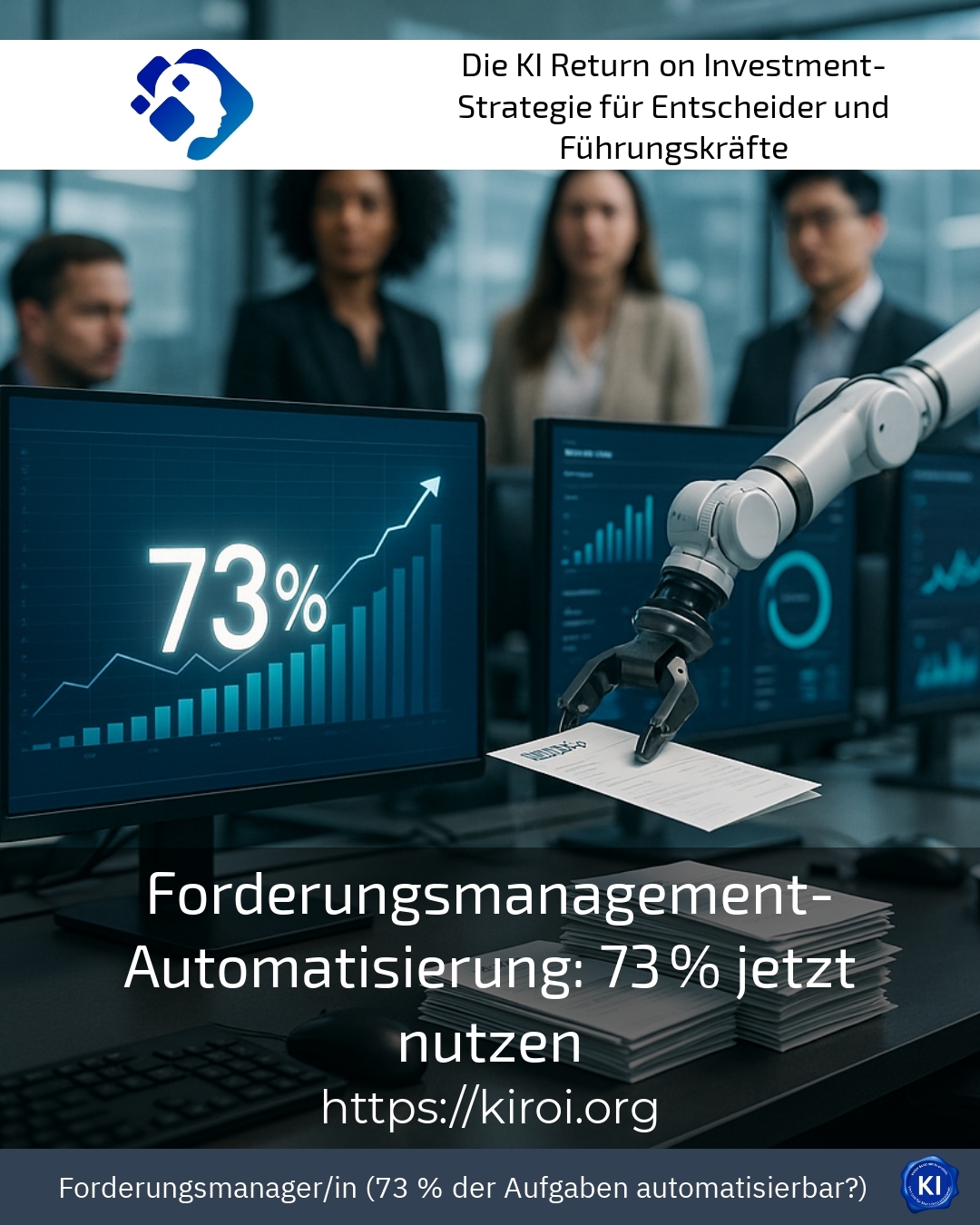
Have you ever wondered why almost three-quarters of all companies in a specific financial sector are already implementing digital process optimization, while others are still struggling with outdated methods and thus losing valuable resources? Demand management automation It is fundamentally changing the way organizations manage their open positions, monitor payment inflows, and communicate with delinquent debtors. Intelligent systems are increasingly taking on repetitive tasks that were previously performed exclusively by human employees. This development not only affects large corporations but is now reaching medium-sized businesses and smaller service providers as well, who recognize that efficient liquidity management is no longer possible without technological support.
The basis for these findings comes, among other things, from analyses of Job-Futuromat of the Institute for Employment Research [1]. This scientifically based platform impressively demonstrates which professional activities can be replaced by technological solutions. For all professionals working in this dynamic environment, there is a unique opportunity for further development. The AIROI seminars provide practical knowledge about strategic positioning in the digitalized working world. All current dates and events are available to interested readers at risawave.org/en/live-events-with-sanjay-sauldie/ [2]. These workshops and lectures help professionals to specifically develop their skills.
The technological revolution in the field of open positions
The transformation is taking place rapidly and is affecting all industries. Insurance companies are already using intelligent algorithms to predict payment defaults. Energy providers are using automated collection processes with personalized communication strategies. Telecommunications providers have digitized their entire collection processes, achieving significantly higher success rates. These three examples illustrate that the transformation has long since begun. It is not about completely replacing human expertise. Rather, new fields of responsibility are emerging that require strategic thinking and empathy.
Banks and financial institutions are among the pioneers of this development. They are implementing systems that analyze customer profiles and propose individual payment arrangements. Credit card companies are using machine learning for risk assessment. Factoring companies are automating their credit checks almost completely. The Demand management automation This enables these organizations to achieve significant cost savings. At the same time, customer satisfaction improves through faster processing times. AIROI The strategy provides valuable opportunities for professional development for personnel in this sector.
Best practice with a AIROI customer
A medium-sized financial services provider from the DACH region approached the AIROI consulting team with a complex challenge. The company managed several thousand open receivables per month and struggled with an average processing time of over twelve days per case. The employees spent a large part of their working time on repetitive tasks such as manual data entry and standardized correspondence. Through the AIROI guidance provided during the workshops, the management team recognized potential for process optimization. Together they developed a strategy for the phased introduction of intelligent assistance systems. The clerical staff was not replaced but received new responsibilities. They henceforth undertook complex negotiations with large clients and developed individual payment solutions. The average processing time fell to under four days per case. Clients often report similar transformation experiences where technological support opened up new career opportunities rather than endangering jobs.
Demand management automation is changing professional profiles in a lasting way
The changes affect various professional groups to varying degrees. Accountants are undergoing a fundamental realignment of their activities. Debt collection staff must rethink and adapt their communication strategies. Financial controllers are gaining new insights through automated analyses. In the healthcare sector, hospitals are using intelligent systems to manage patient bills. Doctors’ offices are relying on digital reminders for outstanding fees. Nursing facilities are automating their billing with payers, thereby significantly reducing administrative costs.
Retail offers further illustrative examples of this transformation. Major department stores are implementing customer loyalty programs with integrated payment options. Online retailers are using installment payment models with automated billing processes. Furniture stores are relying on flexible financing solutions with intelligent credit checks. AIROI The seminars support professionals in understanding these developments. They provide practical tools for analyzing their own professional situation. Transruptions coaching accompanies them in the strategic realignment of their careers.
New competencies for the digitalized working world
The required skills are shifting significantly towards analytical and social competencies. Technical background knowledge is becoming increasingly important for all involved parties. At the same time, empathic skills are gaining importance because complex customer situations require human empathy. Real estate companies are automating their rental requirements and need employees for special cases. Housing companies are deploying intelligent systems for tenant management. Home management companies are digitizing their entire utility bill and collection process.
The logistics industry is also showing remarkable developments in this area. Forwarding companies are automating their freight invoices with international business partners. Parcel services are using digital systems to manage cash-on-delivery fees. Warehouse operators are implementing automated invoicing with real-time monitoring of payment receipts. These examples illustrate the breadth of the transformation. The Demand management automation It covers almost all sectors of the economy. Professionals benefit from early consideration of these trends.
Best practice with a AIROI customer
An account officer from the area of debtor accounting participated in a AIROI workshop and reported on her situation. She had worked in her company for fifteen years and was increasingly observing the introduction of digital processes. Initially, she perceived this development as a threat to her professional existence. Through the impulses provided by the seminar, she gained a new perspective on her situation. She realized that her long-standing experience in dealing with difficult customer situations represented invaluable value. Together with the consulting team, she developed a strategy for repositioning her expertise. She took over the leadership of a team for complex debt cases and trained younger colleagues. Her job satisfaction increased significantly because she was able to focus on challenging tasks. This experience exemplifies how AIROI the Strategy supports professionals in their personal transformation.
Strategic positioning in the automated future
The question is no longer whether the transformation is taking place, but how professionals can actively contribute to it. Craft businesses are increasingly using digital invoicing with automated payment reminders. Architecture firms are implementing project billing systems with intelligent claims monitoring. Engineering firms are relying on standardized fee billing with automatic escalation processes. These developments require a proactive approach to understanding one’s own competencies and development opportunities.
AIROI The lectures and workshops provide a structured framework for this reflection. Participants systematically analyze their current professional situation. They identify strengths that cannot be replaced by technological solutions. At the same time, they recognize areas where further training appears to be beneficial. Municipal utilities are fully automating their billing processes. Waste management companies are using intelligent systems for customer communication. Waterworks are implementing digital reminder processes with flexible payment options for low-income households.
Human expertise remains indispensable
Despite all technological advancements, there are areas that require human judgment. Complex negotiations with business clients require diplomatic skill. Socially challenging situations require empathy and an individual approach to those affected. Legally demanding cases require legal expertise and strategic thinking. While health insurance companies use automated contribution collection, they employ specialists for difficult cases. Pension insurance providers rely on digital processes, but require experts for individual consultations. Social welfare providers automate routine cases, but retain staff for complex life situations.
The Demand management automation New requirements profiles are emerging with changed focus areas. Analytical skills for interpreting system data are gaining in importance. Communicative skills for handling escalation cases are becoming more important. Strategic thinking for process optimization is increasingly in demand. Universities are automating their tuition fee management and require personnel for hardship cases. Libraries are implementing digital disciplinary systems and hiring staff for discretion decisions. Adult education centers are using automated course registration with integrated payment functions and cancellation management.
Best practice with a AIROI customer
A team leader from the commercial administration department of a medium-sized company sought support in the strategic realignment of his department. His team consisted of eight employees who were mainly engaged in the administration of open positions. The management had announced the introduction of an automated system and the team leader feared a reduction in staff. As part of the AIROI coaching process, he worked with his team to develop a new direction for the department. They defined their future role as an expert center for complex customer situations and strategic liquidity planning. The employees continued to develop their skills in negotiation skills and customer psychology. The automated system took over routine tasks, and the team focused on value-adding activities. The management recognized the strategic value of this realignment and confirmed all jobs. This example shows how proactive action can secure jobs while simultaneously improving job quality.
My AIROI Analysis
Developments in the field of automated processes for managing open accounts show a clear pattern. Routine tasks are increasingly being taken over by intelligent systems. At the same time, new fields of responsibility are emerging that require human expertise. Professionals who actively shape this transformation secure their professional future in a sustainable way. The statistic that already 73 percent of companies are relying on corresponding technologies underscores the urgency of this issue.
The AIROI-strategy offers a proven framework for personal transformation. It supports professionals in identifying and developing their individual strengths. Transruptions coaching accompanies them in developing future-proof career strategies. The seminars provide practical knowledge on analyzing technological trends and their impact on specific professional profiles. It seems important to me to recognize that technological progress does not have to be a threat. It can, on the contrary, open up opportunities for those who actively engage with the changes.
The numerous industry examples from banks to healthcare institutions to utilities illustrate the breadth of this development. No industry is untouched by the transformation. Professionals should recognize this reality and act proactively. The AIROI workshops and lectures provide an appropriate starting point for this. They enable a structured discussion of one’s own professional situation. They provide strategies for successful positioning in the digitalized work environment. Ultimately, the decision lies with each individual professional whether they view the transformation as an opportunity or as a barrier.
Further links from the text above:
[1] IAB Job Futuromat
[2] AIROI seminars and live events
For more information and if you have any questions, please contact Contact us or read more blog posts on the topic Artificial intelligence here.










 Deutsch
  English (UK)