
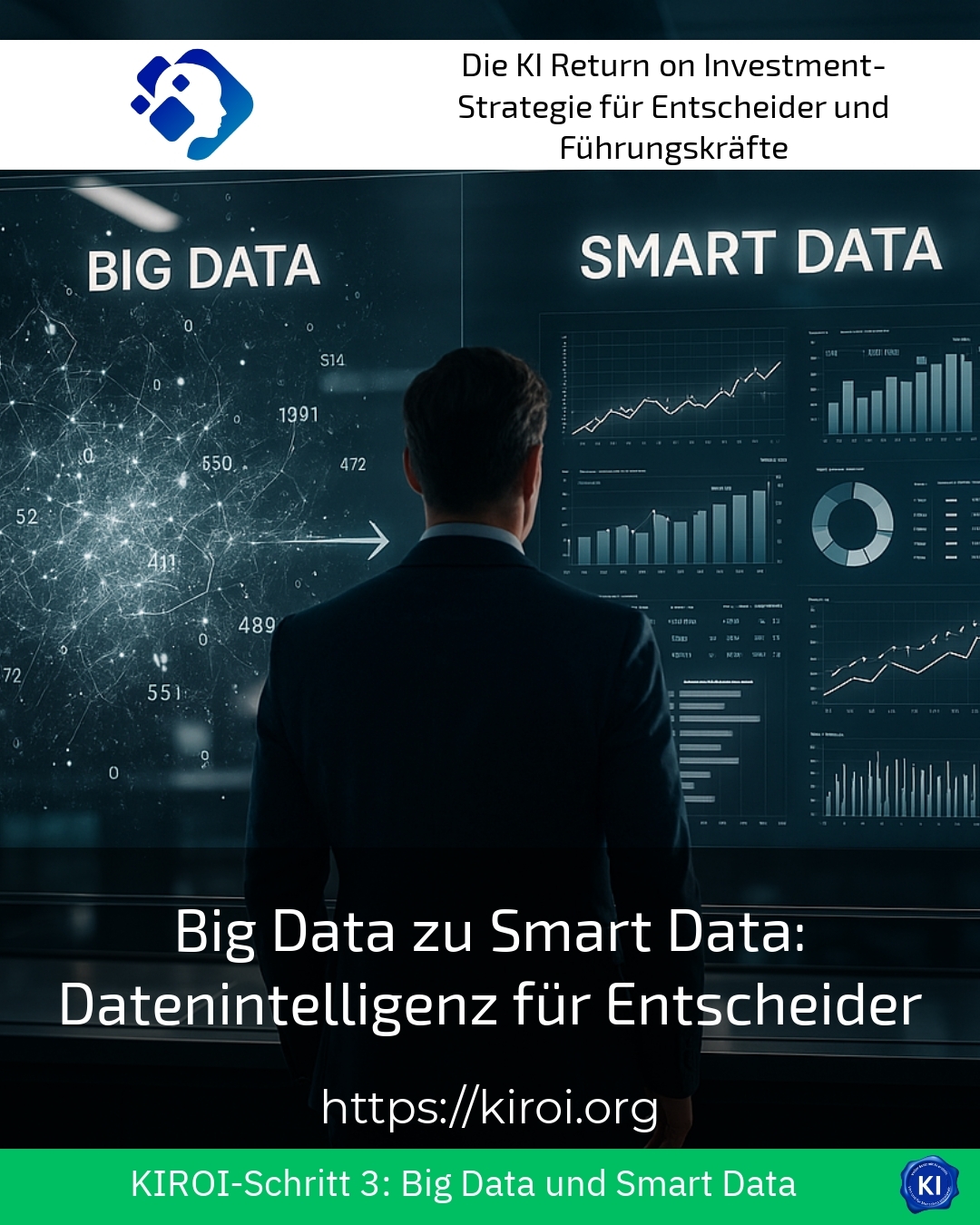
In a world where unfathomable amounts of information are generated daily, leaders face a crucial challenge: how can actionable insights actually be extracted from this seemingly endless stream of numbers, facts, and patterns? The transformation from Big Data to Smart Data: Data intelligence for decision-makers marks a fundamental paradigm shift, as the mere quantity of collected information no longer takes centre stage, but rather its qualitative preparation and strategic usability. Many companies are quite literally drowning in their own data stores. They diligently collect, but don't know what to do with it. This is precisely where intelligent data processing comes in. It transforms rough diamonds into polished jewels of decision-making.
The Evolution of Data Processing in Modern Organisations
The history of how businesses have used data has seen remarkable development over the past few decades, evolving from simple spreadsheets to highly complex algorithmic analysis systems. Initially, it was sufficient to manually record basic business metrics and summarise them in manageable reports. Today, however, even medium-sized companies generate daily data volumes that would have overwhelmed earlier mainframe computers.
For example, a manufacturing company in the mechanical engineering sector implemented sensors on all its production facilities. These sensors provide information on temperature, vibration, and energy consumption down to the second. Initially, those responsible didn't know what to do with this flood of information. Only through intelligent filtering and pattern recognition did usable recommendations for action emerge. A logistics company collected route data from its vehicle fleet over several years. The sheer volume of GPS coordinates and delivery times initially provided no discernible added value. Through targeted aggregation, the company finally identified inefficient routing. An energy supplier used smart meters to record its customers' consumption patterns. The raw data filled huge storage capacities with no immediate benefit. Only by linking it with weather data and price fluctuations did precise demand forecasts become possible.
Best practice with a KIROI customer
An automotive supplier with international operations faced the challenge of fundamentally optimising the quality control of its production processes, while simultaneously meeting its customers' increasing demands for traceability and transparency. Over the years, the company had collected millions of data sets from various manufacturing stages, but had never systematically analysed or linked them, meaning valuable insights remained unused. As part of the transruption coaching, we supported the project team, initially in developing a clear hierarchy of goals for data utilisation and then in identifying relevant sources of information. Together, we developed criteria for filtering, aggregating, and preparing data for different decision-making levels. Management received compact dashboards with real-time indicators. Quality managers were provided with more detailed analysis tools for root cause analysis of deviations. Within a few months, the company was able to reduce its scrap rate by a significant percentage, as problems were identified and resolved earlier. The collaboration highlighted the importance of structured support for such transformation projects.
Big Data to Smart Data: Data Intelligence for Decision-Makers as a Strategic Competitive Advantage
The ability to distil relevant insights from information floods is increasingly becoming the crucial differentiator for successful companies, because those organisations that smartly utilise their data holdings can react more quickly to market changes and make more informed strategic decisions than their less data-savvy competitors. This is not about accumulating as much information as possible. Rather, the focus is on targeted consolidation. Decision-makers do not need data graveyards. They need living information ecosystems.
A trading company used till data, loyalty card information, and stock levels to generate personalised offers. Linking these different data sources enabled a holistic view of customer behaviour for the first time. Instead of general promotions, customers now received individually tailored recommendations. An insurance group analysed claims reports using text recognition algorithms, thereby identifying recurring fraud patterns that had remained hidden from human claims handlers due to the sheer volume of cases. A pharmaceutical company linked clinical trial data with real-world evidence from patient registries. This combination significantly accelerated the development of new therapeutic approaches.
Technological Foundations of Intelligent Data Processing
The technical infrastructure for intelligent data processing has rapidly evolved in recent years, now encompassing a wide spectrum of tools, ranging from classic relational database systems and distributed storage solutions to highly specialised analysis platforms that meet diverse requirements for speed, scalability, and processing depth. Cloud technologies enable flexible resource utilisation. Companies no longer need to operate their own data centres. They can book and release capacity as needed. Machine learning automates detection processes. Algorithms identify patterns in seconds. Humans would require weeks or months for the same task.
A telecommunications provider implemented real-time analysis of network traffic to predict congestion and automatically reallocate capacity. A financial services company used graph databases to analyse relationship networks between accounts and uncover suspicious transaction patterns [1]. A media company relied on streaming analytics to understand user behaviour on its platforms in real-time and dynamically adapt content recommendations.
Challenges in the transformation to a data-driven organisation
The path from pure data collection to intelligent data utilisation is paved with numerous obstacles, which can be both technical and organisational in nature and are often underestimated. Many companies do not fail due to a lack of technology. They fail due to a lack of strategy and insufficient willingness to change. Data silos represent one of the biggest problems. Departments jealously hoard their information. Company-wide exchange falls by the wayside.
An industrial company had production data, quality information, and maintenance logs stored in separate systems that did not communicate with each other. Integrating these data sources required significant investment and, above all, organisational persuasion. A retailer struggled with inconsistent master product data because different local subsidiaries used different names and categorisations [2]. A healthcare provider faced strict data protection requirements that initially blocked innovative analysis projects. It was only through anonymisation procedures and privacy-by-design approaches that compliant solutions could be developed.
Best practice with a KIROI customer
A medium-sized family business from the food industry approached us with the request to optimise its production planning while simultaneously reducing inventory costs, without compromising on delivery capability. The company had historical sales data spanning several decades, but had never systematically used it for forecasting, instead relying on the experience of long-serving employees. As part of our transruption coaching, we developed a structured approach to data cleansing and integration together with the project team, placing particular emphasis not on replacing the existing expert knowledge of employees, but on meaningfully combining it with algorithmic forecasts. Clients often report that it is precisely this combination of human expertise and machine analysis that yields the best results, as both perspectives bring their specific strengths to bear. The implemented solution today supports dispatchers in their decisions by automatically taking into account relevant influencing factors such as seasonal fluctuations, weather forecasts, and promotional planning. The project team particularly appreciated the continuous support during the implementation phase.
The human factor: competence building and cultural change
Technology alone is not enough to successfully manage the transformation from Big Data to Smart Data: data intelligence for decision-makers, because without the appropriate skills and a data-savvy corporate culture, even the most advanced analytical tools remain unused or are used superficially at best. Data literacy must be developed at all hierarchical levels. Not every employee needs to become a statistician. However, a basic understanding of data quality and interpretation limits is essential.
A consulting firm invested in extensive training programmes to empower its consultants in the use of analytical tools. A mechanical engineering company established a central data science unit that acts as an internal service provider for all business units. A consumer goods manufacturer set up so-called Data Ambassadors in each department, who act as bridge-builders between subject matter experts and data specialists, promoting knowledge transfer in both directions [3].
Practical implementation strategies for different business sizes
The implementation of intelligent data strategies varies significantly depending on company size, industry, and available resources, which is why there is no universal approach that would be equally suitable for all organisations. Smaller companies can often proceed more agilely. They have shorter decision-making processes and can implement new solutions more quickly. Larger organisations have more resources. However, they struggle with more complex coordination processes and established structures.
A fintech start-up built its entire business logic on a data-driven foundation from the outset. All processes were designed to automatically capture relevant information for later analysis. An established mid-sized company began with a limited pilot project in quality assurance. The approach was only expanded to other areas after successful validation. A large corporation founded an independent subsidiary to develop innovative data products. This organisational separation enabled faster development cycles.
Ethical aspects and responsible data handling
With the increasing importance of data-driven decision-making, the ethical requirements for companies are also growing, as they must ensure that their analytical methods are transparent, fair, and non-discriminatory. Algorithmic biases can creep in unnoticed. They often reflect historical biases in the training data. Regular reviews and diverse development teams can help to identify such problems early on.
A recruitment agency reviewed its automated pre-selection processes for potential discrimination patterns and adjusted the algorithms accordingly [4]. A credit institution introduced explainability requirements for all algorithmic decisions. Customers now receive understandable reasons why an application was rejected. An insurance company deliberately refrained from using certain data sources, even though they would have improved forecast accuracy, because their use was classified as ethically questionable.
My KIROI Analysis
The transformation from Big Data to Smart Data: data intelligence for decision-makers is not purely a technical challenge, but requires a holistic rethink of how organisations handle information, make decisions, and design their processes. From my consulting practice, I know that many companies are initially fascinated by data collection without defining clear objectives for its use. This approach frequently leads to frustration because the hoped-for insights are not forthcoming. Successful transformation projects are characterised instead by starting with concrete business questions and aligning the data infrastructure accordingly.
Transruption coaching can offer valuable insights for such projects because it addresses not only technical aspects but also takes organisational and cultural dimensions into account. Guidance from experienced consultants helps leaders develop realistic expectations while simultaneously pursuing ambitious goals. It's not about guaranteed successes or universal solutions. It's about tailor-made strategies that fit the respective company culture. Clients often report that precisely the external perspective and the structured approach have helped them overcome blockages and discover new perspectives. The path to a data-driven organisation is a marathon, not a sprint. Companies that consistently pursue this path will be better positioned in the long term to make informed decisions and identify opportunities early in an increasingly complex business world.
Further links from the text above:
[1] Bitkom: Big Data and Analytics
[2] McKinsey: Data to Value Journey
[3] Harvard Business Review: Management of Data
[4] Federal Commissioner for Data Protection and Freedom of Information
For more information and if you have any questions, please contact Contact us or read more blog posts on the topic Artificial intelligence here.











 Deutsch
  English (UK)