
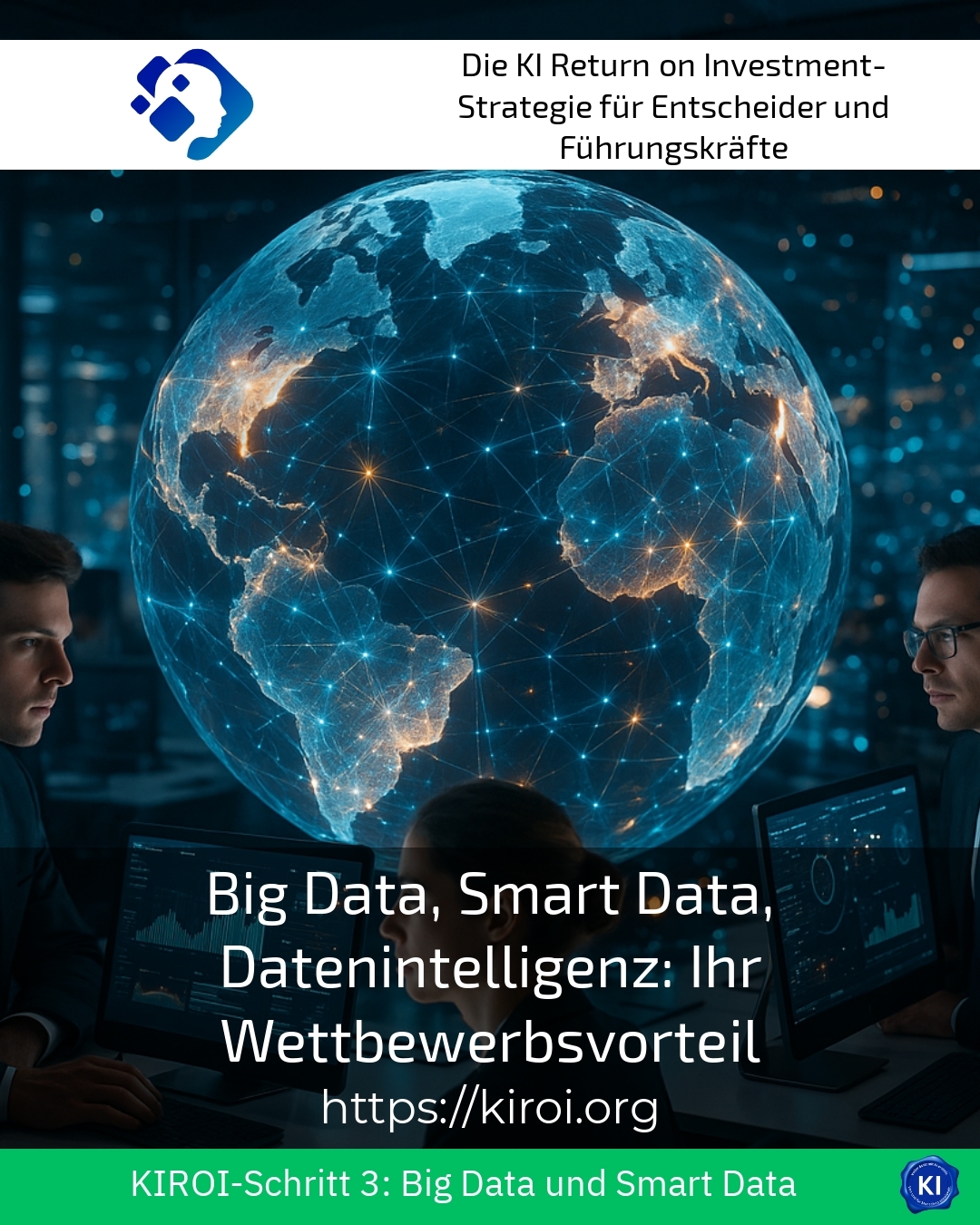
Imagine if you could turn every single patient contact, every medical diagnosis and every treatment outcome into actionable insights that not only enhance the quality of care, but also sustainably strengthen your financial position. In healthcare today, more than ever, the ability to derive precise recommendations for action from vast amounts of data determines the success or failure of clinics, practices and medical care centres. Big Data, Smart Data, Data Intelligence: Your Competitive Advantage – these terms describe a development that is fundamentally transforming the entire healthcare system. Anyone who misses this development risks losing touch with an industry that is digitalising at a rapid pace and in doing so is setting completely new standards for efficiency, patient safety and economic sustainability.
Understanding the data revolution in healthcare
Hospitals, rehabilitation centres and outpatient facilities generate gigantic amounts of information every day. This information arises from electronic patient records, imaging procedures and laboratory values. Added to this are data from wearables, telemedicine applications and networked medical devices. The challenge is not to collect these data. Rather, it is about extracting relevant patterns from the sheer volume. A medium-sized hospital generates around 50 terabytes of raw data per day [1]. However, these data often remain unused and stored in isolated systems.
For example, Heidelberg University Hospital uses intelligent algorithms for the early detection of sepsis. This has been shown to reduce mortality rates. In the radiology department of the Charité hospital in Berlin, image-analysis systems assist in the detection of tumours, resulting in faster and more precise diagnoses. General practitioners also benefit from data-driven decision support tools. These systems warn against drug interactions and suggest evidence-based treatment options.
However, transforming raw information assets into actionable insights requires more than just technical infrastructure. It calls for a strategic approach that takes into account the specific needs of medical institutions. Big Data, Smart Data, Data Intelligence: Your Competitive Advantage only becomes a tangible benefit when data silos are broken down and information flows are intelligently connected.
Best practice with a AIROI customer
A group of rehabilitation clinics in southern Germany faced the challenge of systematically analysing their patients' treatment outcomes and adapting their therapy programmes accordingly. The existing documentation systems had grown organically over time and did not communicate with one another, meaning valuable insights into recovery processes and treatment successes remained scattered across different departments. Through the guidance of transruptions coaching, a comprehensive inventory of all available data sources was first carried out, taking into account not only clinical systems but also administrative processes and patient feedback. Together, the teams developed an integrated data model that maps treatment pathways across departments and enables automated analyses. Following implementation, therapists regularly report faster adjustments to individual treatment plans because relevant information is now centrally available. According to internal surveys, patient satisfaction rose significantly and the average length of stay was reduced by several days, benefiting both the patients and the clinics' financial performance.
From data volume to data intelligence
The transition from mass data collection to intelligent data usage marks a paradigm shift in healthcare. While the mere availability of electronic health records was previously considered progress, decision-makers today recognise the necessity of more in-depth analyses. Munich Re uses predictive models for the risk assessment of policyholders. These models are based on anonymised health data and enable more precise tariff calculations. Health insurers such as Techniker implement data-driven programmes for the prevention of chronic illnesses. As a result, at-risk patients can be identified early and targeted directly.
Intelligent analytical methods are also playing an increasingly important role in drug development. Pharmaceutical companies scour clinical trial data for patterns that would remain hidden from human researchers. The identification of suitable study participants is considerably accelerated by algorithmic pre-selection. Side-effect profiles can be recorded much more comprehensively through the evaluation of real-world data than in controlled study settings.
Quality assurance in hospitals also benefits from data-driven approaches. Infection rates, complication rates and readmission rates are continuously monitored. Deviations from defined threshold values trigger automatic alarms. In this way, quality deficiencies can be identified and rectified at an early stage.
Strategic implementation as the key to success
The successful use of data-driven systems in healthcare requires a well-thought-out implementation strategy that equally considers technical, organisational and cultural aspects. Clients from the clinical sector frequently report resistance among the workforce. This resistance often arises from uncertainty or a lack of understanding of the new possibilities. Transruption coaching can provide valuable impetus here to constructively accompany change processes.
A common issue facing leaders in healthcare facilities is the integration of disparate data systems. The IT landscape of many hospitals resembles a patchwork of systems from various manufacturers and generations. These systems were often designed for isolated use cases and are not optimised for data exchange. Creating uniform interfaces and data standards therefore forms a central prerequisite for successful data utilisation.
Best practice with a AIROI customer
A municipal hospital group with several sites was looking for ways to optimise occupancy planning and resource allocation in order to avoid both overcrowding and uneconomic vacancies. Previous planning was largely based on empirical values and short-term adjustments, which regularly led to bottlenecks in certain areas while other departments were under-utilised. As part of the collaboration with transruptions-Coaching, a comprehensive analysis of existing data sources was first carried out, capturing patient flows, seasonal fluctuations and dependencies between different treatment areas. On this basis, the teams developed a predictive model that provides occupancy forecasts for various time horizons, thereby enabling proactive staff scheduling. The implementation took place gradually and was accompanied by intensive staff training, ensuring that employees perceived the new tools as a form of support rather than a control instrument. Today, ward managers routinely use the system for their daily planning and report significantly more relaxed working conditions because surprises have become less frequent and bottlenecks can be identified early on.
Big Data, Smart Data, data intelligence: your competitive advantage in everyday clinical practice
The practical application of intelligent data analysis spans almost all areas of healthcare and offers diverse starting points for efficiency gains and quality improvements. In the emergency department of Essen University Hospital, incoming patients are pre-sorted using a triage system. This system takes into account vital signs, symptoms and historical data to assess urgency. Waiting times for critical cases have thus been significantly reduced.
In the care sector, sensor-based monitoring systems support the early detection of pressure sores and falls. The data feeds into central dashboards, giving nursing staff a quick overview of their patients' condition. Critical changes are reported automatically, enabling interventions to take place in good time. The documentation burden on nursing staff is noticeably reduced through automated recording.
Hospital administration also benefits from data-driven decision-making aids. Materials management and inventory control can be optimised through consumption forecasts. Rota planning can be designed proactively based on historical utilisation patterns. Financial key performance indicators are monitored in real time to detect deviations from the budget at an early stage.
Data protection and ethical aspects as a framework for development
The use of sensitive health data is subject to strict regulatory requirements and demands a high degree of responsibility. The General Data Protection Regulation sets clear limits on the processing of personal data. However, anonymisation and pseudonymisation techniques often enable data protection-compliant analysis. Patients' trust in the careful handling of their data forms the basis of any successful digitalisation strategy [2].
Gematik, as the national agency for digital medicine, is driving the development of secure infrastructures. The electronic health record creates a standardised framework for the exchange of data between healthcare providers. At the same time, patients retain control over who is allowed to access their data. This patient autonomy is a central element of the German healthcare digitalisation strategy.
Ethical questions arise in particular when using algorithmic decision-making systems. The transparency and comprehensibility of automated recommendations must be guaranteed. Medical staff continue to bear responsibility for treatment decisions. Data-driven systems can support, but not replace.
Best practice with a AIROI customer
A group of specialist doctors who specialised in chronic conditions wanted to introduce a patient portal that would give those affected more autonomy and better insights into their health data. The challenge was to present complex medical information in a way that is understandable for laypeople without sacrificing accuracy. As part of the support provided by transruptions coaching, workshops were initially held with patient representatives in order to understand their needs and preferences. Based on this, a concept was developed for a clear dashboard that presents laboratory values, medication plans and appointment overviews in an understandable format. Particular emphasis was placed on compliance with data protection requirements, with two-factor authentication and encrypted transmission paths being implemented. Patients now frequently report a better understanding of their condition and feel more involved in the treatment process, which has a positive effect on adherence to treatment. Communication between doctor and patient has also improved because both sides can access the same information and misunderstandings occur less frequently.
Future prospects for data-driven health management
The development in the field of data intelligence is advancing rapidly, continuously opening up new possibilities for the healthcare sector. Generative language models are already being trialled for the creation of medical discharge letters and documentation. Imaging procedures are becoming ever more precise in detecting pathological changes through algorithmic analysis. The integration of genomic data into clinical decision-making is increasingly enabling personalised treatment approaches [3].
Telemedicine applications continue to gain in importance and are generating additional data streams. The continuous monitoring of patients with chronic illnesses is made possible by connected devices. Early-warning systems can detect critical deteriorations before they become emergencies. The boundary between outpatient and inpatient care is increasingly blurring.
Healthcare facilities that are investing in their data literacy now are laying the foundations for long-term success. Big Data, Smart Data, Data Intelligence: Your Competitive Advantage will be even more crucial in the future than it is today. The ability to use data intelligently distinguishes leading institutions from those that are losing ground.
My AIROI Analysis
A review of current developments in the healthcare sector clearly shows that the intelligent use of data is no longer optional, but rather an essential prerequisite for competitive medical institutions. However, the transformation of raw data volumes into actionable insights requires far more than technical investments alone. It demands a holistic approach that focuses equally on people, processes and technologies.
From my experience in supporting healthcare institutions with digitalisation projects, it can be stated that success depends significantly on the involvement of all participants. Doctors, nursing staff and administrative employees must be able to recognise the benefits of new systems for their daily work. Resistance often arises from legitimate concerns about workload, data protection or the quality of patient care, which must be taken seriously.
The technical implementation forms only part of the challenge. At least as important are the development of new skills, the adaptation of workflows and the creation of a data-savvy organisational culture. Transruption coaching can provide valuable guidance here in order to make change processes sustainable and constructively overcome blockages. Investing in data intelligence pays off in the long term if it is understood as a strategic project and implemented professionally.
Further links from the text above:
[1] Federal Ministry of Health – Digitalisation in Healthcare
[2] Data protection in healthcare – information portal
[3] Gematik – National Agency for Digital Medicine
For more information and if you have any questions, please contact Contact us or read more blog posts on the topic Artificial intelligence here.









 Deutsch
 English (UK)