
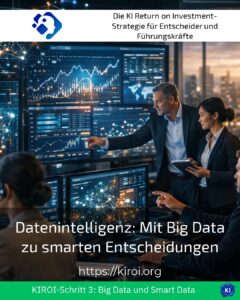
Imagine your company is sitting on a mountain of information, yet nobody knows what treasures lie hidden within it. This is precisely where the journey of Big Data to Smart Data, which is fundamentally transforming modern organisations and opening up completely new perspectives. Today, the ability to extract valuable insights from raw data determines success or failure. In this article, you will learn how companies can turn their flood of information into strategic advantages through systematic approaches.
Understanding the transformation of big data to smart data
The difference between pure data volumes and usable information is like the difference between an overflowing archive and a sorted library. Whilst big data merely describes the presence of large quantities of information, smart data refers to the intelligent preparation of these resources. This transformation process requires both technological tools and strategic thinking, because only the combination of both elements delivers sustainable results. Companies that master this transition frequently report significant efficiency gains and improved decision-making processes.
For example, a medium-sized mechanical engineering company spent years collecting sensor data from its production systems without systematically evaluating it. By introducing intelligent analytical methods, the company was suddenly able to predict maintenance needs. A logistics service provider used similar approaches to carry out route optimisation and reduce fuel costs. A retail company also benefited by better understanding customer behaviour and being able to plan inventory levels more precisely.
Best practice with a AIROI customer
An international manufacturing company approached transruptions-Coaching with a complex problem that many organisations know and fear. The company had data from more than twenty different source systems that never communicated with one another. The sales department worked with different figures than production, and the management board received conflicting reports. As part of the support, we jointly developed a data consolidation strategy that was implemented step by step. First, we identified the most important information sources and their quality issues. We then established processes for the automatic cleansing and harmonisation of incoming information. The employees received training to be able to use the new tools effectively. After about six months of intensive project work, the company had a unified information base for the first time. The management was now able to make well-founded decisions based on consistent figures. The sales department reported a significant improvement in customer service because relevant information was available more quickly. This example impressively demonstrates how transruptions-Coaching supports projects revolving around complex transformation initiatives and provides impetus for sustainable change.
Intelligent analysis methods for better decisions
The path from big data to smart data inevitably leads via modern analysis methods that go far beyond classical statistics. Machine learning makes it possible to recognise patterns in information that would remain hidden from human analysts. These technologies support decision-makers in drawing well-founded conclusions and assessing risks better. In doing so, they do not replace human expertise, but rather complement it in a meaningful way.
An insurance company used such methods to process claims more quickly and to identify attempted fraud [1]. In the healthcare sector, similar approaches help to optimise treatment courses and to identify complications early on. The retail sector relies on intelligent forecasting models to better predict seasonal fluctuations and to avoid excess stock.
Practical applications in everyday business life
The practical implementation of intelligent information use often fails not because of the technology, but due to organisational hurdles. Many companies struggle with data silos in which departments do not share their information with one another. These structural problems first require cultural changes before technical solutions can take effect. Experience shows that successful projects must always take both dimensions into account.
An energy supplier solved this problem by forming cross-departmental teams for analysis projects [2]. A bank held regular workshops in which business departments could articulate their information needs. An automotive supplier established a central unit that acted as an intermediary between IT and the business departments.
The journey from big data to smart data: mastering the challenges
The transformation into an information-driven organisation brings numerous challenges that should not be underestimated. Data protection requirements set strict limits on the use of personal information, meaning creative solutions are required. Quality issues with input data inevitably lead to flawed analysis results, which is why cleansing processes are essential. Last but not least, many organisations lack qualified professionals who understand both technical and business requirements.
A pharmaceutical company countered the skills shortage through targeted further training programmes for existing employees. A telecommunications provider relied on external expertise while simultaneously building up internal capabilities. An industrial corporation founded its own competence centre that acts as an internal service provider and supports projects across all business divisions.
Best practice with a AIROI customer
A medium-sized family-owned business in the consumer goods sector sought support in introducing intelligent analysis tools because previous attempts had failed. The management had already purchased several software solutions, which were, however, hardly used. During the joint analysis, it turned out that the employees had not been sufficiently involved in the selection process. There was a lack of understanding regarding the concrete benefits in everyday work, which led to resistance. As part of our support, we first organised discussions with all relevant user groups in order to understand their actual needs. Building on this, we developed a training plan that focused on practical use cases. Using their own tasks, the employees learned how the new tools could support them. We also established a network of multipliers to act as primary contacts within the departments. Following this intervention, the usage rate of the analysis tools rose significantly, and initial success stories motivated further colleagues. This project illustrates how important the human component is in technological changes and how transruptions coaching successfully guides such processes.
Data quality as the foundation of intelligent analytics
Without reliable input information, even the most advanced analysis tools remain ineffective, because flawed foundations can only lead to incorrect conclusions. Ensuring high quality standards requires continuous effort and clear responsibilities within the organisation. Automated checking routines can catch obvious errors, but expert plausibility checks remain indispensable. Companies frequently report that merely engaging with data quality leads to valuable insights into their business processes [3].
Through quality checks, a chemical company discovered systematic recording errors in production that had previously gone unnoticed. An insurance company identified duplicates in its customer database, which led to significant cost savings. A retail group realised that different branches labelled identical products differently, making comparisons impossible.
Strategic advantages through the intelligent use of information
Organisations that successfully make the transition from big data to smart data unlock sustainable competitive advantages across multiple dimensions. They respond more quickly to market changes because relevant information is promptly available and can be analysed. They understand their customers better because behavioural patterns become visible and personalised offers are possible. They optimise their internal processes because inefficiencies can be identified and systematically eliminated.
A travel company was able to significantly improve its capacity utilisation through better demand forecasting. A media company used usage data to produce content more selectively and increase reach. A mechanical engineering firm developed new business models based on usage data from its products at the customer's site.
My AIROI Analysis
The transformation of raw information into actionable insights represents one of the central challenges of modern corporate management, and yet many organisations fail in this endeavour. My observation from numerous advisory projects shows that technological hurdles are usually overestimated, while cultural and organisational factors are underestimated. Companies frequently invest substantial sums in software solutions without creating the necessary prerequisites within their organisation.
A successful project first requires clarity regarding the actual information needs, because technology can only be a means to an end. Involving all stakeholders from the very beginning increases acceptance and provides valuable perspectives on practical requirements. Managers must actively support the project and act as role models in dealing with information-based decisions. A step-by-step approach with early successes motivates the organisation and builds trust in the change process.
The AIROI methodology provides a structured framework for tackling such transformation projects systematically and avoiding typical pitfalls. It combines strategic planning with pragmatic implementation and gives equal consideration to both technical and human aspects. Those who take these principles to heart significantly increase their chances of generating real added value from their existing wealth of information.
Further links from the text above:
[1] McKinsey Digital – Data Analytics Insights
[2] Gartner – Smart Data Definition and Application
[3] Forbes Tech Council – Data Quality Management
For more information and if you have any questions, please contact Contact us or read more blog posts on the topic Artificial intelligence here.









 Deutsch
 English (UK)