
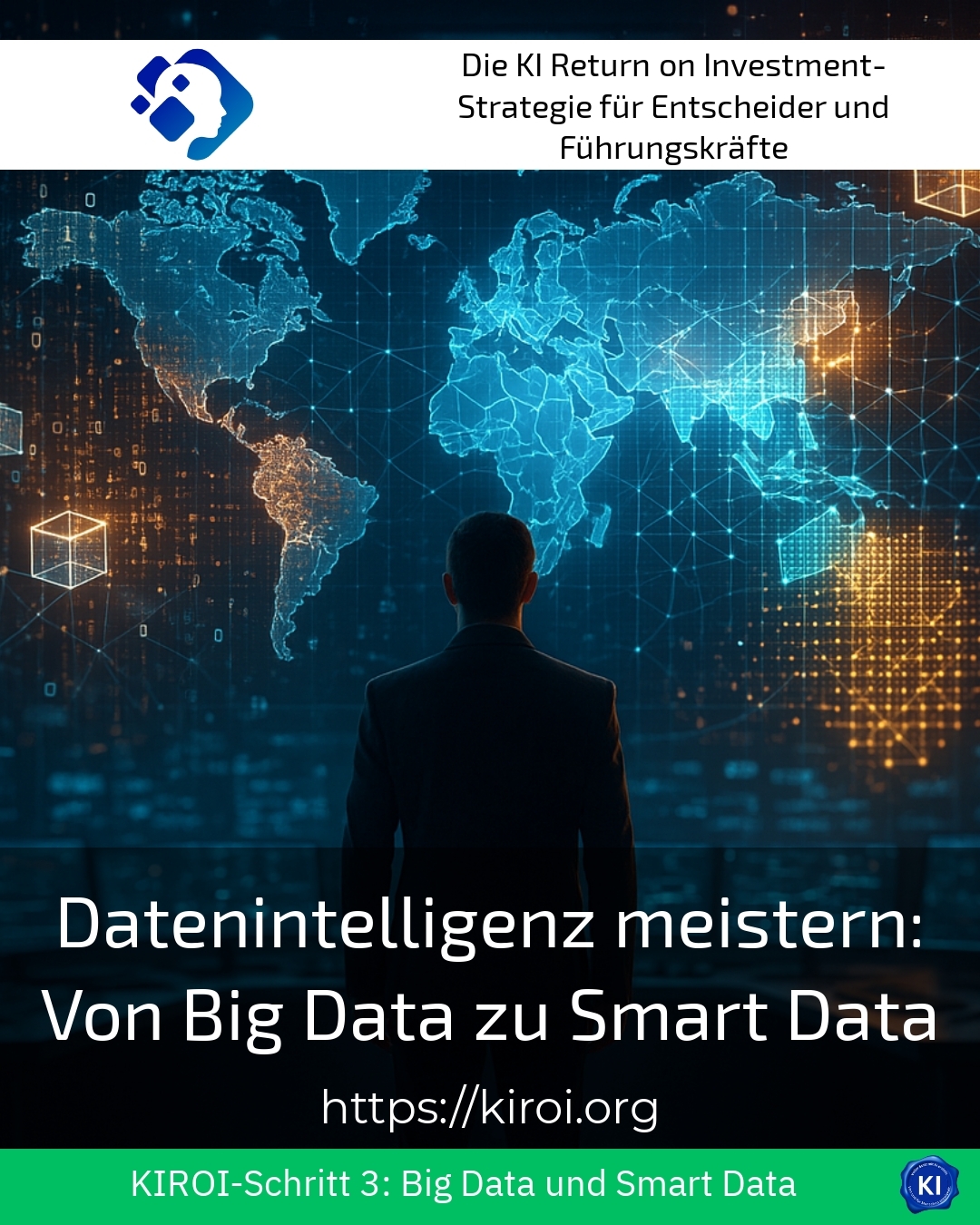
Imagine your company collects millions of data points daily, yet only a fraction of them lead to actionable insights. Almost all industries are familiar with this challenge today, which is why the transformation from Big Data to Smart Data has become a central task. Mastering data intelligence means not just collecting information, but strategically transforming it into strategic decisions. In this article, you will learn how companies from various sectors are successfully shaping this transformation and what impulses transruption coaching can provide.
The fundamental difference between data deluge and data value
The sheer volume of available information overwhelms many organisations today. Companies store terabytes of customer interactions, production data, and market analyses. Nevertheless, the ability to draw actionable conclusions from this data is often lacking. For example, a medium-sized mechanical engineering company records all sensor data from its plant facilities. However, without intelligent analysis, this data remains worthless. The transformation to Smart Data therefore requires a fundamental shift in perspective. Instead of collecting more data, companies should be asking better questions. A logistics company does not optimise its route planning through additional GPS data. Instead, it combines existing information with weather data and traffic forecasts. This results in precise delivery time prediction models. Energy suppliers work similarly by analysing consumption patterns. They use historical data in conjunction with current weather forecasts. This allows them to better anticipate peak loads and deploy resources more efficiently.
Mastering data intelligence through structured processes
The path to intelligent data utilisation begins with clear processes. First, companies must identify their relevant data sources. Next, these sources need to be systematically connected. For example, a financial service provider links customer portfolios with macroeconomic indicators. This results in personalised investment recommendations with a higher degree of accuracy. At the same time, this measurably increases customer satisfaction. Retail companies, in turn, connect till data with movement patterns in the store. They analyse which product placements lead to higher sales figures. These insights are directly incorporated into assortment design. Pharmaceutical companies use clinical trial data along with real-world evidence. This significantly accelerates drug development. The systematic linking of different data streams creates entirely new possibilities for insight.
Best practice with a AIROI customer
A manufacturing company operating internationally faced the challenge of fundamentally improving its quality control, as its previous system relied on manual spot checks, leading to many errors being detected late. Within the scope of a transruption coaching project, we supported the company in analysing all machine data from the production lines in real-time and correlating it with quality parameters. The collaboration initially involved a comprehensive inventory of all available data sources, revealing that valuable information already existed, but had previously lain dormant and isolated in various systems. By intelligently linking temperature data, pressure values, and material specifications, the team developed an early warning system for potential quality deviations. Clients often report that it is only through this external support that they can fully recognise the potential of their own data landscape. After six months, the company was able to reduce its scrap rate by approximately fifteen percent, leading to significant cost savings and simultaneously increasing customer satisfaction.
Technological foundations for intelligent data analysis
Modern technologies form the foundation for successful data strategies. Artificial intelligence and machine learning play a central role in this [1]. These tools make it possible to recognise patterns in complex datasets. For example, an insurance company uses algorithms for fraud detection. The system automatically analyses claims and identifies suspicious patterns. Banks use similar technologies for creditworthiness assessment. They evaluate not only classic financial indicators but also alternative data sources. Telecommunications providers, in turn, forecast the probability of their customers cancelling their contracts. This allows them to initiate targeted retention measures before the customer switches to another provider.
Cloud technologies enable the scalable processing of large amounts of data [2]. Companies no longer need to invest in expensive data centres. Instead, they use flexible computing capacities as needed. For example, a media company analyses streaming data in real-time. It immediately recognises which content is particularly well-received. These findings are directly incorporated into content decisions. Car manufacturers collect vehicle data from connected cars worldwide. They use this information for product improvements and new service offerings. The technological infrastructure supports the entire data intelligence process.
From Big Data to Smart Data: The Human Factor
However, technology alone is not sufficient for sustainable success. People need to interpret the results and translate them into action. Therefore, employee data literacy is becoming increasingly important. Companies are investing more in training programmes for data-driven decision-making. A retailer is training its branch managers in dealing with sales data. They learn to correctly interpret sales forecasts and adjust their orders. Hospitals are training doctors in the use of diagnostic support systems. These systems provide valuable guidance, but the final decision is made by the doctor. Public utilities are enabling their technicians to independently evaluate maintenance data. This allows them to act proactively instead of just reacting to disruptions.
Mastering data intelligence in practical implementation
The concrete implementation requires a structured approach with clear milestones. Transruption coaching supports companies in identifying their individual potential. The first step always involves an honest assessment of the existing data landscape. What information is already being collected and how is it being used? For example, a construction company realised that project data was scattered across various systems. Consolidating this data enabled company-wide resource planning for the first time. A hotel chain experienced something similar, bringing together booking data, reviews, and staff scheduling. This allowed them to better anticipate occupancy fluctuations and deploy staff more efficiently.
Best practice with a AIROI customer
A logistics service provider approached us regarding route optimisation because, despite using modern fleet management software, delivery efficiency had stagnated and fuel costs were continuously rising. During the transruption coaching process, we collaboratively analysed the entire data architecture and uncovered untapped potential within historical order data and driver feedback, which had previously only been sporadically evaluated. By systematically integrating weather data, local traffic patterns, and seasonal fluctuations, the project team developed a dynamic planning system that adapts routes in real-time, also taking into account customer preferences for delivery time windows. The support provided not only covered the technical implementation but also the training of dispatchers in using the new tools, as clients often report that employee acceptance is crucial for project success. Following the implementation phase, the company reduced its average delivery time by twelve percent, while simultaneously achieving a noticeable decrease in fuel consumption and a significant increase in customer satisfaction ratings.
Ethical Aspects of Data Usage
With increasing data usage, ethical requirements are also growing [3]. Companies must create transparency regarding their data processing. Data protection regulations provide important guidelines in this regard. An online retailer actively informs its customers about personalisation algorithms. In doing so, it builds trust and strengthens customer relationships in the long term. Insurance companies must be able to explain how automated decisions are made. The traceability of algorithms is therefore becoming increasingly important. Employers ensure that personnel analyses do not have discriminatory effects. They regularly check their systems for unintended biases. This diligence pays off because it minimises reputational risks.
Future prospects for intelligent data utilisation
Development is progressing rapidly, constantly opening up new possibilities. Edge computing enables data analysis directly at the point of origin. This allows production machinery to make decisions in milliseconds. Autonomous vehicles process sensor data on-site, reacting to traffic situations faster than any cloud solution. New application areas are also emerging in healthcare. Wearable devices continuously monitor vital signs and detect irregularities early. Agricultural businesses use drone data for precise irrigation and fertilisation, thereby increasing yields while simultaneously reducing resource use. The intelligent use of data is thus permeating all economic sectors.
Mastering data intelligence is increasingly becoming a competitive factor that determines market success. Companies that actively shape this change secure their future viability. This is not about technology for its own sake, but about genuine customer benefit. An energy supplier forecasts peak demand and proactively informs customers about favourable times to use energy. An airline optimises its pricing and thus offers more attractive fares. These examples show how data strategies can create tangible added value.
My AIROI Analysis
The transformation of Big Data into Smart Data presents companies with multifaceted challenges that extend far beyond technical questions and touch upon fundamental aspects of business management. My analysis clearly shows that successful organisations must address three central dimensions simultaneously: technology, processes, and people. While the technological infrastructure forms the necessary foundation, without clear processes and competent employees, the potential remains untapped. I frequently observe that companies make significant investments in analytics platforms but neglect accompanying organisational development. Transruption coaching can provide valuable impetus here by bringing together different perspectives and supporting a holistic transformation approach. Guidance on data intelligence projects requires sensitivity to the respective company culture and specific industry requirements. A phased approach seems particularly important to me, as overly ambitious transformation projects often fail due to internal resistance. Instead, I recommend starting with concrete use cases that deliver quickly visible successes, thereby promoting acceptance within the company. The ethical dimension is continuously gaining importance, as customers and regulators increasingly demand transparency. Companies that act proactively in this regard build trust and position themselves as responsible players. The future belongs to organisations that not only collect data but also use it intelligently, always keeping people at the centre.
Further links from the text above:
[1] IBM – Artificial Intelligence Fundamentals
[2] Google Cloud – Introduction to Cloud Computing
[3] European Commission – Ethics Guidelines for Trustworthy AI
For more information and if you have any questions, please contact Contact us or read more blog posts on the topic Artificial intelligence here.






 Deutsch
  English (UK)