
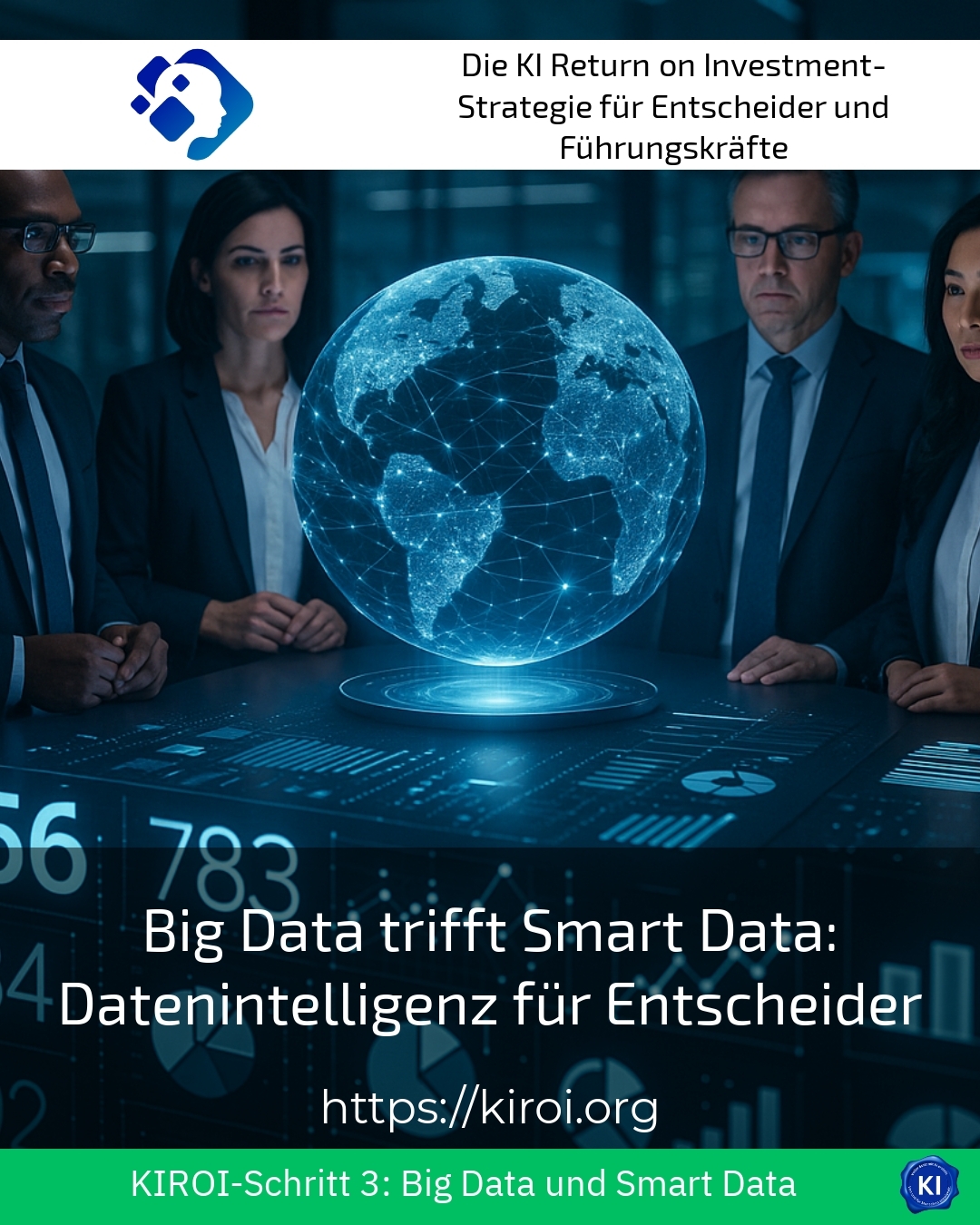
Imagine your company generates millions of data points every day, yet no one knows which ones are truly relevant. This is precisely where the transformation of Big Data meets Smart Data: Data intelligence for decision-makers This is because this development triggers fundamental changes in corporate strategic management. The amount of available information is growing exponentially, but it is only the intelligent processing and preparation of these data streams that enables genuine competitive advantages. Today, executives face the challenge of distilling actionable insights from an ocean of numbers, facts, and metrics that can form a solid foundation for strategic decisions.
From data deluge to strategic resource
The digital transformation has unleashed an unprecedented information explosion in almost all economic sectors. Sensors, networked systems, and digital business processes continuously generate new data. However, the real value lies not in quantity, but in quality and relevance. Companies that have understood this difference transform raw amounts of information into usable insights. They use advanced algorithms and learning systems to recognise patterns. These patterns often remain hidden from the human eye.
In the manufacturing sector, production facilities analyse machine data in real-time, for instance. This allows them to detect signs of wear and tear early on. A car parts supplier monitors thousands of sensors on its production lines. This enables them to precisely plan maintenance intervals and avoid unplanned downtime. A food manufacturer uses similar methods for its cold chains. This ensures product quality and significantly reduces waste. A mechanical engineering company has completely digitised its quality control. Faulty components are automatically sorted out.
Data Intelligence for Decision-Makers: The Path to Precise Analysis
The challenge for leaders is to ask the right questions and select appropriate analysis methods. This is not about technical details, but about strategic decisions. What information supports business goals? Which processes can be optimised through data-driven insights? These questions require a deep understanding of both business requirements and analytical possibilities.
A retail group simultaneously evaluates purchasing behaviour and inventory levels. It optimises its supply chains and reduces excess inventory. An energy supplier analyses its customers' consumption patterns. It offers personalised tariffs and increases customer loyalty. A logistics company uses combined traffic and weather data. It plans optimal routes and achieves significant fuel cost savings.
Best practice with a KIROI customer
A medium-sized company in industrial manufacturing came to us with a classic problem. Management felt they were drowning in data and couldn't derive any actionable recommendations from it. The organisation possessed extensive information from production, sales, and customer service, but this data was stored in isolated systems and couldn't be linked. As part of our transruption coaching, we guided management in first identifying relevant data sources and setting priorities before implementing technical solutions. We worked together to define key performance indicators (KPIs) that actually have strategic relevance and don't just reflect historical developments. Particularly valuable was the management team's realisation that the amount of data analysed isn't what's crucial, but rather its significance for concrete business decisions. After the coaching, those responsible reported significantly improved decision-making quality. They were able to react more quickly to market changes and deploy resources more effectively. The investment in intelligent analysis structures paid for itself within a few months through more efficient processes.
Intelligent Systems as Decision Support
Modern analytical tools go far beyond classic reporting. They recognise connections and forecast future developments. Predictive models enable executives to play through scenarios. They can assess the impact of various courses of action in advance. This ability to foresee fundamentally changes the way companies plan and make decisions.
A financial services provider uses advanced risk models for lending. It significantly improves its default forecasts and optimises its portfolio. An insurance company analyses claims histories and customer behaviour. It develops preventive measures and reduces its costs in the long term. A technology group monitors social media and market trends. It recognises innovation potential early on and remains competitive.
Big Data meets Smart Data in practice
The practical implementation of intelligent data strategies requires more than technical infrastructure. It demands a cultural shift within the organisation. Employees at all levels must learn to think and act in a data-driven manner. At the same time, analytical insights must not replace human judgement. Instead, they should complement and enrich it. Finding this balance represents one of the central management tasks.
A pharmaceutical company is accelerating its clinical trials through intelligent data analysis. It identifies suitable participants faster and reduces development times. A construction group systematically analyses project data from past ventures. It calculates more accurately and effectively avoids cost overruns. A media house continuously analyses user behaviour on its platforms. It personalises content and increases reader engagement [1].
Best practice with a KIROI customer
A family-run wholesale business with a long tradition approached us because the second generation of management wanted to make the company more digital and data-driven, but encountered significant internal resistance. Long-serving employees trusted their experience and were initially sceptical of analytical tools. In guiding them through transruptions coaching, we placed particular emphasis on bringing both perspectives together and demonstrating the advantages of data-supported decisions using concrete business situations. Together with the team, we developed pilot projects where experienced employees combined their expertise with analytical insights, achieving better results than with either method alone. These successes convinced even the sceptics and created a culture of constructive collaboration between humans and machines. Today, those responsible regularly report situations where the combination of human intuition and machine analysis has led to surprisingly good business decisions. The company has significantly strengthened its market position and is now actively tapping into new customer segments that would not have been identified by traditional methods.
Governance and ethical responsibility
As analytical systems are used more and more, so do the requirements for responsible data use increase. Decision-makers bear the responsibility for transparent and fair algorithms. They must ensure that automated processes do not produce discriminatory results. Regulatory requirements such as the General Data Protection Regulation (GDPR) set clear frameworks for this. These regulations should be seen as an opportunity for design [2].
A recruitment agency regularly reviews its selection algorithms for fairness. It ensures that all applicant groups receive equal opportunities. A credit institution documents its scoring models transparently and comprehensibly. It can explain decisions to customers and regulatory authorities. A healthcare provider anonymises patient data to the highest standards. It enables research and protects privacy at the same time.
Data intelligence for decision-makers: building competence as a key factor
The successful use of intelligent analysis methods requires new competencies at management level. Decision-makers don't need to be able to program or develop statistical models themselves. But they do need a fundamental understanding of the possibilities and limitations of analytical approaches. Only then can they ask the right questions and critically assess results.
A trading company is making targeted investments in training for its management team. The managers now have a better understanding of which analyses are possible and make sense. An industrial company has appointed a Chief Data Officer to its executive board. This individual serves as the bridge between technical expertise and strategic leadership. A service group is fostering exchange between specialist departments and data specialists. It is establishing regular workshops and joint project teams [3].
Transformation as a continuous process
The development towards a data-driven organisation is not a one-off project. It is an ongoing transformation process. Technologies continue to evolve and new analysis methods emerge. Market conditions change and require adapted strategies. Companies must therefore create structures that enable continuous learning.
A telecommunications provider has introduced agile methods in its analytics teams. It quickly adapts its models to changing customer requirements. A consumer goods manufacturer continuously tests new analytics tools in pilot projects. Successful approaches are scaled and rolled out across the organisation. A mobility service provider works closely with research institutions. It benefits from the latest scientific findings and remains innovative.
My KIROI Analysis
The transformation of massive datasets into actionable insights represents one of the key management challenges of our time, and my experience in supporting numerous organisations shows that success depends less on technical factors than on the strategic clarity and cultural readiness of the leadership. Companies that view this development as a purely technical project regularly miss their targets, while those organisations that achieve sustainable success understand and actively shape the change as a holistic transformation. The combination of technological possibilities and human judgement creates added value that far exceeds what either side could achieve alone.
In my work as a coach, I repeatedly see how leaders are initially overwhelmed by the complexity of the subject and look for simple solutions, yet it is precisely this search for a magic bullet that often leads them astray. Big Data meets Smart Data: Data intelligence for decision-makers In practice, this mainly means having a deep understanding of one's own business processes and deriving from them which information is truly relevant for decision-making. The technical implementation then follows almost inevitably from this strategic clarity. I support decision-makers in developing this clarity and designing the transformation process in a way that fits the corporate culture and available resources. The aim is not to strive for perfection, but to proceed pragmatically and learn from every step. The most successful projects I've had the privilege to support are characterised by the courage to experiment and openness to unexpected insights.
Further links from the text above:
[1] Bitkom – Data-Driven Business Models
[2] EU Commission – Data Protection and Data Usage
[3] McKinsey Digital Insights – Data Analytics Leadership
For more information and if you have any questions, please contact Contact us or read more blog posts on the topic Artificial intelligence here.











 Deutsch
  English (UK)