
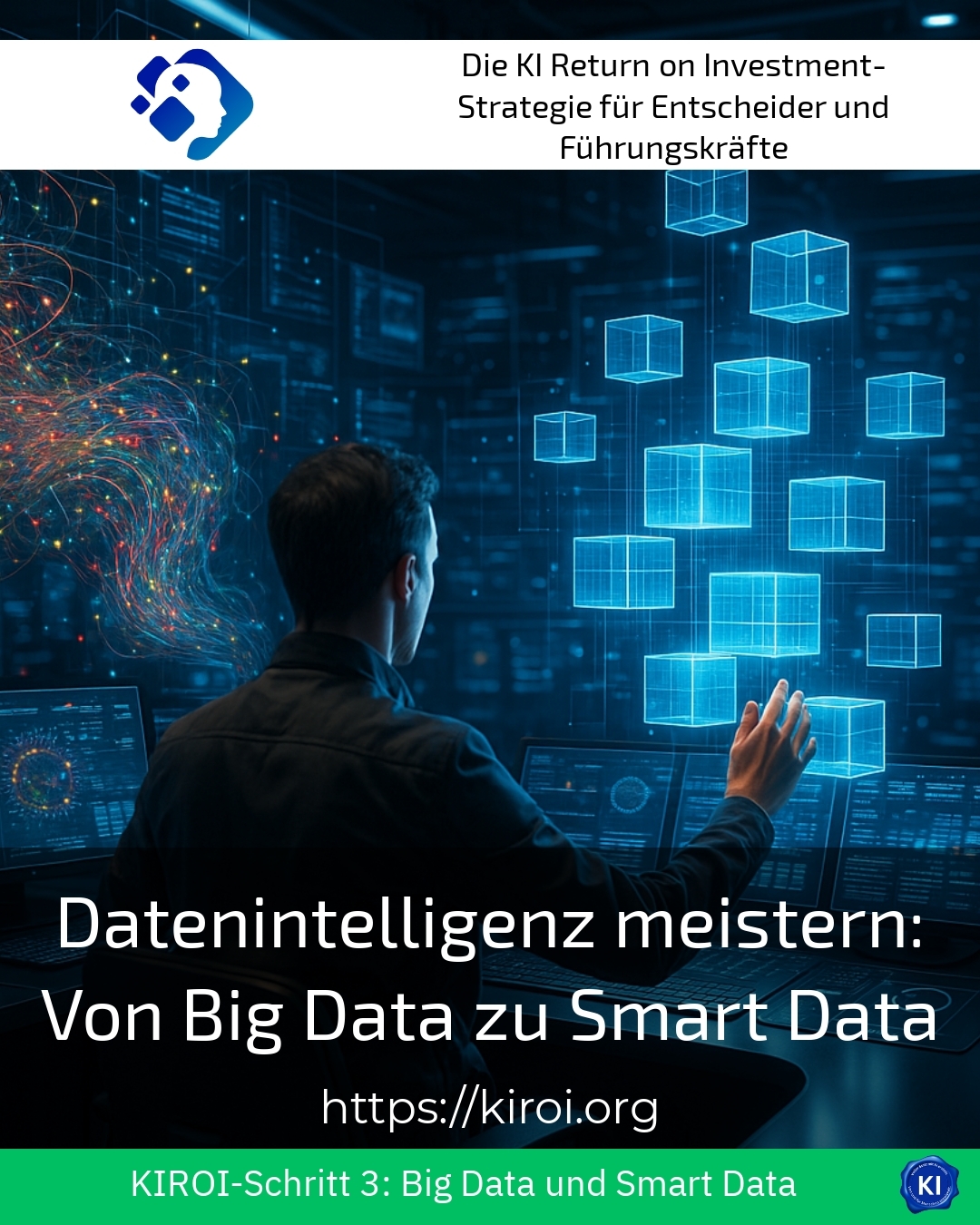
Imagine your company is swimming in an ocean of information, but no one knows which pieces are actually valuable and which are just digital ballast. This is precisely where Mastering Data Intelligence Strategies that create the crucial difference between mere data volume and true business value. In a world where billions of data points are generated daily, the ability to filter intelligently becomes an indispensable competitive advantage. Companies that understand and actively shape this transformation often report significant improvements in their decision-making processes. This article shows you the path from pure data collection to strategic value creation.
The fundamental transformation of information processing
The digital landscape has fundamentally changed in recent years, and with it, the demands on modern organisations. Previously, the motto was to collect and store as much information as possible. Today, however, it is evident that this strategy generates little added value without intelligent processing. Companies are increasingly recognising that quantity alone is not enough. Instead, the quality and relevance of the insights gained are becoming central to strategic considerations.
On average, a medium-sized company generates several terabytes of information per year. This amount far exceeds human processing capacity. Therefore, organisations require intelligent systems that can identify and process relevant patterns. The challenge lies in filtering the essential signals from the noise. Modern analysis tools support this process through automated pre-selection and prioritisation.
Clients frequently report feeling overwhelmed by the sheer volume of data. They gather information from a wide variety of sources without a clear plan for its use. This situation often leads to frustration and wasted resources. Transruption coaching supports companies in developing clear strategies for this transformation process, with a focus on individual needs and realistic implementation steps.
Mastering data intelligence through strategic filtering
The transition from raw data volumes to actionable insights requires a systematic approach. First, organisations must clearly define their actual information needs. Which questions need to be answered? Which decisions require what basis? This clarity forms the foundation of any successful transformation.
Strategic filtering begins with the acquisition of relevant information sources. Not every available source actually contributes to gaining knowledge. Some merely produce redundant or irrelevant content that ties up resources. Careful selection of sources saves time and increases the quality of the results. Modern tools support this pre-selection through automated relevance checks.
Best practice with a AIROI customer
An established company approached us with a common challenge familiar to many organisations. Their existing information systems produced hundreds of reports and analyses daily. However, hardly anyone used these reports for actual decision-making. Employees felt completely overwhelmed by the flood of information and ignored the analyses. As part of the transruption coaching, we first analysed the actual decision-making processes within the company. This revealed that only about twelve percent of the generated reports were actually relevant. Together, we developed a focused dashboard system with the truly important key figures. Employees received training on interpreting and using the consolidated information. After six months, managers reported significantly faster and more well-founded decisions. The acceptance of the analytical tools increased significantly because they now delivered real added value. This example illustrates that less often really means more.
Practical approaches to information condensation
The consolidation of information into actionable insights follows certain established principles. First and foremost is the aggregation of related information into meaningful patterns. Individual data points only gain their full significance in context. For example, isolated sales figures reveal a discernible trend. Visualisation tools support this process through intuitive representations.
Another important aspect concerns the contextualisation of the findings obtained [1]. Numbers without a frame of reference remain meaningless. Only comparison with historical values or benchmarks allows for meaningful interpretation. Modern systems deliver this contextual information automatically. This enables decision-makers to reach well-founded conclusions more quickly.
Prioritisation by action relevance represents a third essential building block. Not all findings require immediate responses. Intelligent systems classify information according to its urgency and importance. Critical deviations receive automatic highlighting and notification. Less urgent findings are documented for later analysis.
Mastering technological support on the path to data intelligence
Modern technologies offer diverse opportunities to support information transformation [2]. Machine learning algorithms automatically recognise patterns in large volumes of information. They identify correlations that might otherwise be missed by human analysts. However, these tools are only effective when used correctly. Technical implementation alone does not guarantee success.
Artificial intelligence is increasingly supporting the interpretation and preparation of insights. Natural language processing enables the analysis of text information on a large scale. Image recognition systems extract relevant information from visual sources. These technologies significantly expand the spectrum of usable information sources. At the same time, they reduce the manual effort for standard analyses.
Cloud-based platforms are democratising access to advanced analytical tools. Even smaller organisations can now utilise powerful systems. The scalability of these solutions allows for flexible growth without massive upfront investments. However, integration with existing systems often presents a challenge. Professional guidance can significantly ease the transition.
Challenges in organisational implementation
The technical side of the transformation forms only part of the overall challenge. The organisational and cultural aspects are at least as important. Employees need to learn and accept new ways of working. Leaders need to understand the possibilities and limitations of analytical tools. Without these human factors, technical investments remain ineffective.
We frequently encounter the challenge of fragmented information landscapes. Different departments use different systems without sufficient integration. Information silos emerge, making an overall overview difficult. Overcoming this fragmentation requires both technical and organisational measures. Transruption coaching provides impetus for both dimensions of this challenge.
Best practice with a AIROI customer
A growing organisation approached us with the desire to make better use of its existing information. The various business units operated with different systems and standards, making it virtually impossible to create a unified view of the business situation. Management often made decisions based on incomplete or conflicting information. As part of our collaboration, we first developed a shared understanding of information needs. Workshops with representatives from all departments identified overlaps and differences. On this basis, a concept for a unified information architecture was developed. The phased implementation took into account the specific requirements of each area. Today, the organisation has an integrated information system with clear responsibilities. In the opinion of the leadership team, the quality of strategic decisions has significantly improved. The cross-departmental collaboration during the project proved to be particularly valuable.
Ethical Dimensions and Responsible Handling
The increasing use of information for business decisions raises important ethical questions [3]. Data protection and privacy must be considered in all initiatives. Transparency towards those affected forms an essential basis for trust. Organisations are responsible for the appropriate handling of sensitive information. This responsibility extends to all phases of information processing.
Algorithmic decision-making carries the risk of hidden biases and discrimination. Historical data can reproduce and amplify societal inequalities. Responsible organisations regularly examine their systems for such unintended effects. Mechanisms for human review of automated decisions remain important. Full delegation to algorithms is not appropriate in many cases.
The balance between potential benefits and risk minimisation requires continuous reflection. Not everything that is technically possible is also ethically justifiable. Clear guidelines and governance structures support responsible action. Transruption coaching also accompanies organisations in developing appropriate frameworks. Ethical principles do not form a restriction, but a foundation for quality.
Future prospects of intelligent information utilisation
Developments in information processing are progressing at an impressive pace. New technologies are continually expanding the possibilities for analysis and consolidation. At the same time, the available volumes of information continue to grow exponentially. This dynamic makes continuous learning and adaptation indispensable. Organisations that invest today are laying important foundations for tomorrow.
The convergence of various technologies is opening up new areas of application. Combinations of artificial intelligence, the Internet of Things, and cloud computing are enabling previously unthinkable analytical possibilities. Real-time processing is becoming the standard in an increasing number of application areas. Predictive analytics is shifting the focus from looking at the past to anticipating the future. These developments are fundamentally changing how organisations make decisions.
The way to the Mastering Data Intelligence is not a one-off project but a permanent journey. Organisations embarking on this path develop new skills and perspectives. They transform raw information into strategic advantages. The shift from Big Data to Smart Data becomes a continuous improvement process. With the right guidance, this transformation is achieved sustainably and effectively.
My AIROI Analysis
The transformation of extensive information resources into actionable insights represents one of the central challenges for modern organisations. In my consulting practice, I regularly observe that technical solutions alone are not sufficient. The crucial success factor lies in the integration of technology, processes, and people. Organisations that consider all three dimensions achieve significantly better results.
The development of a clear strategy before implementing technical solutions seems particularly important to me. Many companies invest in tools without having sufficiently analysed their actual needs. This approach often leads to disappointment and poor investments. A thorough needs analysis forms the indispensable foundation for successful projects.
The human element is often underestimated in technology-driven discussions. Employees need to understand and accept the new tools. Managers require competence in interpreting analytical results. Without appropriate training and change management, even the best systems remain ineffective. Transruption coaching therefore supports organisations holistically on this journey.
Finally, I want to emphasise that the shift towards more intelligent information usage is not an optional modernisation. It is a strategic necessity for organisations that want to remain competitive. The good news is that this transition can be accomplished in manageable steps. With the right guidance and a clear focus on value creation, the transformation will be sustainable.
Further links from the text above:
[1] Bitkom – Smart Data and Data Analysis
[2] Gartner – Data and Analytics Insights
[3] Federal Commissioner for Data Protection and Freedom of Information
For more information and if you have any questions, please contact Contact us or read more blog posts on the topic Artificial intelligence here.









 Deutsch
  English (UK)