
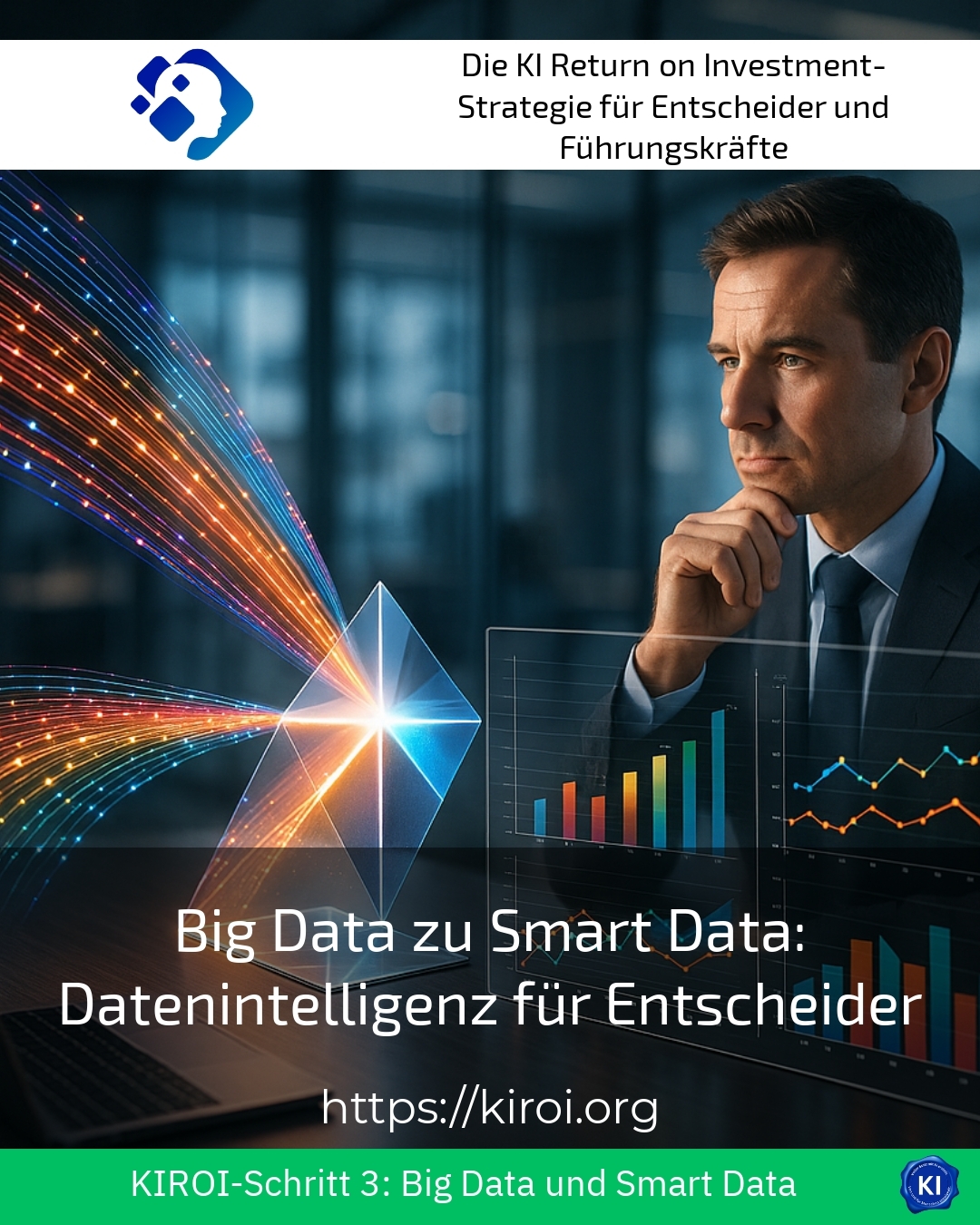
The flood of information that modern companies generate daily far exceeds human imagination. But what good are billions of data points if decision-makers cannot extract actionable insights from them? This is precisely where the shift from Big Data to Smart Data – a transformation that promises nothing less than a revolution in corporate management. Leaders face the challenge of filtering out real signals from digital noise. The ability to use data intelligently is increasingly determining success or failure. This article shows how data intelligence works in practice and what impetus it provides for strategic decisions.
Understanding the challenge of the modern information deluge
Companies today generate more information in a few minutes than they used to in entire years. Sensors in production facilities continuously provide measurements of temperature, pressure, and wear. Customer interactions on digital platforms leave detailed traces of preferences and behaviours. Logistics systems log every movement step of goods through complex supply chains. These volumes of data offer enormous potential for better decisions. At the same time, the sheer mass carries the risk of overwhelm. Many managers report frustration with unmanageable dashboards. They feel swamped by columns of numbers without receiving clear recommendations for action.
For example, a medium-sized mechanical engineering company collected all the production data from its machinery over several years. The servers filled up with terabytes of information, but no one knew exactly what to do with it. A retail company experienced something similar, storing millions of transaction records. The data lay dormant and unused in databases, primarily incurring costs. A logistics company, in turn, struggled with integrating various data sources from different systems. These examples highlight a widespread problem. Raw masses of data alone do not create added value for decision-makers.
From Collecting to Intelligent Understanding: The Core of Big Data to Smart Data
The crucial difference between mere data collection and true data intelligence lies in contextualisation. Smart Data are created when raw information is enriched with meaning. Modern analysis methods and machine learning play a central role in this process. Algorithms recognise patterns that remain hidden to the human eye. They identify connections between seemingly unrelated events. These insights form the basis for well-founded decisions at all levels of a company.
An energy supplier today uses predictive analytics for grid control. The system identifies potential disruptions early on and enables preventative maintenance. A retailer analyses purchasing behaviour in real-time and dynamically optimises its product range. A bank assesses credit risks by intelligently evaluating diverse data sources. These applications demonstrate the transformative potential of intelligent data utilisation. The shift from Big Data to Smart Data enables entirely new business models and competitive advantages.
Best practice with a KIROI customer
An internationally operating manufacturing company faced the challenge of fundamentally modernising its quality control. The existing systems produced several gigabytes of measurement data daily from various production lines. Quality managers spent hours manually generating reports and documenting deviations. As part of our transruption coaching support, we jointly developed a strategy for intelligent data utilisation. The project team first identified the truly relevant key figures for quality decisions. We then implemented a system that automatically detects anomalies and generates action recommendations. Quality managers now received clear dashboards with prioritised tasks instead of unmanageable raw data. The lead time for quality checks was reduced by more than half. At the same time, the error detection rate improved significantly because the system also identified subtle patterns. Employees reported a noticeable reduction in their daily workload thanks to the new solution.
Data intelligence as a strategic leadership tool
Modern decision-makers require reliable foundations for far-reaching strategic course-setting. Traditional gut-feeling decisions are no longer sufficient in complex market environments. Data intelligence supports leaders in better assessing risks and identifying opportunities early on. The combination of human experience and data-driven insights creates a new quality of decision-making. In this process, technology does not replace people but considerably expands their capabilities.
A pharmaceutical company is using data intelligence to optimise its research activities. Algorithms analyse scientific publications and identify promising active ingredients. A automotive supplier forecasts demand fluctuations with impressive accuracy through intelligent market analyses. A telecommunications provider recognises its customers' intention to cancel early and takes targeted countermeasures. These use cases illustrate the broad spectrum of strategic applications. Data intelligence is increasingly becoming an indispensable tool in senior management.
Consider the human component when moving from Big Data to Smart Data
While there is great enthusiasm for technological possibilities, the human dimension must not be forgotten. Data tells stories, but people must be able to interpret these stories. The ability to critically engage with data-driven recommendations is becoming a core competency for leaders. Algorithms can contain biases that lead to false conclusions. Ethical questions surrounding data protection and privacy require careful consideration. Ultimately, the responsibility for decisions remains with humans.
An insurance company ran into trouble because its risk models systematically disadvantaged certain demographic groups. A recruitment agency had to revise its selection system because it amplified unconscious bias. A media company realised its recommendation algorithms were favouring problematic content. These examples serve as a warning about the use of automated decision systems [1]. Transruption Coaching helps companies navigate these complex challenges.
Practical implementation of data intelligence in everyday corporate life
The introduction of intelligent data utilisation requires more than just technical investment. Successful transformations begin with a clear vision and defined objectives. The company culture must support and promote data-driven decision-making. Employees at all levels need the appropriate skills and training. While the technical infrastructure forms the basis, the real change happens in people's minds.
A chemical company gradually introduced data-driven process optimisation in its plants. Production managers initially received training on interpreting the new dashboards. Pilot projects in selected plants demonstrated the benefits and gained acceptance. A fashion company fundamentally transformed its purchasing processes through intelligent trend forecasting. Buyers now work closely with data analysts and make better decisions. A construction company uses sensor technology and data analysis to optimise its construction sites.
Best practice with a KIROI customer
A medium-sized family business in the consumer goods sector wanted to modernise its sales management. The previous planning was mainly based on historical experience and personal assessments of field sales representatives. This approach regularly led to over- or underproduction with corresponding costs. In the transruption coaching process, we first developed a shared understanding of the possibilities of data-based forecasting. Management defined clear priorities and provided the necessary resources. Together with the IT department, we consolidated relevant data sources from sales, marketing, and production. A forecasting model was developed iteratively with constant involvement of the specialist departments. The sales representatives learned to understand the new tools as support rather than a threat. After one year, the company reported significantly improved inventory turnover and higher customer satisfaction. The combination of data-based recommendations and human expertise proved to be particularly successful.
Success factors for sustainable data intelligence
Long-term success in the transformation to intelligent data utilisation depends on several factors. Firstly, the quality of the underlying data is crucial for actionable results [2]. Without clean, consistent, and up-to-date data, even the best algorithms will produce useless outcomes. Integrating various data sources requires careful technical and organisational planning. Clear responsibilities for data quality and data stewardship must be established.
An industrial company initially invested significantly in cleaning up its master data. This foundational work later enabled meaningful cross-site analyses. A financial service provider established central data management with clear governance structures. A hospital chain harmonised its documentation processes to enable comparable evaluations. These examples underscore the importance of solid foundational work for successful data intelligence. Big Data to Smart Data Transformation requires a systematic approach and patience.
Future prospects for intelligent data utilisation
Developments in the field of data intelligence are advancing rapidly, constantly opening up new possibilities. Advances in artificial intelligence are enabling increasingly precise predictions and recommendations. The availability of real-time analytics is fundamentally changing operational decision-making processes. At the same time, the requirements for data protection and ethical data usage are continuously growing [3]. Companies must carefully balance innovation and responsibility.
A municipal utility company is experimenting with smart grids that automatically balance supply and demand. A transport company is testing autonomous route planning based on real-time traffic data. A healthcare provider is developing personalised prevention programmes based on individual health data. These developments point to a future where data intelligence will be even more deeply integrated into our lives. The ability to competently manage these developments will become a key qualification for leaders.
My KIROI Analysis
The transformation of raw data volumes into actionable intelligence represents one of the biggest challenges for many companies. My experience from numerous consulting projects shows that technical solutions alone rarely lead to success. The crucial success factor lies in the combination of people, processes, and technology into a coherent overall concept. Leaders often report feeling overwhelmed by the complexity of the topic. They desire practical guidance and concrete first steps instead of abstract strategy papers. This is precisely where the KIROI concept comes in, offering structured support on the path to becoming a data-driven organisation.
The examples presented clearly illustrate the enormous potential of intelligent data use across a wide range of industries and applications. At the same time, the challenges described call for careful planning and implementation. Data intelligence is not an end in itself, but must provide concrete business value. Involving all stakeholders from the outset significantly increases the chances of success. Transruption coaching supports decision-makers in setting the right priorities and avoiding pitfalls. The path from Big Data to Smart Data is challenging, but the rewards for successful implementation are considerable.
Further links from the text above:
[1] AlgorithmWatch – Societal Effects of Algorithmic Decision-Making Systems
[2] Bitkom – Data and Analytics in Corporate Use
[3] Federal Commissioner for Data Protection - Current Information on Data Protection
For more information and if you have any questions, please contact Contact us or read more blog posts on the topic Artificial intelligence here.











 Deutsch
  English (UK)