
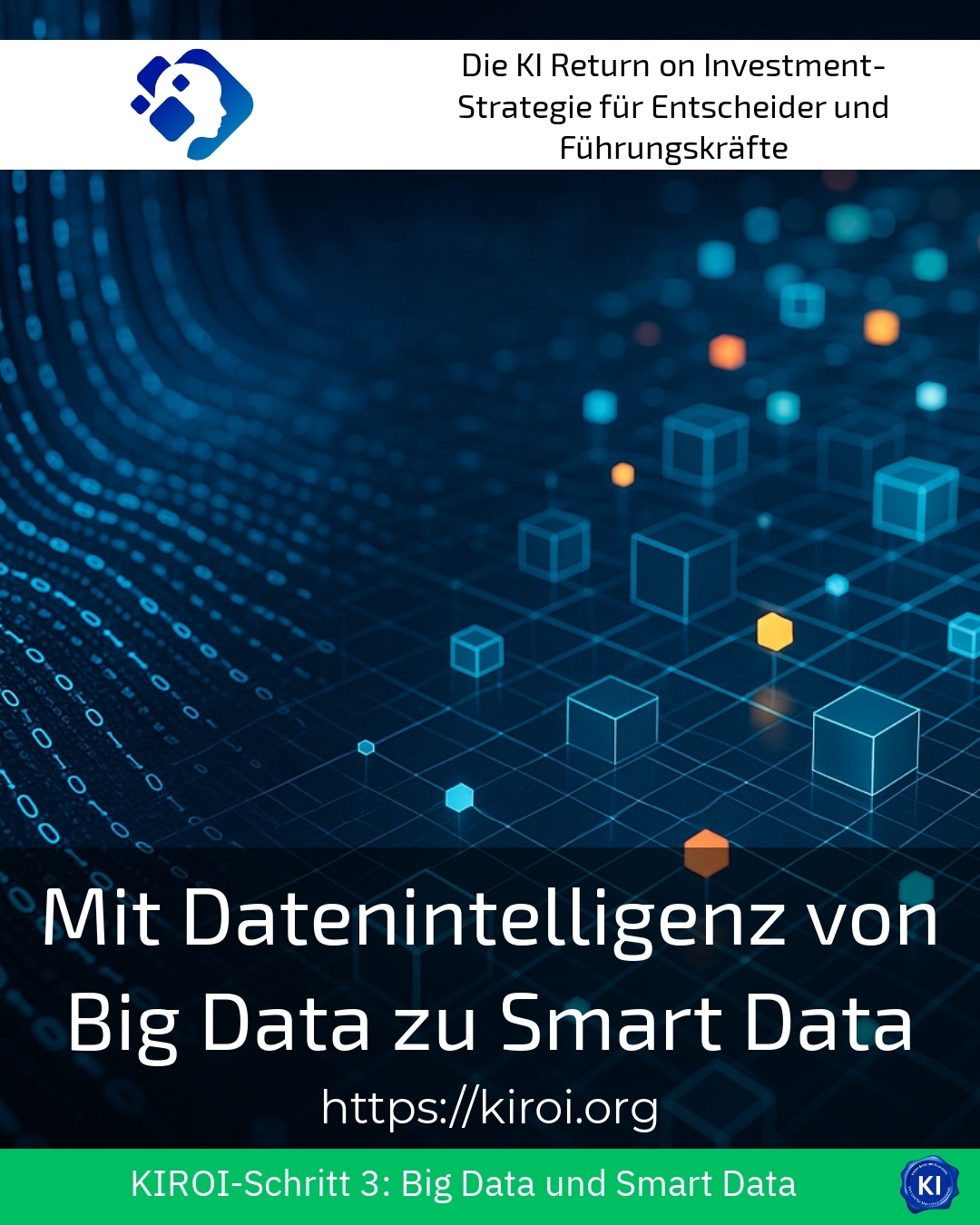
Imagine your company collects millions of data points every day, yet no one knows what to do with them. This is precisely where the transformative approach comes in, helping organisations move from Big Data to Smart Data with data intelligence. Many executives report overflowing databases and empty insights. Numerous companies are familiar with this situation from their daily work. Change begins where raw data finally learns to speak. And that is exactly what this article is about.
Understanding the Challenge of the Modern Data World
Businesses of all sizes today face a paradoxical situation that can be observed in almost every industry. They have more information than ever before in the history of commerce. At the same time, many decision-makers feel more lost than ever. The reason is obvious: quantity alone does not create added value. A retailer, for example, captures every receipt and every customer movement in the shop. But what do these numbers really mean? A manufacturing company collects sensor data from thousands of machines. But which patterns indicate an impending failure? An insurance company analyses claims from decades. Nevertheless, cases of fraud often remain undiscovered.
Transruption coaching supports organisations through precisely this transformation. It's about providing impetus and changing perspectives. Clients often report that it was only through external support that they learned to ask the right questions. Because technology alone doesn't solve problems. People need to understand which data is relevant. Only then does real intelligence emerge from mere masses of information.
With Data Intelligence from Big Data to Smart Data in Practice
The transition from unstructured data volumes to actionable insights requires a systematic approach. Firstly, companies must identify and evaluate their data sources. A logistics company, for example, uses GPS data from its vehicle fleet. This raw data initially only shows positions and times. Through intelligent analysis, this can lead to route optimisations and fuel savings. In turn, a hospital collects patient data from various departments. Linking this information can significantly improve treatment outcomes. An energy provider collects consumption data from millions of households. This allows them to predict peak loads and stabilise grids.
Best practice with a AIROI customer
A medium-sized retail company with over two hundred branches faced a fundamental challenge regarding its data utilisation. The organisation had been collecting transaction data, customer feedback, and inventory levels for years across various systems that did not communicate with each other. As part of the transruption coaching process, we first analysed the existing data landscape and identified critical gaps and redundancies. Together, we developed a strategy for data consolidation that could be implemented step by step. The team learned to distinguish relevant from irrelevant information and to set clear priorities. The introduction of dashboards that enabled real-time analysis proved particularly valuable. Branch managers could now independently recognise trends and act proactively. After six months, management reported a significantly improved decision-making quality. Inventory levels noticeably decreased, while the availability of popular products increased. This case impressively demonstrates how support in data transformation can enable sustainable success.
Understanding technologies as tools
The technological basis for transforming raw data into usable insights is rapidly evolving. Machine learning enables the automatic recognition of patterns in vast amounts of data. A financial services provider uses this technology to identify unusual transaction patterns. An airline optimises its pricing in real-time with it. A telecommunications provider uses it to identify customers with an increased likelihood of switching. However, the technology always remains a tool in human hands.
Cloud Computing provides the necessary infrastructure for complex analysis processes [2]. Companies no longer need to invest in their own data centres. Scalable resources are immediately available when needed. A pharmaceutical company uses this to analyse clinical trial data in record time. A car manufacturer simulates vehicle designs with enormous computing power. A media company personalises content for millions of users simultaneously.
Data quality as the foundation for intelligent decisions
The best analysis software provides worthless results if the underlying data is flawed. Therefore, ensuring data quality is a central aspect of any transformation strategy. A construction company had to realise that project data was available in different formats. A food manufacturer struggled with inconsistent product names across different markets. A tourism group had customer data duplicated across multiple systems.
Cleaning these data sets requires time and resources. Companies often underestimate this effort significantly. Transruption coaching supports the realistic assessment of such projects. Together with the teams, we develop pragmatic approaches for step-by-step improvement. Because perfection is rarely achievable, but continuous optimisation is certainly possible.
With data intelligence from Big Data to Smart Data through cultural change
Technical transformation alone is not enough for lasting success. Cultural change within the organisation is at least as important. Employees must learn to think and decide based on data. A traditional family business, for example, had relied on intuitive decision-making processes for decades. The introduction of data analytics initially met with considerable resistance. It was only when examples of success became visible that attitudes fundamentally changed. A public administration office had similar experiences with its long-serving employees. A craft business had to convince its master craftsmen of the benefits of digital documentation.
Best practice with a AIROI customer
A service company from the healthcare sector approached transruptions coaching with a specific concern. The leadership team had already invested in modern analysis software, but its utilisation fell far short of expectations. Analysis quickly revealed that technical barriers were not the main problem. Instead, there was a lack of a data-driven company culture and corresponding skills within the team. Together, we developed a training programme that involved various levels of the hierarchy. Identifying internal champions who acted as multipliers was particularly important. These key individuals received intensive support and were subsequently able to pass on their knowledge. In parallel, we established regular data dialogues where teams exchanged their findings. Initial scepticism gradually turned into genuine interest and engagement. After about a year, the utilisation rate of the analysis tools had more than tripled. The organisation reported noticeably improved patient outcomes through data-based treatment decisions.
Consider the ethical dimensions of data usage
With growing analytical capabilities, the responsibility of companies also increases. Data protection and ethical principles must never be neglected [3]. A staffing service provider must carefully consider which applicant data it analyses. A credit institution must not use discriminatory algorithms for lending. A technology group must make it transparent how it uses user data.
These questions are increasingly occupying the public and lawmakers as well. Companies that proactively establish ethical standards build trust with customers and employees. Transruption coaching also supports these sensitive aspects of data transformation. We provide impetus for the development of company-specific ethical guidelines. Because long-term success is based on responsible action.
Future prospects for intelligent data utilisation
Developments in data analysis are progressing relentlessly. Artificial intelligence will increasingly be able to recognise complex interrelationships independently [4]. A chemical company could use this to develop new materials on a computer. A city planner could optimise traffic flows in real-time. A farm could predict crop yields more precisely than ever before.
At the same time, the importance of human interpretation and decision-making is growing. Machines deliver analyses, but people make decisions. This division of labour will become increasingly sophisticated. Companies must prepare their employees for these changed requirements. Skills in handling data and analytical tools will become indispensable.
My AIROI Analysis
In my assessment, most organisations are still at the beginning of their data journey. The technical possibilities are impressive, yet their use often remains fragmented and superficial. The biggest obstacle is rarely a lack of technology or insufficient budgets. Instead, there is often a lack of clear vision and the necessary cultural transformation. Companies that want to progress from Big Data to Smart Data with data intelligence must think holistically. They need technical infrastructure, qualified employees, and a supportive corporate culture in equal measure.
Organisations that start small and grow incrementally are particularly successful. They identify concrete use cases with measurable benefits. They celebrate early successes and build upon them. They invest in the further training of their teams. They do not shy away from bringing in external expertise when their own knowledge is insufficient. Transruption coaching can be a valuable support in this process, broadening perspectives and helping to avoid pitfalls. The future belongs to companies that understand and responsibly use data as a strategic resource. The path to get there is challenging, but rewarding.
Further links from the text above:
[1] IBM – What is machine learning?
[2] AWS – What is cloud computing?
[3] The Federal Commissioner for Data Protection and Freedom of Information
[4] BMWK – Artificial Intelligence
For more information and if you have any questions, please contact Contact us or read more blog posts on the topic Artificial intelligence here.







 Deutsch
  English (UK)