
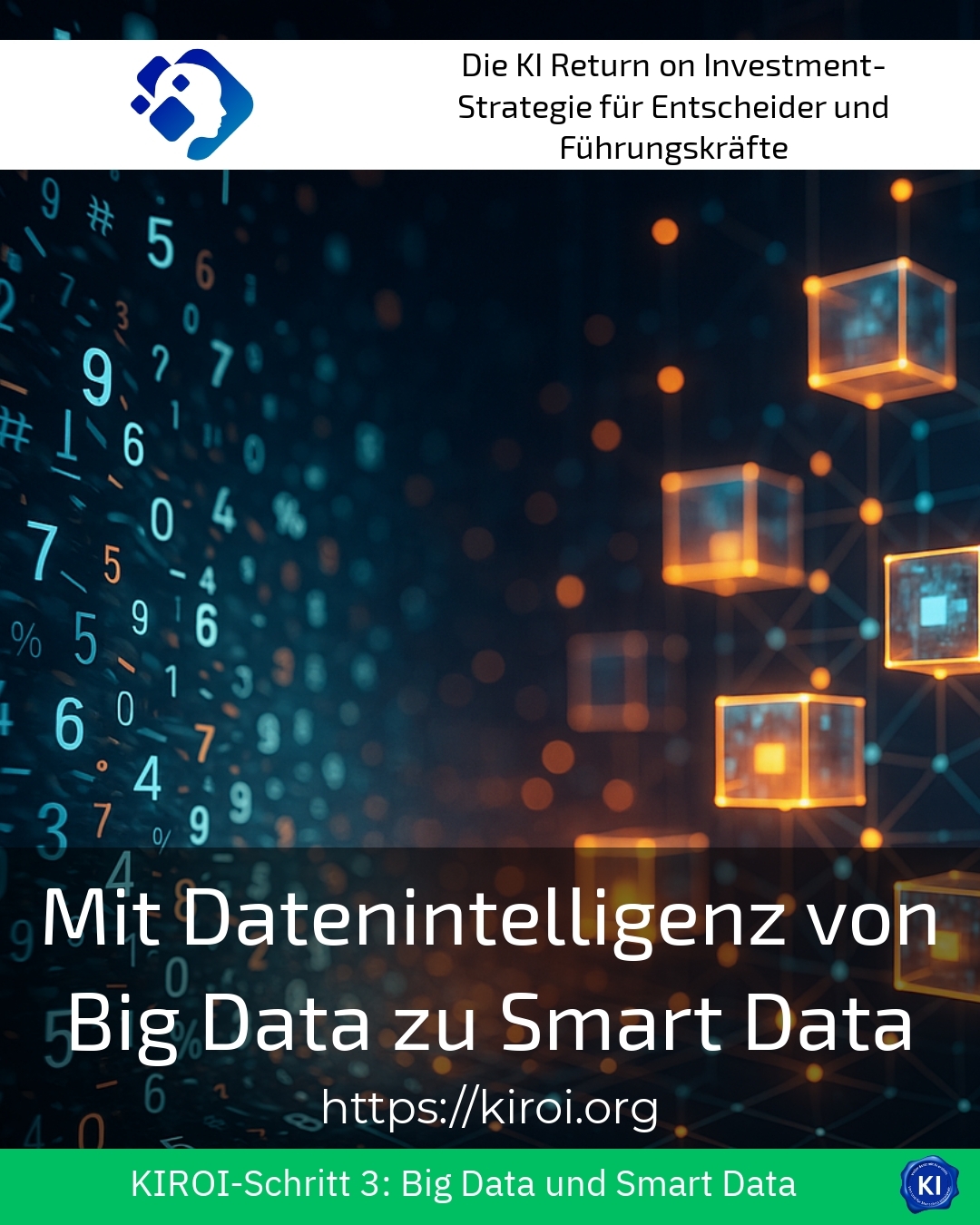
Imagine your company is sitting on a treasure trove of data, but no one knows how to extract valuable insights from it. This is precisely where the transformation From Big Data to Smart Data Because the sheer volume of information alone does not provide a competitive advantage. It is only through the intelligent processing, analysis, and utilisation of this data that real added value is created for organisations of all sizes. In an era where billions of data points are generated daily, the ability for targeted data intelligence determines market success or failure. This article shows you how companies can make the leap from pure data collection to strategic data utilisation.
Understanding and mastering the data flood
Many organisations today collect more information than ever before in human history. Servers store customer interactions, production data, and market information in unimaginable quantities. However, this abundance often leads to being overwhelmed rather than clear recommendations for action. Decision-makers regularly report feeling lost in the flood of information. The real art lies not in collecting, but in intelligently filtering and processing.
For example, a medium-sized machine manufacturer records thousands of sensor data points from its production facilities per minute. However, these raw data alone are not helpful to the company. Only when algorithms recognise patterns and identify anomalies do usable insights emerge. This allows the maintenance department to act proactively before costly failures occur. A logistics company uses similar approaches for its vehicle fleet. The data from the telematics systems are continuously evaluated and converted into real-time recommendations. This measurably reduces fuel costs and increases delivery reliability. This principle is also impressively evident in the retail sector. Till systems, online shops and customer loyalty cards jointly generate a complex data picture. However, transforming this raw data into personalised offers requires specialised analysis tools and well-thought-out strategies [1].
Data intelligence as a strategic success factor
The way From Big Data to Smart Data requires more than just technical solutions. Companies must first understand which questions they actually want to answer. This strategic groundwork is often underestimated and leads to costly wrong decisions. A clear target vision helps to identify the relevant data sources. This way, organisations avoid haphazardly collecting information without any discernible benefit.
For example, an insurance company wanted to speed up its claims processing. Instead of analysing all available customer data, it focused on a few key indicators. This focused approach enabled processing times to be reduced by more than half. A pharmaceutical company uses data intelligence to optimise clinical trials. The targeted analysis of patient data significantly supports the recruitment of suitable study participants. In the energy sector, intelligent analysis systems help to predict peak loads. Network operators can thus plan their resources better and minimise the risk of outages [2].
Best practice with a AIROI customer
An internationally active automotive supplier faced the challenge of fundamentally improving its quality control. The production facilities generated several terabytes of sensor data daily, but this remained largely unused in databases. As part of a transruption coaching project, we supported the company in developing a holistic data strategy. First, together with the specialist departments, we identified the truly critical key figures for quality assurance. It turned out that only about five percent of the recorded data was actually relevant to the core issues. The project team then implemented a dashboard system that visualises this key information in real-time. For the first time, quality engineers gained a comprehensive overview of critical production parameters. The automatic pattern recognition for deviations from target values proved particularly valuable. The system was able to detect potential quality problems before faulty parts left production. After six months, the customer reported a reduction in the scrap rate of more than thirty percent. The investment in the data infrastructure had therefore paid for itself faster than originally expected.
Technological Foundations for the Transformation of Big Data into Smart Data
The technical implementation of an intelligent data strategy requires various components. Modern cloud platforms often form the foundation for scalable analytics systems. They enable the flexible processing of large amounts of data without high initial investments in hardware. Data integration tools connect different source systems to a unified information pool. Machine learning algorithms are increasingly taking over automatic pattern recognition in complex datasets [3].
For example, a telecommunications provider uses cloud-based analysis platforms for its customer management. The systems process millions of usage data points and identify churn risks early on. This allows the company to initiate targeted customer retention measures. A financial services provider relies on similar technologies for fraud detection. Unusual transaction patterns are identified in real-time and forwarded for review. In healthcare, intelligent analysis systems support diagnostic processes. Medical image data is automatically evaluated and anomalies are highlighted.
Data Intelligence in Practical Application
Besides technology, the successful implementation of data intelligence also requires organisational changes. Employees must be able to understand the new tools and integrate them into their daily work. Change management therefore plays a central role in corresponding transformation projects. Managers should lead by example and actively demonstrate data-driven decision-making. Only then will a true data culture emerge throughout the entire company.
For example, a retail group implemented a company-wide data analysis training programme. Employees learned to independently create and interpret analyses. This significantly increased acceptance of data-driven processes. A media company established so-called Data Champions in all departments. These multipliers support their colleagues in their daily work with analysis tools. In the construction industry, innovative companies are relying on digital twins of their projects. The combination of planning data, sensor measurements, and empirical values enables more precise project management [4].
Best practice with a AIROI customer
A medium-sized retail company with multiple branches was struggling with shrinking margins and increasing online competition. Management recognised that their existing customer data represented an untapped treasure trove. As part of our support, we collaboratively developed a concept for personalised customer engagement. Firstly, we consolidated all available data sources into a central data warehouse. Till data, loyalty card information, and online interactions formed the basis for comprehensive customer profiles. Subsequently, machine learning algorithms segmented the customer base according to purchasing behaviour and preferences. The marketing team was then able to develop targeted campaigns for different customer groups. The response to personalised offers significantly exceeded expectations. Returning customers received perfectly tailored recommendations based on their previous purchases. New customers were presented with introductory offers in categories that matched their identified interest profile. After one year, the company reported a twenty-five percent increase in customer retention. Average basket values also increased measurably because customers received more relevant product suggestions.
From Big Data to Smart Data: The Human Factor
Despite all technological possibilities, humans remain the decisive factor. Algorithms can recognise patterns and make recommendations. However, the strategic interpretation and final decision continue to lie with professionals with domain knowledge. That is why smart organisations invest not only in technology but also in their employees. Data literacy, i.e. the ability to work competently with data, is becoming a key skill.
For example, a chemical company established an in-house further training programme for data analytics. Engineers and scientists learned how to apply advanced analytical methods to their specialist questions. A logistics provider further trained its dispatchers in the use of forecasting models. The combination of practical experience and data-driven predictions significantly improved planning quality. In the banking sector, risk analysts work closely with data scientists. These interdisciplinary teams develop models that are both statistically sound and practically applicable [5].
Considering the ethical aspects of data intelligence
With increasing data usage, so too do the demands for responsible conduct grow. Data protection regulations set clear legal limits for the processing of personal information. Furthermore, customers and business partners expect a transparent approach to their data. Companies must therefore develop ethical guidelines for their data activities. These build trust and form the basis for sustainable business relationships.
For example, an insurance company openly communicates which data are used for tariff calculations. Customers can decide for themselves which information they wish to share. An e-commerce provider gives users comprehensive control over their personalisation settings. This transparency strengthens customer trust and positively differentiates the company from the competition. In the healthcare sector, particularly strict standards apply to the handling of patient data. Anonymisation and pseudonymisation nonetheless enable valuable analyses for medical research.
My AIROI Analysis
The Transformation From Big Data to Smart Data presents one of the central challenges for companies across all industries. My experience from numerous consulting projects shows that technological solutions alone do not lead to the goal. Rather, organisations require a holistic strategy that considers people, processes, and technology equally. I often observe that the greatest resistance does not stem from technology. Instead, projects fail due to a lack of leadership support or insufficient change management.
Companies that successfully implement data intelligence are characterised by certain features. They start with clear business questions rather than technology. They invest in the skills of their employees and create a data-driven culture. They remain pragmatic and seek quick wins rather than perfect solutions. In transruption coaching, I guide organisations step-by-step along this path of transformation. I provide impetus for strategic alignment and support operational implementation. Clients often report that the interdisciplinary perspective, in particular, delivers valuable new insights. The combination of industry knowledge, technological understanding, and change expertise enables sustainable progress. Those who invest in intelligent data utilisation today lay the foundation for future business success. The path may be demanding, but the results justify the effort in the vast majority of cases.
Further links from the text above:
[1] Bitkom – Big Data and Analytics
[2] McKinsey – The Data-Driven Enterprise
[3] Gartner – Smart Data Definition
[4] Forbes – Big Data Insights
[5] Harvard Business Review – Análise de Dados
For more information and if you have any questions, please contact Contact us or read more blog posts on the topic Artificial intelligence here.








 Deutsch
  English (UK)