
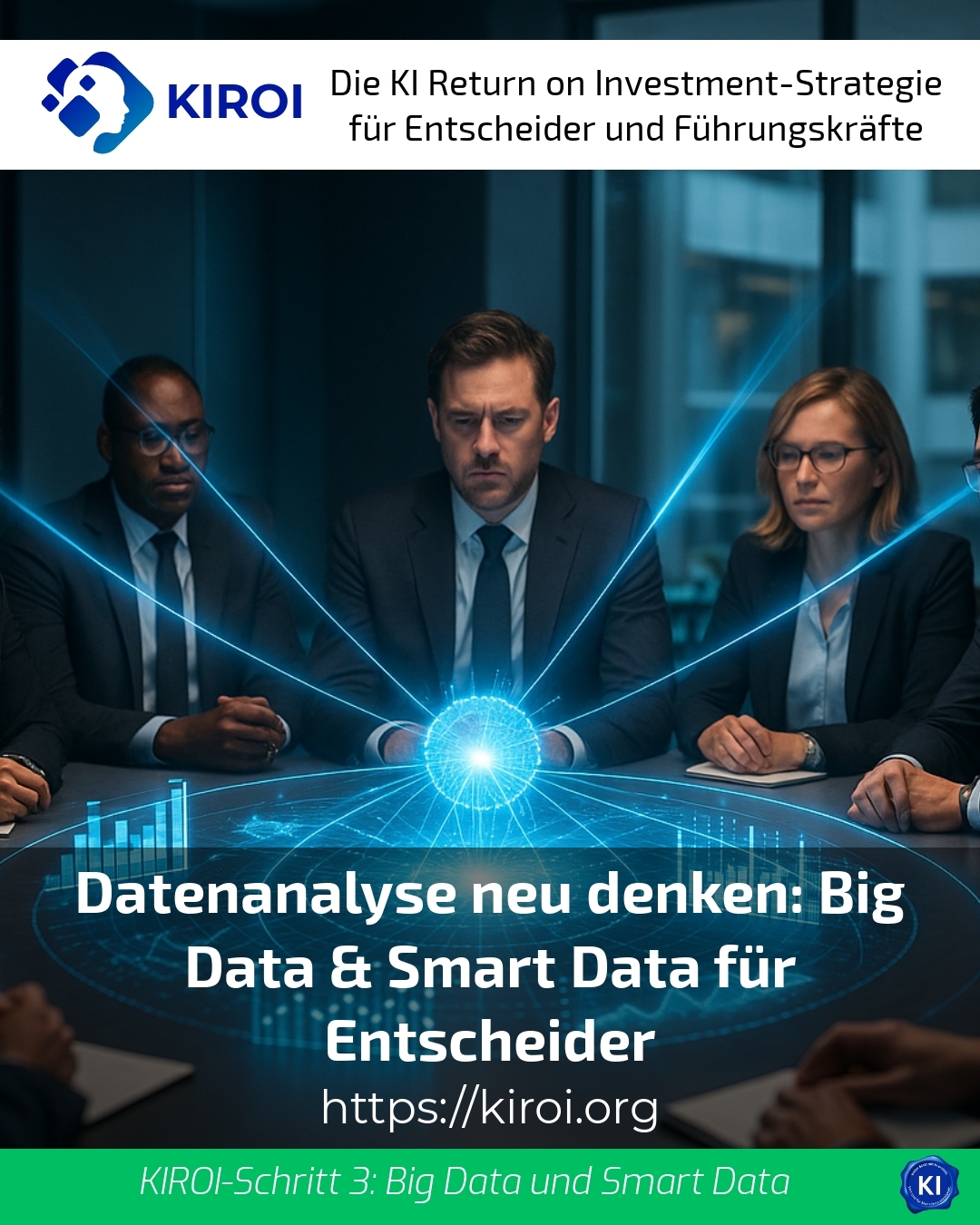
Data Analysis: Rethinking between Big Data and Smart Data
The challenges of data analysis are steadily growing with the volume of data. Companies frequently report the problem that Big Data, despite its vast volume, does not always deliver the desired insights. Therefore, a new approach that prioritises data quality and speed is gaining importance: Smart Data. Decision-makers are increasingly asking how they can rethink data analysis to achieve better, more targeted results and successfully support their projects.
Big Data and Smart Data: A Difference in Approach
Big Data refers to the processing of large, complex datasets with a focus on volume and variety. Smart Data, on the other hand, aims to filter these vast amounts of data, select, and extract only the truly relevant, high-quality information. This creates clearer, actionable insights that can significantly support decision-making processes. While Big Data often requires elaborate processing and many resources, Smart Data can also be prepared in real-time, offering immediate benefits to businesses.
Many businesses are noticing that collecting massive datasets doesn't automatically guarantee better decisions. Quite the opposite: unfiltered big data can be overwhelming and lead to misinterpretations. For this reason, clients often report that guidance with data analysis and a shift towards smart data provide valuable momentum for working more purposefully.
Targeted Data Analysis for Greater Efficiency
Targeted data analysis helps companies use their resources more efficiently. Smart data, for example, enables trends in customer behaviour to be identified more quickly and marketing measures to be precisely targeted. The quality of the data is crucial here. Experience shows that inaccurate data can lead to misinvestments – for instance, if advertising is shown to unsuitable target groups.
AIROI Best Practice at Company X (Name changed due to NDA) In a manufacturing company, the material flow has been optimised through careful filtering of data from the logistics department and the use of smart data. This has allowed bottlenecks to be identified more quickly and disruptions to be reduced. The company reports a significantly improved basis for decision-making and less wasted resources.
The benefit is also evident in the financial sector: only relevant and high-quality data lead to better risk assessments and portfolio decisions. This way, professionals avoid being blinded by excessive data volume and instead create added value through clear insights.
Smart Data: Adaptation to individual needs
A key strength of Smart Data is its ability to be individually tailored to specific industry requirements. A large company in the retail sector will need different data than one in the energy industry. When redesigning data analysis, these specific characteristics are taken into account, meaning that decisions are not only data-based but also context-specific.
AIROI Best Practice with Service Provider Y (Name changed due to NDA) A service company uses smart data to increase customer satisfaction. After targeted data preparation, this information could be used to optimise service processes. Through data analysis, employees receive valuable insights to better understand customer needs and respond individually.
This specific focus is a key component when rethinking data analysis. Clients report that this tailoring to their own needs facilitates cooperation and implementation.
Real-time decisions thanks to smart data
In manufacturing or trade, quick decisions are often crucial. Smart Data can be processed in real time. This enables immediate reactions to market changes or internal process deviations. This allows companies to remain flexible and secure their competitiveness.
AIROI Best Practice with Industrial Company Z (Name changed due to NDA) An industrial company uses Smart Data to monitor production data in real-time. Deviations are detected immediately and messages are sent to quality management. This has minimised downtime and significantly improved product quality.
Rethinking data analysis with coaching processes
The transition from Big Data to Smart Data is best achieved with accompanying support. AIROI coaching offers practical guidance for this, upon request. It provides impetus for developing a sustainable understanding of data and encourages its integration into everyday workflows. This rethinks data analysis, making it more targeted and successful. Clients frequently report a significant increase in clarity and structure when implementing their projects.
This support helps companies make data-driven decisions without being overwhelmed by the sheer volume of data. The coaching assists you in asking the right questions, setting priorities, and making optimal use of technical solutions. This is how data is transformed into real value creation.
My analysis
Data analysis today means transitioning from raw data to targeted, high-quality information. The combination of Smart Data and coaching services can help decision-makers make better decisions and optimise operational processes. The practical examples show how companies from a variety of sectors are working more efficiently with this approach. This makes it clear: rethinking data analysis means focusing on quality, individuality, and speed of action.
Further links from the text above:
[1] Big Data vs. Smart Data: Is More Always Better?
[2] Big Data to Smart Data | The evolution of data science and AI
[4] Big Data vs. Smart Data: Key Insights for Operational Optimisation
[7] Big Data vs. Smart Data: Valuable Insights to Optimise
For more information and if you have any questions, please do not hesitate to contact us regarding the topic. Data analysis or read more blog posts on the topic Data analysis here.









 Deutsch
  English (UK)