
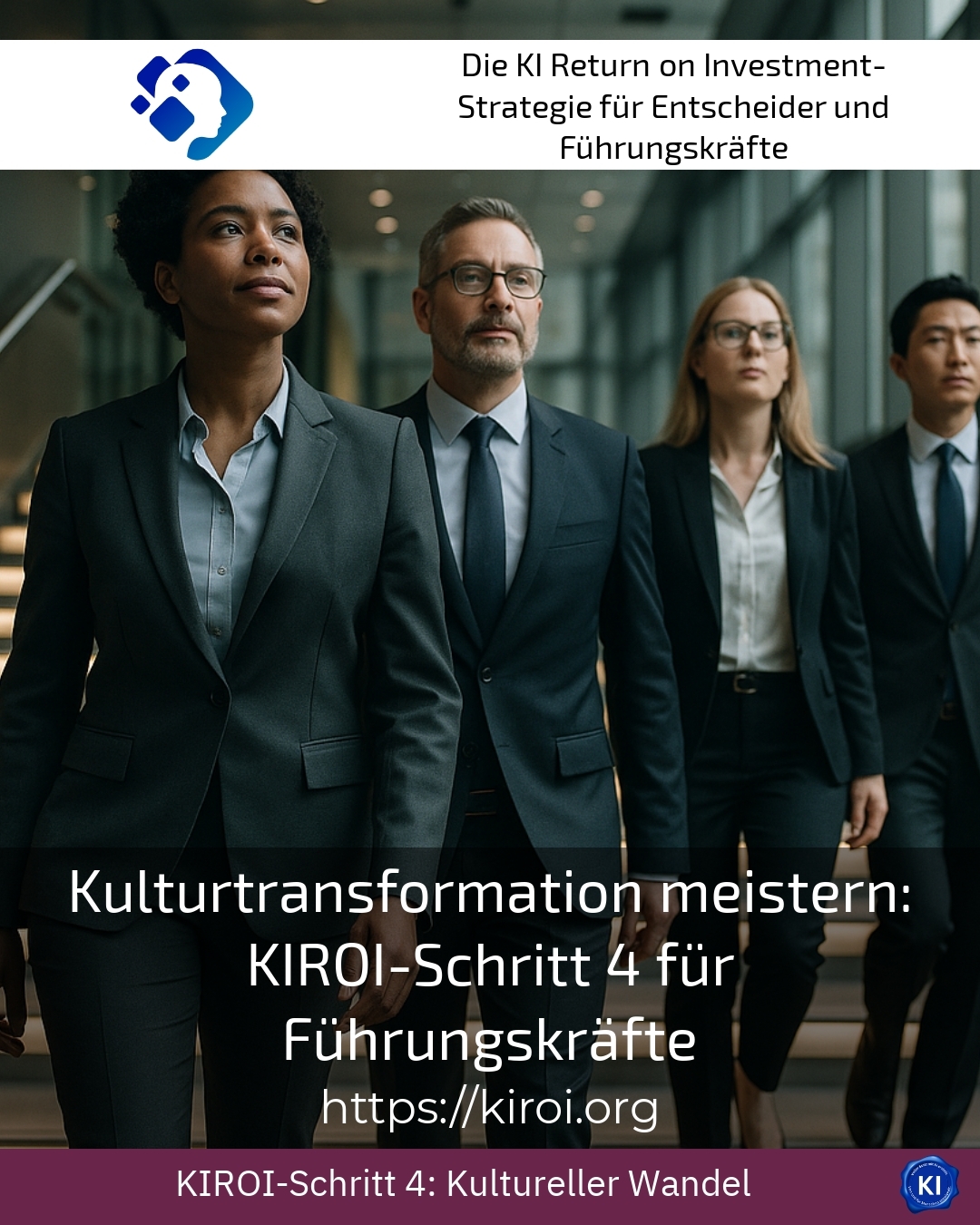
Cultural transformation presents companies with significant challenges. It calls on leaders to act proactively as shapers and role models. In the fourth step of the KIROI model, leaders learn how to effectively guide this change and anchor it sustainably. Cultural transformation here means more than just change – it is a process that profoundly realigns values and behaviours within organisations, thereby securing their future viability.
The essential role of leaders in culture transformation
Leaders are the central players in cultural transformation. They take responsibility by authentically embodying desired values and acting as catalysts for change. Particularly in practice, leaders from various sectors, such as manufacturing, healthcare, or IT, report that their own behaviour significantly contributes to the acceptance and implementation of the new corporate culture.
An example from the healthcare sector demonstrates how leaders established a culture of trust and transparency through open communication, which significantly boosted employee motivation. Likewise, a medium-sized industrial company supported its leaders with team workshops to overcome resistance to new innovation values and promote future-oriented collaboration. In the IT sector, a coaching programme accompanied leaders in consciously reflecting on their values and allowing them to effectively become cultural guideposts.
KIROI Step 4: Leaders as the driving force of culture transformation
In the fourth step of the KIROI process, the focus is on establishing leaders as active drivers of cultural transformation. This means that they not only perform management tasks but also deliberately model behaviours that make the new understanding of culture visible. This step supports leaders in recognising old patterns and courageously implementing changes.
For example, a municipal administration project supported its leadership team through intensive coaching to foster a trusting communication culture, which had a positive impact on the entire organisation. Similarly, a globally active IT service provider conducted individual coaching sessions that strengthened leaders in being cultural ambassadors and visibly demonstrating a readiness for innovation. In the manufacturing sector of medium-sized companies, a team coaching process helped to embed new values as inspiring role models within the corporate culture.
Practical approaches to implementing cultural transformation
Effective cultural transformation is achieved when leaders use supportive tools and actively involve employees. The following methods have proven effective:
- Individual and team coaching to strengthen reflection and role modelling.
- Regular workshops where cultural values are actively discussed and lived.
- Realigning HR processes such as recruitment, performance appraisal, and development to embed cultural guidelines.
- Cascading orientation programmes, in which leaders pass on knowledge, thereby spreading change within the company.
An internal best-practice case study demonstrates how a medium-sized technology company empowered its leaders through cascading training processes to drive cultural changes across all departments, thereby sustainably transforming the company culture.
BEST PRACTICE with one customer (name hidden due to NDA contract)
In an international IT company, we supported executives in one-to-one coaching sessions to reflect on their values and roles as cultural catalysts. This targeted support enabled the executives to authentically and consistently embody the desired behavioural model. As a result, the working atmosphere noticeably changed, fostering greater trust, openness, and a willingness to innovate.
Challenges and solutions in culture transformation.
Transforming a company culture doesn't just happen on its own. Leaders often encounter internal resistance, entrenched behaviours, and uncertainties. Therefore, it's crucial that they reflect on these issues and address them openly. In practice, clients often express a desire to strengthen their personal impact to overcome barriers within the team or company.
Approaches that have proven successful include:
- Transparent communication regarding the reasons behind the cultural transformation, to alleviate anxieties and build trust.
- Bespoke support to foster the courage to question old habits.
- Promoting a feedback culture so that change can be experienced as a shared process.
For example, a service company was able to strengthen a culture of openness and measurably increase employee satisfaction through targeted workshops and continuous leadership development.
My analysis
Cultural transformation is a central building block for the sustainable development of organisations. The fourth step of the KIROI model, in particular, makes it clear how essential the active role of leaders is. They are the bridge between strategy and lived practice and can set impulses with their behaviour that accompany and accelerate change. Practical examples from various industries show that cultural transformation can be supported and established in the long term through targeted coaching, open communication, and structured programmes.
Only through conscious and continuous guidance of these changes can organisations be created that are innovative, resilient and attractive to employees. Leaders have the opportunity here not only to accompany cultural transformation but to actively master it.
Further links from the text above:
Mastering cultural transformation: KIROI step 4 for leaders
Leaders as catalysts for co-creative transformation
Culture transformation – 4 steps and 4 interconnections
For more information and if you have any questions, please contact Contact us or read more blog posts on the topic Artificial intelligence here.











 Deutsch
  English (UK)