
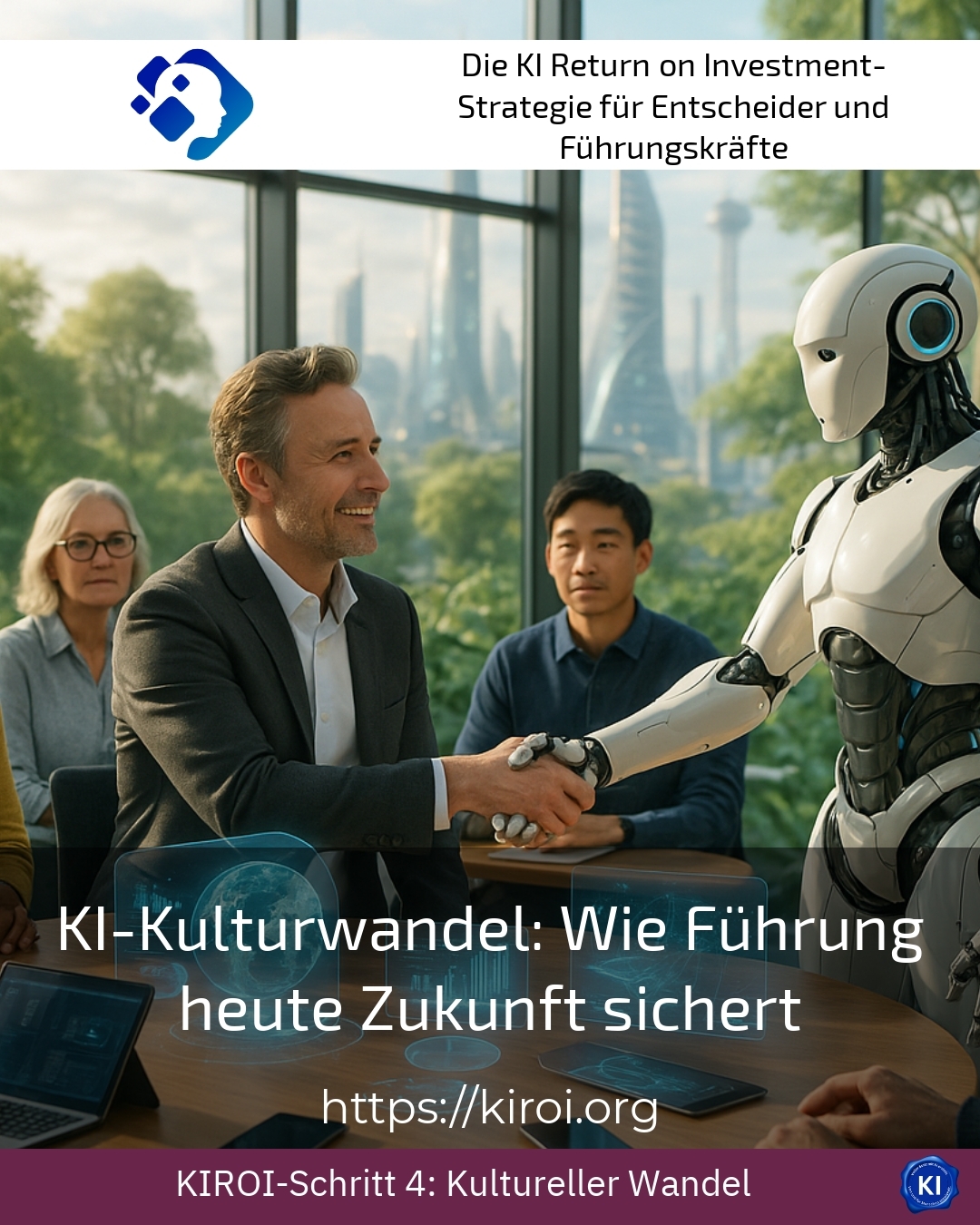
Imagine your entire organisation is at a crossroads, where old certainties no longer hold and new competencies are not yet sufficiently developed. It is precisely in this area of tension that countless companies find themselves today, realising that the AI Cultural Change: How Leadership Secures the Future Today no longer represents an abstract vision, but has become a pressing reality. The transformation affects not only technical systems or digital tools. It deeply impacts the self-understanding of teams, departments, and entire organisations. Leaders are faced with the challenge of providing stability and enabling radical change simultaneously. This requires a completely new understanding of leadership and support.
The new role of the leader in the AI culture change: how leadership today secures the future
Traditional leadership models often rely on control and hierarchical decision-making. However, these approaches are reaching their limits in an interconnected, data-driven world. Leaders are increasingly becoming enablers who create space for experimentation. They must be able to tolerate uncertainty while providing direction. This is only possible if they themselves are willing to learn continuously. The managing director of a medium-sized mechanical engineering company recently described how difficult he found it to relinquish control. His engineers wanted to test new intelligent systems, but he hesitated at first. Only after he familiarised himself with the possibilities could he develop trust. In a logistics company, on the other hand, the management decided to have all leaders trained themselves first. This created multipliers who could authentically embody the change. A financial services provider introduced weekly experimentation rounds. Teams were allowed to explore new applications there without the pressure of success and share their findings.
Trust as the foundation for sustainable change
Without trust, every transformation fails before it can truly begin. Employees watch very closely how leaders deal with uncertainty and mistakes. If failure is punished, an innovation culture cannot emerge. Instead, psychological safety is needed, which invites experimentation. A pharmaceutical company established so-called learning labs for this purpose, where mistakes were explicitly welcomed. The results were incorporated into improvement processes and created real added value. In an insurance company, success stories and failures began to be shared equally. This transparency significantly strengthened trust between hierarchical levels. A retail company introduced anonymous feedback channels to receive honest feedback. The management visibly reacted to the suggestions, thereby demonstrating genuine appreciation.
Best practice with a AIROI customer
A long-established family business in the manufacturing sector approached transruptions-Coaching because its digital transformation had stalled. Employees showed significant resistance to new technologies, and management felt overwhelmed. Initially, the coaching involved a comprehensive assessment of the existing culture. This revealed that many fears stemmed from a lack of communication and insufficient opportunities for involvement. Together, a programme was developed that empowered managers to act as bridge-builders between technical innovation and human needs. In workshops, the leadership learned how to take their teams' concerns seriously while also conveying confidence. After six months, most departments reported a noticeably improved atmosphere. The willingness to try out new tools increased significantly. It was particularly important that the management itself visibly participated in the process and openly shared their own learning experiences. This authenticity acted as a catalyst for the entire cultural change.
Communication as a strategic instrument in the AI cultural shift
Change is only successful when everyone involved understands why it is necessary. Leaders must therefore become excellent communicators who can convey complex issues in an understandable way. This is not about one-off announcements or slick presentations. Rather, it requires continuous dialogue on an equal footing. An energy supplier introduced monthly town hall meetings for this purpose, where the board of directors answered questions. Employees could submit questions and received transparent answers about strategic decisions. A software company introduced internal podcasts where managers shared their perspectives. This format also reached employees who didn't have time for long meetings. A hospital used visual roadmaps to illustrate the transformation process so that it was comprehensible to everyone. This created a common understanding of goals and next steps.
Recognising and constructively using resistance
Resistance to change is not a weakness, but an important signal. It shows where fears, uncertainties, or unresolved questions exist. Savvy leaders do not suppress resistance, but use it as a source of information. They inquire about the causes and jointly seek solutions. In a construction company, experienced project managers initially expressed great scepticism towards digital planning tools. Instead of bypassing them, management invited them to a pilot project. Their expertise was incorporated into the adaptation of the tools, and the resistance transformed into commitment. At a media house, editors resisted automated text suggestions. Workshops were organised where they could test and co-design the technology themselves. This participation led to significantly higher acceptance. A retailer realised that cashiers had concerns about their jobs. These fears could be addressed through open discussions and further training opportunities.
Competence development as a continuous process
The skills that are in demand today can be obsolete tomorrow. Therefore, a culture of lifelong learning is needed at all levels. Leaders must lead by example and show that learning is not a weakness. They should provide resources and actively advocate for learning time. An automotive supplier set up an internal academy that was open to all employees. It provided training in both technical and general skills. At a bank, managers received individual learning budgets that they could use freely. This autonomy increased motivation and led to a variety of training activities. A chemical company established mentoring programmes where younger employees shared their digital knowledge with experienced colleagues. This reverse knowledge transfer enriched both sides and promoted intergenerational exchange.
Best practice with a AIROI customer
An international trading company sought support from transruptions-Coaching because middle management had been identified as a bottleneck for innovation. Many team leaders felt caught between the expectations of senior management and the concerns of their staff. The support process began with the managers engaging in self-reflection. Through one-to-one coaching sessions, they identified their personal strengths and areas for development. In parallel, group sessions were held to discuss shared challenges and learn from one another. A key element was the development of a shared leadership vision for the company. This vision was not dictated from above, but jointly developed and formulated. As a result, the managers felt they were co-creators rather than mere implementers. Following the support programme, participants frequently reported a new clarity regarding their roles. They were able to deal with uncertainty more confidently and lead their teams more effectively through turbulent periods. Consequently, the company recorded a significantly higher rate of innovation and improved employee satisfaction.
AI Cultural Change: How Leadership Secures the Future Through Ethical Guidance Today
Technological possibilities alone are not enough for sustainable success. Leaders must also address ethical questions and convey clear values. What data can be used, and what boundaries must be respected? How can we ensure that decisions remain fair and transparent? A telecommunications company established an ethics council that reviewed new applications before their introduction. This body fostered trust among both customers and employees. A recruitment company developed guidelines for handling automated selection processes [1]. This transparency helped minimise discrimination risks and build trust. A healthcare provider involved patient representatives in the development of new digital offerings. This ensured that the needs of those affected were at the forefront.
Balancing agility and stability
Rapid changes demand agile working methods and flexible structures. However, at the same time, people also need stability and predictability. Leaders face the challenge of managing this paradox. They must decide where flexibility is beneficial and where fixed frameworks provide security. A consulting firm introduced agile methods while retaining proven quality standards. This approach combined innovation with reliability towards customers [2]. A publishing house experimented with self-organising teams, but defined clear responsibilities. This balance enabled creativity without descending into chaos. An industrial company established so-called "stability anchors", i.e., immutable values and principles. Within this framework, teams were free to experiment and forge new paths.
My AIROI Analysis
The change described represents one of the biggest challenges organisations face today. It affects not only technical aspects but also deeply impacts human dynamics and cultural patterns. Leaders cannot delegate this process or outsource it to experts. They must lead by example, demonstrating that change is possible and worthwhile. From my observation, this is particularly successful when authenticity and humility are the guiding principles. Nobody expects perfect leaders who know all the answers. Instead, employees appreciate superiors who openly address their own uncertainties. Guidance from transruptive coaching can provide valuable impetus and create spaces for reflection. It's about shaping individual development paths while simultaneously improving organisational frameworks. The examples from various industries show that there is no one-size-fits-all solution. Each organisation must find its own way, tailored to its existing culture and specific challenges. However, what applies universally is the need for courage, openness, and a willingness for continuous learning. Leaders who embody these qualities lay the foundation for their organisations' successful future.
Further links from the text above:
[1] Federal Ministry of Labour and Social Affairs – Digitalisation of the World of Work
[2] Harvard Business Review – Leadership
For more information and if you have any questions, please contact Contact us or read more blog posts on the topic Artificial intelligence here.






 Deutsch
  English (UK)