
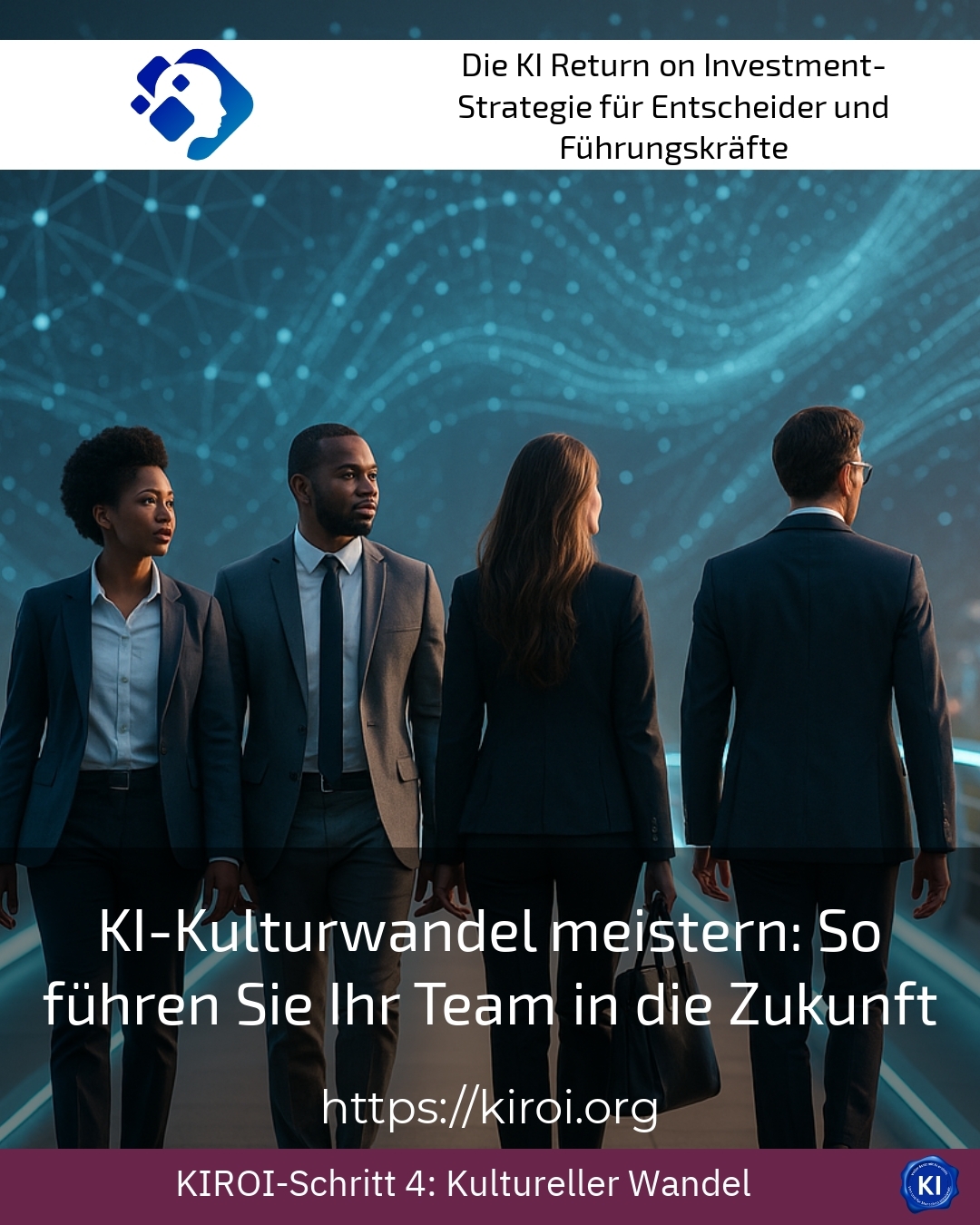
The world of work is facing a fundamental upheaval. Companies that seize the Mastering AI cultural change wish to, face the challenge of not just introducing technology. They must transform their entire company culture at the same time. This is about far more than software implementations or process optimisations. It's about people, their fears, their hopes, and their willingness to change. Leaders often report resistance within their teams. They experience uncertainty among employees who question whether their work is still needed. At the same time, enormous pressure arises from competition. Companies must act if they don't want to fall behind. But how can this change be achieved without overwhelming the workforce or losing valuable talent?
Why mastering the AI cultural shift is a leadership task
Technological transformations rarely fail because of the technology itself. They fail due to a lack of preparation among the people who are expected to work with it. Leaders therefore bear a particular responsibility. They must create the framework in which change becomes possible. Trust and transparency play a central role in this. Employees must understand why changes are necessary. They need clear information about objectives and timescales. And they require the assurance that their concerns are taken seriously [1].
In many companies, we are currently experiencing a two-tier society. On one side are tech-savvy employees who welcome innovation. On the other side are people who feel overwhelmed by the speed of change. Bridging this gap requires empathetic leadership. Leaders must engage and connect with both groups. This can be achieved through regular communication and open dialogue formats. It can be achieved through training offers that cater to different levels of knowledge. And it can be achieved through a culture where questions are welcome and mistakes are seen as learning opportunities.
The introduction of new technologies fundamentally changes workflows. Tasks that previously took hours can suddenly be completed in minutes. This creates free time, but also uncertainty. What happens to the time saved? What new skills are needed? These questions occupy employees at all levels. Managers must be able to provide convincing answers. They need to show how job profiles will evolve. And they must offer prospects that motivate rather than unsettle.
Best practice with a AIROI customer
A medium-sized manufacturing company faced the challenge of integrating automated systems into existing workflows. Initially, management opted for a purely technical approach, introducing systems without adequate preparation of the workforce. The result was sobering, as acceptance remained low and productivity stagnated. A new approach was developed as part of the transruption coaching support. First, we held intensive discussions with employees at all hierarchical levels. This revealed that many fears were based on a lack of information. People felt excluded and overlooked. Together, we developed a communication concept that included regular updates and feedback loops. In addition, we established a mentoring program where tech-savvy employees acted as ambassadors. They supported colleagues with training and helped overcome inhibitions. After six months, the mood had fundamentally changed. Productivity increased measurably, and employee satisfaction reached new highs. Staff turnover decreased significantly because people felt like part of the company again.
Communication as the Key to Successful Change
Change processes thrive on successful communication. This sounds like a truism, but it is astonishingly often neglected. Many leaders underestimate the information needs of their teams. They assume that one-off announcements are sufficient. However, people need repeated messages to process new information. They require different formats and channels. Some prefer written information, others learn better through direct conversation. A smart communication strategy takes these differences into account [2].
Authenticity plays a crucial role in this. Employees can sense very precisely whether leaders are genuinely convinced of the change themselves. Forced enthusiasm is counterproductive and breeds mistrust. It is better to openly discuss opportunities and challenges. Leaders are allowed to admit that they don't have all the answers either. This honesty builds trust and invites co-creation. Teams that feel like co-creators engage more actively with changes.
Regular feedback loops are indispensable for successful transformations. They make it possible to identify problems early on and take countermeasures. Anonymous surveys can help to capture even critical voices. Town hall meetings offer space for direct exchange. Smaller discussion groups allow for more in-depth discussions. The mix makes the difference and reaches different personality types.
Understanding and constructively using resistance
Resistance to change is not a sign of stubbornness or incompetence. It is a natural human reaction to uncertainty. Savvy leaders view resistance as valuable feedback. It shows where further explanation is needed or where fears have not been adequately addressed. Instead of silencing critics, leaders should listen to them. Often, critical objections hide important clues to weaknesses in the change process.
Involving sceptics can bring surprising benefits. Those who ask critical questions often think particularly thoroughly. These people can help to uncover blind spots. They can identify risks that enthusiasts overlook. If sceptics can be persuaded, they often become the most convincing ambassadors for change. Their transformation from critic to proponent appears more authentic to others than the enthusiasm of people who are always open to new things anyway.
Mastering the AI cultural shift with transruption coaching
Transformation processes are complex and multifaceted. External guidance can provide valuable impetus and open up new perspectives. Transruption coaching positions itself as a partner for companies aiming for sustainable change. The guidance begins where internal resources reach their limits. It supports managers in reflecting on their own role in the transformation. And it helps teams to jointly develop new ways of working [3].
The coaching approach is based on the conviction that every company is unique. There are no one-size-fits-all solutions that work everywhere. Instead, it's about developing individual solutions. These solutions take into account the specific company culture and history. They consider existing resources and competencies. And they respect the pace that is appropriate for the respective organisation.
Clients often report feelings of being overwhelmed by the sheer volume of change. The simultaneity of technological change, altered market conditions, and societal shifts is incredibly demanding. Coaching can help here to set priorities and reduce complexity. It supports separating the essential from the non-essential. And it provides impulses on how changes can be broken down into digestible steps.
Best practice with a AIROI customer
A service company with multiple locations was facing a comprehensive transformation of its business processes. Management had set ambitious goals, but implementation stalled at the middle management level. Team leaders felt caught between the expectations of senior management and the concerns of their employees. As part of the transruption coaching support, we developed a special programme for these "sandwich" managers. Firstly, we created safe spaces where they could address their own fears and uncertainties. Then, we worked together on concrete tools for difficult conversations with employees. The team leaders learned how to communicate changes without making false promises. They practised dealing with emotional reactions and conducting constructive dialogues. In parallel, we established regular communication between the locations so that best practices could be shared. After a few months, the dynamic had fundamentally changed, with the team leaders becoming genuine drivers of the transformation. Management reported significantly improved implementation speed and higher quality of results.
Developing skills for the workplace of tomorrow
The demands on employees are fundamentally changing. Routine tasks are increasingly being automated, while more complex activities are gaining importance. Creativity, critical thinking, and emotional intelligence are becoming more important than ever. These competencies cannot be developed overnight. They require continuous learning and practice. Therefore, companies must invest in the further development of their people.
Traditional training formats often reach their limits in this regard. Multi-day seminars are time-consuming and not always practical. Shorter, more flexible learning formats are often more suitable. Microlearning units, which can be integrated into everyday work, are enjoying growing popularity. Peer learning groups enable the exchange of experiences between colleagues. And mentoring programmes connect different levels of experience.
The development of learning competencies is particularly important. Those who have learned to learn can also adapt to unknown challenges. This metacognitive skill is becoming increasingly important in a rapidly changing world. Leaders should therefore actively foster curiosity and a joy for experimentation. They should create spaces where trying things out is encouraged. And they should set an example by demonstrating that they too are constantly learning.
Corporate culture as the foundation for change
Technology alone does not create transformation. What is crucial is the culture into which it is embedded. An open, learning-oriented culture significantly facilitates change. A rigid, hierarchical culture, on the other hand, can cause even the best technology to fail. Cultural change is therefore not an optional add-on, but the core of every successful transformation.
Culture emerges from the daily actions of all involved. It manifests in small gestures and decisions. How are mistakes handled? Are new ideas welcomed or blocked? Does information flow freely or is it hoarded? These everyday practices shape culture more strongly than any mission statement. Leaders must therefore critically reflect on their own behaviour. They are role models, whether they want to be or not.
Building a learning organisation requires patience and perseverance. Cultural change takes time and cannot be forced. Quick successes are possible, but sustainable change occurs over months and years. It is important to stick with it and accept setbacks as part of the process. Each organisation develops its own rhythm, which should be respected [4].
My AIROI Analysis
The consideration of numerous transformation projects shows clear patterns that determine success or failure. Companies that Mastering AI cultural change, are characterised by several common traits. They invest early in communication and take their employees' concerns seriously. They understand that technological change always means cultural change too. And they give their people time and resources to develop.
At the same time, it is apparent that external support can make a difference. Internal perspectives are valuable, but sometimes an outside view is needed. Transruption coaching offers precisely this complementary perspective and supports companies in achieving their transformation goals. Experience shows that companies that use professional support progress faster and experience less friction.
Looking ahead, it's clear that the pressure for change will continue to increase. Companies that invest in their capacity for change today will be ahead of the game tomorrow. It's not about adopting every new technology immediately. It's about creating an organisation that is ready for change, whatever form it may take. This readiness begins with leaders and must radiate from there throughout the entire organisation. The path is demanding, but it's worthwhile, because at the end of it stand resilient organisations that can also overcome future challenges.
Further links from the text above:
[1] Harvard Business Review – Change Management
[2] McKinsey – Future of Work Insights
[3] transruptions-Coaching – Transformation Support
[4] Gallup – Workplace Learning and Development
For more information and if you have any questions, please contact Contact us or read more blog posts on the topic Artificial intelligence here.









 Deutsch
  English (UK)