
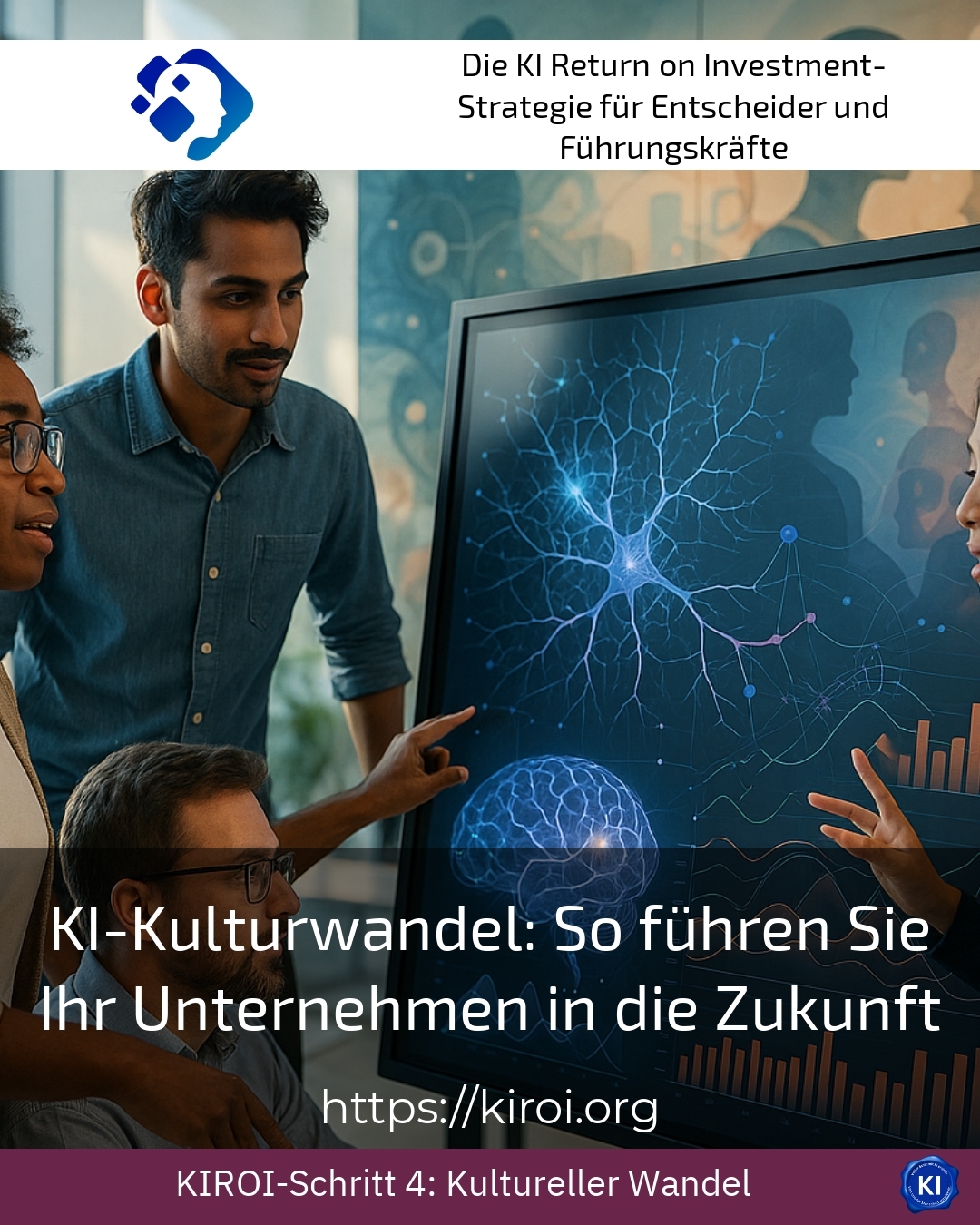
Imagine your company wakes up one morning to discover that the competition has gained a massive lead overnight. This lead is not based on better products or cheaper prices. It results from a fundamental transformation of the company culture, which makes the use of intelligent technologies possible. AI Culture Change: How to Lead Your Business into the Future is no longer an abstract vision. It is already happening as you read these lines. Many leaders massively underestimate the human component of this change. They invest millions in software and hardware but forget the most important resource: their employees. This is precisely where transruptions coaching comes in, supporting organisations through this profound transformation.
The Invisible Revolution at the Top
A quiet but profound change is currently taking place in German companies. This transformation affects not only processes and systems. It fundamentally changes how people collaborate and make decisions. Leaders face a dual challenge. On the one hand, they must understand and implement new technologies. On the other hand, they must navigate their teams through a period of great uncertainty.
Many managing directors report similar experiences. They introduced modern analysis tools and expected immediate productivity increases. Instead, they encountered resistance, fear, and misunderstandings. For example, a medium-sized mechanical engineering company from Bavaria invested significant sums in predictive maintenance systems. The technology worked flawlessly, but experienced technicians refused to trust the recommendations. A financial services provider from Frankfurt introduced automated risk assessments. The consultants felt their expertise was no longer valued and their motivation sank noticeably. A logistics company from Hamburg implemented intelligent route planning. The drivers consistently ignored the suggestions at first because they valued decades of experience more highly.
These examples clearly show that technological innovation alone is not enough. True change begins in people's minds and hearts. That's why transruptions coaching specifically supports companies with these cultural transformation projects.
AI Culture Change: How to guide your company through the transition
Successfully adopting new technologies first requires an honest assessment. Where does your organisation actually stand in terms of digital literacy? What unspoken fears exist within your teams? What beliefs may be blocking progress? These questions sound simple, yet answering them requires courage and openness.
Clients often report deeply ingrained beliefs that stand in the way of change. There's the experienced sales manager who fears being replaced by algorithms. The marketing expert wonders if her creativity is still needed. The production manager worries about the jobs of his long-serving employees. A chemical company from North Rhine-Westphalia experienced massive resistance when introducing automated quality controls. The laboratory technicians felt controlled rather than supported by the technology. A retail group based in Berlin wanted to introduce personalised customer engagement. The sales assistants feared that their personal relationships with regular customers would be devalued as a result. An energy supplier from southern Germany implemented intelligent grid control. The engineers had concerns about losing control in critical decisions.
Best practice with a AIROI customer
A family-run business with a long tradition in the automotive supply sector faced a fundamental challenge that went far beyond technical issues. Management had decided to introduce intelligent production systems to remain competitive. The workforce, comprising many long-serving employees, some with over thirty years of service, reacted with great scepticism and underlying resistance. As part of the transruption coaching, we first supported the management level in reflecting on their own uncertainties and communicating them authentically. Subsequently, we jointly developed a participation model that actively involved experienced employees in shaping the new processes. Particularly effective was the realisation that the decades of experience held by the skilled workers could not be replaced, but rather enhanced through technological support. The production managers became mentors for the new systems because they alone possessed the necessary contextual knowledge. After six months of intensive support, the initial resistance had transformed into genuine enthusiasm, and employees were independently developing suggestions for improving the intelligent systems. Productivity increased significantly, but even more important was the noticeably improved company culture and the strengthened sense of belonging.
The importance of psychological safety in change
Psychological safety forms the bedrock of any successful transformation. Employees must feel safe to ask questions and admit to uncertainties. They need room for error and the assurance that experimentation is encouraged. Without this foundation, even the best technological implementations will fail [1].
In practice, this means concrete changes in leadership behaviour. Leaders must themselves show vulnerability and make their own learning processes transparent. A pharmaceutical company from Hesse established regular „learning circles“ where leaders openly discussed their difficulties with new tools. An insurance group introduced „error conferences“ where failed experiments were analysed with appreciation. A media house developed a „buddy system“ that paired experienced employees with digitally savvy colleagues.
Practical steps for sustainable change
Building a sustainable corporate culture requires a systematic approach. At the same time, there must be enough flexibility to respond to unexpected developments. Striking this balance is the greatest challenge for many organisations. Disruption coaching offers valuable insights and personalised support in this regard.
The first step is to conduct an honest diagnosis of the current cultural landscape. What values are actually lived, not just proclaimed? Where are there informal power structures that could block change? What success stories already exist that can be built upon? A construction company from Munich discovered that its officially communicated enthusiasm for innovation was in stark contrast to its actual culture regarding mistakes. A telecommunications provider realised that middle management levels acted as the biggest block. A retail group found that individual departments had already developed excellent practices that were simply not being communicated [2].
AI Cultural Change: How to Guide Teams Through Uncertainty
Teams typically go through various emotional phases during significant changes. Knowing these phases and actively guiding them is what distinguishes successful transformations from failed ones. Initial euphoria often gives way to a phase of disillusionment and resistance. Only when this phase is navigated constructively can genuine integration take place.
A healthcare provider in Lower Saxony meticulously documented these phases during its digital transformation. The key insight was that resistance was not a disruption, but rather an important signal pointing to unmet needs. An industrial company in Saxony introduced regular „sentiment surveys“ to enable it to respond to changes at an early stage. A service provider in Cologne created dedicated spaces for staff to voice their concerns and fears [3].
Best practice with a AIROI customer
An internationally active consumer goods manufacturer approached us after two previous transformation projects had failed, and the workforce had lost confidence in any change initiatives. The diagnosis revealed that previous projects had been conceived purely technically, completely ignoring the human dimension. Together, we developed a completely new approach that involved the employees as co-creators from the outset, rather than as those being affected. We started with in-depth one-on-one discussions at all hierarchical levels to understand the actual concerns and hopes. It became clear that many employees were indeed open to new ideas but did not feel heard. Transruption coaching supported the managers in developing a new way of communicating, characterised by transparency and genuine dialogue. The introduction of „experimentation spaces,“ where teams could try out new tools without performance pressure, was particularly effective. After a year of intensive support, the company had fundamentally changed, and employee satisfaction reached all-time highs. The technological transformation, which had previously failed twice, now succeeded almost seamlessly because the cultural foundation for it had been laid.
The role of the leader as a culture architect
Leaders shape company culture through their daily behaviour more strongly than through any strategy presentation. What they do carries more weight than what they say. This realisation may seem banal, but it is frequently ignored in practice. Consciously engaging with one's own role as a role model requires continuous reflection and personal growth.
A technology company from Stuttgart fundamentally changed its leadership development. Instead of pure technical expertise, emotional intelligence and change competency were now assessed. A financial institution from Düsseldorf introduced regular supervisions for all management. A production company from the Ruhr region established „reverse mentoring“, where younger employees coached managers on digital topics [4].
Communication as a Key Competence in Transition
The way in which changes are communicated plays a key role in determining their success. It is not about sophisticated communication strategies or professional campaigns. It is about authentic, ongoing and dialogue-based communication on an equal footing. Employees can immediately tell whether communication is genuine or merely PR.
A trading company based in Bremen replaced its formal newsletters with informal video updates from the board. A service provider based in Leipzig introduced weekly „Ask me anything“ sessions, during which all questions were answered. An industrial group based in Baden-Württemberg established „change diaries“, in which managers shared their personal learning journeys.
Ensuring the sustainability of the change
Many transformation projects fail not at the start, but during the consolidation phase. Initial enthusiasm wanes, old patterns creep back in, and eventually, everyday life returns. To prevent this, conscious structures and rituals are needed to keep the new culture alive.
A software company based in Hamburg introduced quarterly „cultural audits“ to identify deviations at an early stage. An insurer based in Munich incorporated cultural aspects into its regular reporting. A mechanical engineering firm based in Swabia embedded cultural objectives in the performance agreements of all its managers [5].
My AIROI Analysis
Following intensive examination of this field, it becomes clear that the AI Culture Change: How to Lead Your Business into the Future represents far more than a technological project. The true transformation takes place on a human level and requires time, patience, and continuous support. Organisations that underestimate this aspect will not achieve sustainable success, despite high investments.
What strikes me as particularly noteworthy is the realisation that resistance is not an obstacle, but a valuable source of information. It highlights where further work is needed and which needs have not yet been addressed. Managers who treat resistance as a disruption miss out on important opportunities for improvement. The most successful transformations I have had the privilege of supporting were characterised by an attitude of radical openness. This openness applied both to their own uncertainties and to the concerns of their staff. It requires courage and a willingness to relinquish short-term control in order to enable long-term change.
My AIROI analysis continues to show that investing in cultural transformation pays off significantly more in the long term than purely technological investments. Companies with a strong culture of change can implement new technologies more quickly and successfully. They are also more attractive to talent and show higher employee retention. The key is to treat culture not as a soft sideline issue, but to understand it as a core strategic competency.
Further links from the text above:
[1] Harvard Business Review – Organizational Culture
[2] McKinsey – People and Organisational Performance
[3] Gallup – Workplace Insights
[4] MIT Sloan Management Review – Leadership
[5] Forbes – Leadership Strategy
For more information and if you have any questions, please contact Contact us or read more blog posts on the topic Artificial intelligence here.








 Deutsch
  English (UK)