
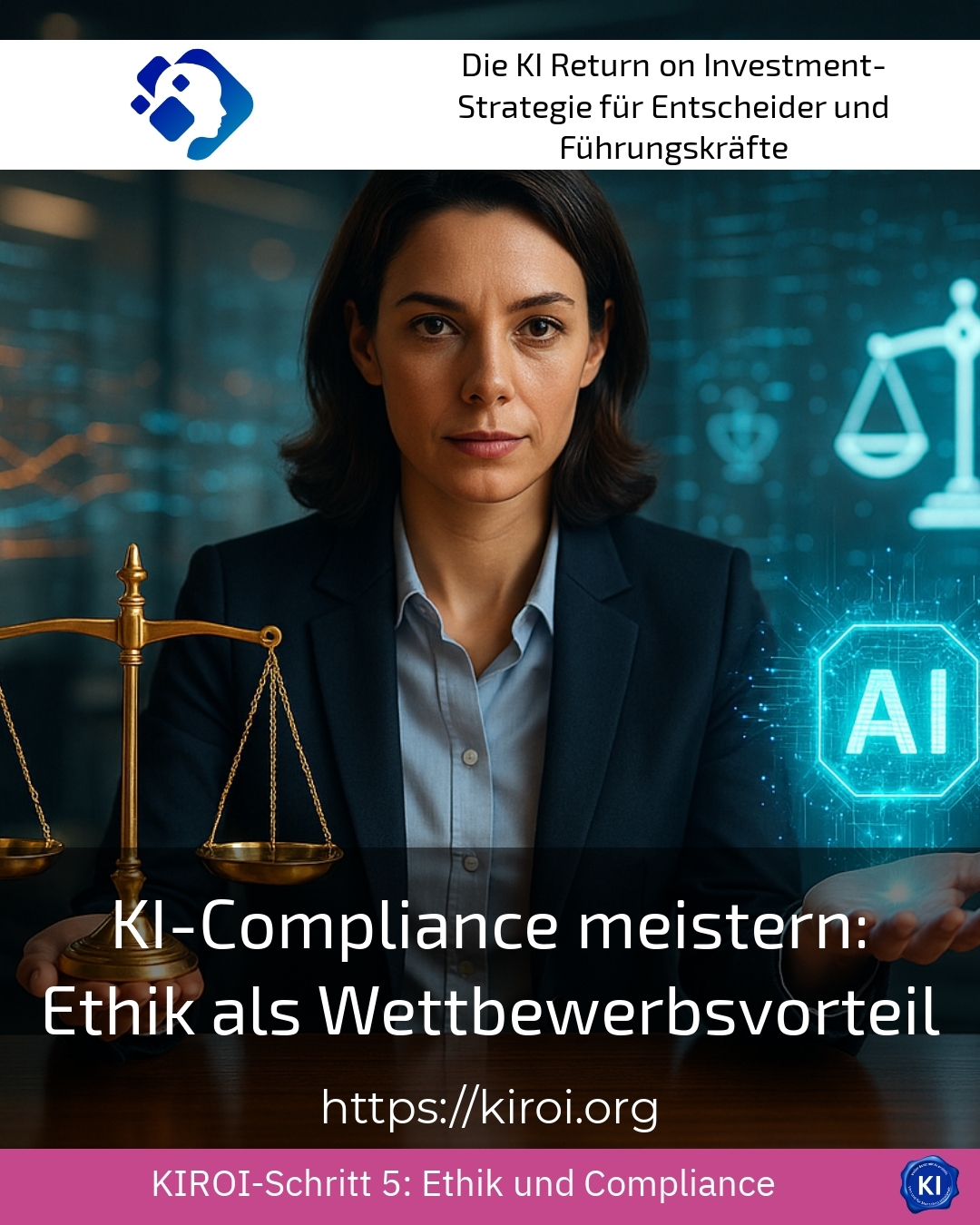
Imagine your company losing the trust of millions of customers overnight because an algorithmic system is making discriminatory decisions – this very scenario has already shaken several well-known corporations and strikingly illustrates why Mastering AI Compliance: Ethics as a Competitive Advantage no longer an abstract question for the future, but an immediate business imperative. The rapid development of intelligent systems in recent years has triggered a fundamental transformation that goes far beyond technological aspects and raises profound ethical questions, with which managers and decision-makers are confronted daily. The proactive engagement with responsible technology use, in particular, opens up enormous opportunities for companies that are willing to think beyond short-term efficiency gains and strive for long-term value creation through trust-building.
Why compliant technology use becomes a strategic priority
The regulatory landscape is currently changing at an unprecedented pace, with European legislators leading the way with comprehensive frameworks, setting global benchmarks that also directly affect internationally operating companies. This development compels organisations to fundamentally re-evaluate their existing processes and establish new structures that can meet both technical and ethical requirements. It is becoming increasingly clear that companies which invest early in relevant competencies can gain significant advantages over reactively operating competitors [1].
For example, a leading telecommunications company implemented a comprehensive audit system for algorithmic decisions in customer service, which not only met regulatory requirements but also demonstrably increased customer satisfaction. In turn, an international insurance group established an ethics board that examines all new applications for potential discrimination risks before their introduction, leading to a significant improvement in public perception. Furthermore, a major energy provider has developed transparent communication guidelines that clearly explain to customers how automated systems are used in tariff setting and consumption analysis.
Mastering the Fundamentals of AI Compliance: Ethics as a Competitive Advantage in Daily Business
The practical implementation of ethical principles first requires a profound understanding of the various risk categories that can arise from the use of intelligent systems. In addition to obvious data protection issues, these include more subtle challenges such as algorithmic biases, a lack of transparency in decision-making, and unintended consequences when scaling automated processes. Companies that systematically identify and address these risks create a solid foundation for sustainable success while minimising potential reputational damage.
A medium-sized financial services company developed a multi-stage evaluation process for new technological applications. A logistics group conducted regular audits of its route optimisation systems. A trading company trained all employees in the fundamentals of responsible technology use, which significantly increased internal acceptance of new systems.
Best practice with a AIROI customer
An internationally operating manufacturing company approached transruption coaching due to significant challenges in implementing an intelligent quality control system based on machine learning, which was intended to make far-reaching decisions about production releases. Initially, employees showed considerable reservations about the new system because they feared that their many years of expertise would be devalued and their jobs endangered. As part of the joint project support, we first developed a transparent communication plan that clearly explained how the system worked and explicitly acknowledged the role of human expertise. Furthermore, we established a governance framework that defined clear responsibilities for algorithmic decisions and laid down escalation paths for critical situations. Targeted training measures empowered the workforce not only to operate the system but also to understand its limitations and intervene correctively where necessary. After six months of intensive support, initial skepticism had transformed into constructive collaboration, and the error rate in production had dropped by over thirty percent without any job losses.
Transparency as the Foundation of Sustainable Technology Strategies
The demand for the explainability of algorithmic decisions presents many companies with significant technical and organisational challenges, but at the same time offers enormous opportunities for differentiation and building trust with customers, partners, and regulators. Modern explanation methods increasingly make it possible to understand even complex systems, with the degree of transparency required depending heavily on the specific application context and the stakeholders involved [2]. What is crucial is not necessarily complete technical disclosure, but rather the appropriate communication of relevant factors in language that is understandable to the respective target audience.
For instance, a health insurer developed simplified explanatory models for its automated claims decisions. A mobility provider publishes regular transparency reports on the use of its algorithms. A media company clearly labels algorithm-driven content recommendations and gives users control over the underlying parameters.
Practical Approaches to Responsible Implementation
The successful integration of ethical principles into technological development processes requires more than formal guidelines and sporadic training – it demands fundamental embedding in the corporate culture and the daily workflows of all involved. This primarily includes establishing clear responsibilities, with specific roles being created for ethical issues, equipped with appropriate authority and resources. Furthermore, integrating checkpoints for ethical reflection into existing development methodologies is recommended, so that relevant considerations are part of the process from the outset, rather than retrospectively.
A pharmaceutical company integrated ethical assessment criteria into its research processes. A technology group established an internal advisory team for responsible innovation. An education provider developed participatory evaluation methods that actively involve learners in the assessment of algorithmic systems.
Mastering AI Compliance: Ethics as a Competitive Advantage through Stakeholder Engagement
The systematic involvement of various stakeholder groups in decision-making processes surrounding technological systems represents a crucial success factor that is often underestimated. While it may appear to be additional effort upon superficial consideration, it actually generates significant long-term benefits. Through dialogue with customers, employees, business partners, and societal actors, companies can identify blind spots, recognise unintended consequences early on, and develop viable solutions that meet with broad acceptance [3]. This participatory approach not only enhances the quality of decisions but also fosters trust in the organisation and its technological initiatives.
A retail group conducted regular customer surveys on its personalised recommendation systems. An employer established employee panels to evaluate new automation projects. A public service provider organised citizen forums to discuss algorithmic administrative decisions.
Best practice with a AIROI customer
A medium-sized financial services provider approached transruptive coaching because they wanted to introduce an automated credit decision system that would comply with regulatory requirements while minimising discrimination risks. The initial situation was complex, as the company had already had negative experiences with a previous system that had led to unintended disadvantages for certain customer groups. Together, we developed a comprehensive fairness framework that took into account various definitions of fairness and established a transparent trade-off process for unavoidable conflicts of objectives. We supported the project team in implementing monitoring mechanisms that continuously check for potential biases and trigger automatic warnings in the event of critical deviations. The joint development of documentation standards, which meet regulatory requirements and are also suitable for internal audits, proved to be particularly valuable. The company reports that the newfound transparency has not only strengthened the trust of regulatory authorities but has also led to more constructive discussions about ethical issues internally, with significantly improved collaboration between technical and legal departments.
Risk management and continuous improvement
The dynamic nature of technological developments requires adaptive risk management that goes beyond static checklists and allows for continuous learning processes, with the ability to adapt quickly to changing frameworks becoming a crucial success factor. Companies should therefore not only implement reactive monitoring mechanisms, but also develop proactive scenarios that anticipate potential challenges and enable forward-looking measures. This forward-looking approach distinguishes long-term successful organisations from those that constantly have to react to external events.
A car manufacturer established an early warning system for ethical risks in its automated driving systems. A healthcare provider conducted regular stress tests of its diagnostic algorithms. A human resources provider developed scenario planning for various regulatory developments.
Cultural change as a prerequisite for sustainable transformation
The successful implementation of responsible technology strategies often fails not due to a lack of resources or expertise, but because of cultural resistance and insufficient embedding within the organisation's values. Therefore, a holistic approach is essential, addressing not only structural but also cultural dimensions. Leaders play a central role in this, as they must not only issue guidelines but also demonstrate through their own behaviour that ethical considerations are genuinely prioritised and not mere lip service [4]. This authentic role-modelling is crucial for the credibility of such initiatives and for motivating employees to actively engage.
A software company integrated ethical performance criteria into its promotion decisions. A consultancy firm established internal recognition programmes for particularly responsible project work. An industrial conglomerate explicitly embedded corresponding values in its leadership guidelines and regularly reviews compliance with them.
My AIROI Analysis
A comprehensive review of the subject matter impressively shows that responsible technology use is far more than a compliance exercise and, with a strategic approach, can generate significant competitive advantages that go far beyond the mere avoidance of risks. Companies that proactively invest in appropriate structures and competencies not only position themselves for current regulatory requirements but also simultaneously create a resilient foundation for future developments, the exact direction of which cannot yet be foreseen, but whose relevance remains undisputed.
The numerous practical examples demonstrate that there are no universal solutions, but rather each organisation must find its own path that suits its specific situation, culture, and strategic direction. Transruption coaching has proven to be valuable support in such transformation projects because it does not impose prefabricated concepts, but rather develops tailored solutions together with the stakeholders that actually work and can be sustainably anchored. Clients often report that the external perspective and systematic approach, in particular, have decisively contributed to overcoming entrenched discussions and achieving practical progress.
The coming months will reveal how the regulatory frameworks evolve and which companies will reap the rewards of their forward-thinking investments. However, one thing is already clear: organisations that view ethical considerations as a chore will, in the long run, fall behind those that have recognised and consistently exploited their strategic value. Now is the time to act, as the foundations laid today will significantly determine tomorrow's competitiveness.
Further links from the text above:
[1] European Framework for Trustworthy AI
[2] Bitkom information on AI governance
[3] VDI Guidelines for Responsible Technology Development
[4] Accenture Studies on AI Implementation
For more information and if you have any questions, please contact Contact us or read more blog posts on the topic Artificial intelligence here.









 Deutsch
  English (UK)