
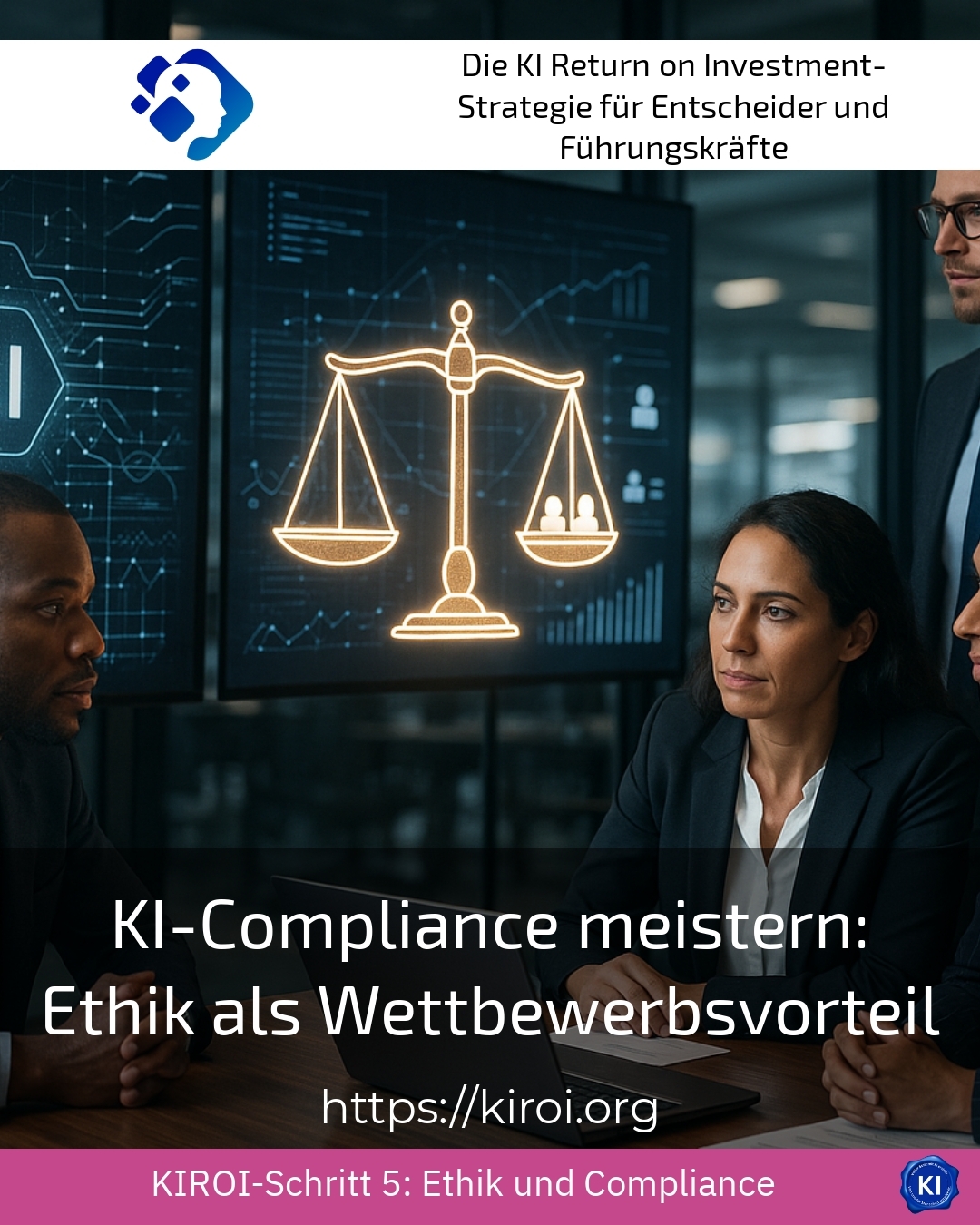
Imagine your company could not only meet legal requirements but also sustainably strengthen your customers' trust. This is precisely where the concept comes in, Mastering AI Compliance: Ethics as a Competitive Advantage to grasp and implement strategically. In a world where algorithmic decision-making systems increasingly shape our daily lives, the responsible implementation of these technologies is becoming the crucial differentiating factor. Companies that act now are positioning themselves as pioneers of a new era of digital responsibility.
Understanding and actively shaping the regulatory landscape
European legislation has made significant progress in recent years. The European Union's AI Act is setting global benchmarks for the responsible use of intelligent systems [1]. Organisations face the challenge of not only understanding these complex regulations but also implementing them in practice. It often becomes clear that companies that prioritise ethical principles early on require less adaptation. They have already proactively established structures that are now in demand.
For example, a medium-sized mechanical engineering company from Southern Germany implemented a predictive maintenance system. Transparency in data processing was ensured from the outset. Employees received comprehensive training and were involved in the process. In contrast, a car parts supplier used algorithmic quality control and documented every decision process comprehensibly. A third example concerns a logistics service provider that designed its route optimisation in such a way that driver ratings could not develop discriminatory patterns.
Best practice with a KIROI customer
An internationally operating manufacturing company approached us with a complex challenge regarding the integration of intelligent systems into their production control. Management had recognised that while the previous implementation worked technically, ethical aspects had been neglected. As part of our transruption coaching support, we first analysed all existing algorithms for potential biases and problematic decision-making patterns. It emerged that the shift scheduling system systematically disadvantaged certain employee groups, unintentionally. Together, we developed a comprehensive governance framework that combined technical, organisational, and cultural measures. The introduction of an Ethics Board with representatives from various departments created transparency and acceptance among the workforce. After six months of intensive collaboration, the company was not only able to demonstrate regulatory compliance but also record measurably higher employee satisfaction. Clients often report that this holistic approach has opened up new perspectives on their own processes.
Mastering AI Compliance: Ethics as a Competitive Advantage in Daily Business
Responsible technology use is not confined to compliance departments. Ideally, it should permeate the entire company culture and become an intrinsic part of every decision. This first requires a shift in mindset at leadership level and appropriate resource allocation. At the same time, employees must be empowered to recognise and address ethical issues. Only then can a culture be created where responsibility is lived.
A pharmaceutical company established a reporting system for algorithmic anomalies in research data analysis. An energy provider trained its customer advisors on how to handle automated tariff recommendations and their potential biases. A financial services provider set up an independent review committee for all data-driven credit decisions. These examples show that practical implementation is possible in various sectors.
Transparency as a trust anchor
Customers increasingly expect insight into how the systems that make decisions about them work. This expectation is amplified by media coverage of algorithmic misdecisions [2]. Companies that proactively create transparency build lasting trust with their target audiences. They differentiate themselves from competitors who treat algorithms as inscrutable black boxes. This transparency can take various forms.
An insurance company published detailed explanations of its algorithm-driven risk assessment. A recruitment agency explained to applicants, upon request, the factors that led to their pre-selection. A telecommunications provider offered its customers the option to have automated contract decisions reviewed manually. All of these measures significantly strengthen customer relationships.
Strategic implementation of ethical guidelines
The development and implementation of an ethical framework requires a structured approach that considers both technical and organisational dimensions, taking into account the specific circumstances of the respective company. One-size-fits-all solutions fall short here. Instead, individual concepts must be developed that fit the corporate culture.
A trading group began with a comprehensive inventory of all algorithm-based systems in use. A media company established clear responsibilities for various application areas of intelligent technologies. An industrial company linked ethical goals to its executives' remuneration structures. These different approaches illustrate the diversity of possible strategies.
Best practice with a KIROI customer
A recruitment services company sought support in ethically realigning its matching algorithms after internal analyses indicated systematic disadvantages for certain applicant groups. The company's management recognised that superficial corrections would not suffice and opted for a fundamental transformation. As part of our "transruptions" coaching support on this project, we first developed a deep understanding of the historically grown data structures and their inherent biases. Subsequently, we worked together on defining fair evaluation criteria that met both legal requirements and ethical standards. Particular emphasis was placed on involving various stakeholder groups, including applicant representatives and client companies, in the development process. This participatory approach led to a system that was not only technically more advanced but also more socially acceptable than its predecessor. The company has consequently been able to noticeably strengthen its market position and is now attracting more clients who value responsible recruitment.
Mastering AI Compliance: Ethics as a Competitive Advantage Through Employee Development
The qualification of the workforce plays a central role in the sustainable embedding of ethical technology use in daily business operations. Without the appropriate competencies, even the best guidelines remain ineffective. Training programmes must therefore impart both technical knowledge and the ability to reflect ethically.
A chemical company developed a multi-stage training programme for management and operational staff. A retail company integrated ethical case studies into its regular continuing education offerings on data-driven decision systems. A consulting firm established an internal certification process for all employees working with intelligent analytics tools. These investments pay off in the long term.
The economic dimension of responsible technology
The ethical use of technology is not merely a cost factor, but can prove to be a genuine driver of value creation. Studies show that companies with strong ethical principles often perform better [3]. Consumers are increasingly favouring brands that demonstrate responsibility. Investors consider ESG criteria in their investment decisions.
A consumer goods company was able to measurably increase customer loyalty through transparent communication of its algorithm governance. A technology provider won a significant public contract due to its exemplary ethics framework. A medium-sized company attracted highly qualified specialists who value meaningful work through its commitment to responsible technology use.
Risk mitigation through proactive action
Organisations that neglect ethical considerations expose themselves to considerable risks. Reputational damage from publicly exposed algorithm scandals can cause immense costs. Legal sanctions under new regulations hit unprepared companies particularly hard.
A financial institution had to make significant provisions after discriminatory lending practices came to light. A technology company lost major clients due to a lack of transparency in its data processing. A service provider faced a class-action lawsuit stemming from algorithm-based price discrimination. These cases illustrate the consequences of insufficient due diligence.
My KIROI Analysis
The intensive examination of responsible technology implementation clearly shows that companies are at a turning point. The approach, Mastering AI Compliance: Ethics as a Competitive Advantage utilising it has proven to be a viable strategy in our consulting practice. Clients often report initial scepticism that gives way to growing conviction. Ethical technology use is not an obstacle to innovation, but its catalyst. It builds trust with customers, employees, and business partners. It reduces regulatory risks and avoids costly retrofits. However, successful integration requires a holistic approach that considers technical, organisational, and cultural dimensions equally, which is what our transruption coaching support ensures for relevant projects. Companies that act now gain a head start that will become increasingly difficult to catch up with in the coming years. Regulatory requirements will continue to increase, as will societal expectations. Those who lay the foundations today can act confidently tomorrow, while others will have to rush to make improvements. The investment in ethical technology use is therefore an investment in the future viability of one’s own company, and it pays off in many ways – economically, in terms of reputation, and not least with regard to self-perception as a responsible player in a digitised world.
Further links from the text above:
[1] EU AI Act – Regulatory Framework for Artificial Intelligence
[2] AlgorithmWatch – Investigations into algorithmic decision-making systems
[3] World Economic Forum – AI Ethics and Governance
For more information and if you have any questions, please contact Contact us or read more blog posts on the topic Artificial intelligence here.











 Deutsch
  English (UK)