
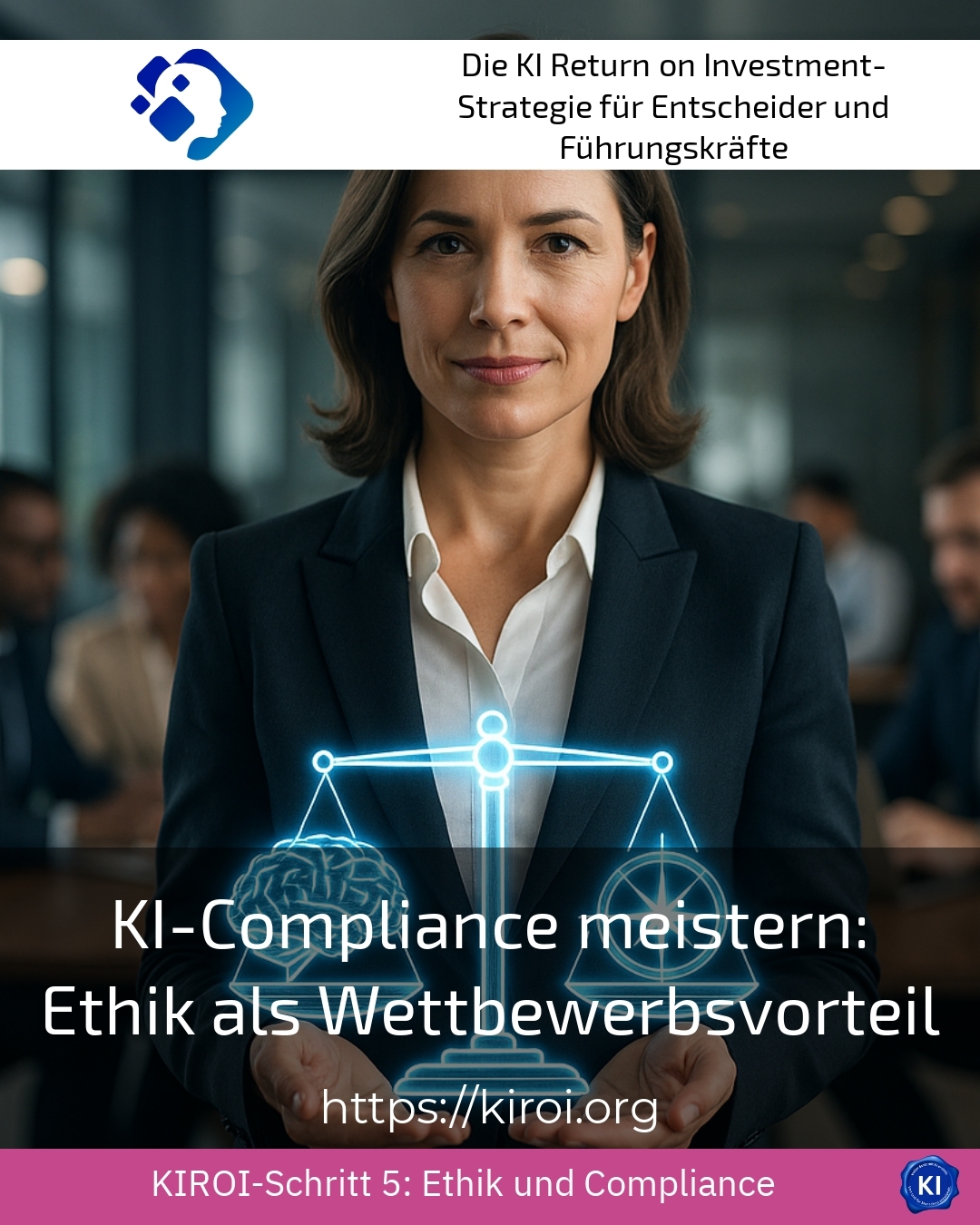
Imagine your company winning tenders not despite, but precisely because of its ethical principles. What was long considered a soft factor is today developing into a hard differentiating feature that secures market share and builds trust. Mastering AI Compliance: Ethics as a Competitive Advantage This is no longer abstract philosophy. It is a measurable strategy that innovative organisations are already successfully implementing. The regulatory landscape is changing rapidly, and those who act now are positioning themselves at the forefront of a movement that is fundamentally transforming industries.
Why responsible technology integration is crucial today
The introduction of algorithmic systems is accelerating exponentially. At the same time, demands for transparency and traceability are increasing. Companies face the challenge of combining innovation and responsibility. A logistics company optimises delivery routes and significantly reduces emissions. An insurer automates claims processing and noticeably shortens waiting times. A human resources service provider uses intelligent systems for more efficient matching. However, all these applications carry risks if ethical guardrails are missing.
European legislation is setting new benchmarks for the use of algorithmic decision-making systems [1]. Non-compliance can result in severe penalties. However, the real driver is not the fear of punishment. Rather, forward-thinking leaders recognise the potential of ethical standards. They create differentiation in saturated markets. They build trust with critical stakeholders. They proactively minimise reputational risks rather than reactively.
Let us consider an example from the financial sector. A bank employs intelligent systems for credit risk assessment. Without ethical governance, potential discrimination risks arise. With a robust framework, however, the bank demonstrably documents fair decision-making processes. Regulatory authorities appreciate this transparency. Customers trust the institution more. Investors assess risk management more positively.
Mastering AI Compliance: Ethics as a Competitive Advantage in Practice
The transformation begins with an honest look at existing processes. Where are you already using algorithmic decision support? Which data sources feed into these systems? Who is responsible for the results and their impact? These questions form the starting point for sustainable change. Clients often report feeling overwhelmed at first by the complexity. However, structured support makes the difference between stagnation and progress.
A medium-sized mechanical engineering company integrated predictive maintenance systems into its production facilities. The algorithms analysed sensor data and predicted probabilities of failure. Initially, however, a framework for transparent communication with customers was missing. Following a support process, the company developed clear guidelines. These regulated data storage, access, and deletion periods. The result convinced even sceptical major customers, who subsequently awarded more contracts.
The relevance is particularly evident in healthcare. Diagnostic support systems analyse imaging data and provide second opinions. The traceability of these recommendations is medically and legally essential. Clinics that implement robust governance structures gain the trust of patients. They proactively meet regulatory requirements. They position themselves as responsible innovators in a sensitive environment.
Best practice with a AIROI customer
An internationally operating trading group faced a complex challenge in introducing algorithmic price optimisation. The system was intended to react dynamically to market conditions and maximise profit margins. At the same time, concerns existed regarding potential discrimination against certain customer groups through personalised pricing. As part of a transruption coaching process, we guided senior management through all project phases. First, we jointly identified critical decision points in the algorithmic process. Subsequently, we developed a multi-stage audit procedure for regular reviews. The project team implemented thresholds that triggered automatic alerts for conspicuous patterns. The development of an internal ethics committee, which evaluated results quarterly, proved particularly valuable. After twelve months, the group recorded a significant increase in customer satisfaction. Complaints about unfair pricing noticeably decreased. The compliance department confirmed full adherence to all regulatory requirements. Furthermore, marketing actively used the ethical standards in customer communication. The group won several tenders explicitly due to its documented governance structures. This case impressively demonstrates how ethical standards can directly contribute to measurable business success.
Transparency as the foundation for sustainable innovation
Transparency does not mean revealing trade secrets. It means documenting decision-making logic in a comprehensible way. An automotive supplier uses intelligent quality control systems in production. These systems identify defects faster than human inspectors. Documenting the detection criteria allows for continuous improvement. Suppliers can address causes specifically. The entire value chain benefits from this openness.
In retail, companies are increasingly relying on personalised recommendation systems. These analyse purchasing behaviour and predict preferences. Customers appreciate relevant suggestions but distrust non-transparent data usage. Retailers who communicate clearly which data are used and how build trust. They sustainably reduce bounce rates and increase conversions. The investment in transparency pays off measurably.
Energy providers face similar challenges in implementing smart grids. Algorithms control load balancing and optimise energy flows. Consumers want to understand how price signals are generated. Regulators demand transparent decision-making processes. Utilities that proactively meet these requirements actively shape the energy transition. They position themselves as trusted partners in the transformation.
Strategic steps for ethical governance
The implementation of ethical governance requires a systematic approach. Initially, a comprehensive inventory of all algorithmic systems is advisable. This inventory forms the basis for risk classification. High-risk applications require more intensive monitoring than standard processes. A pharmaceutical company categorised its applications by patient relevance. Research algorithms were given different governance structures to administrative systems. This differentiation enabled resource-efficient implementation [2].
The next step involves defining clear responsibilities. Who approves the deployment of new algorithmic systems? Who monitors ongoing applications? Who responds to identified issues? A telecommunications company established a three-tier governance model. Operational teams were responsible for daily operations. A central competence centre coordinated standards. Management made strategic decisions. This structure created clarity and expedited decision-making processes.
Training and competence building complete the framework. Employees need to understand the ethical implications of their work. A media company developed a modular training programme. Editors learned to critically evaluate algorithmically curated content. Developers deepened their knowledge of bias detection. Managers received direction on strategic positioning. This investment in people pays off in the long term.
Mastering AI Compliance: Ethics as a Competitive Advantage Through Continuous Improvement
Ethical governance is not a one-off project, but an ongoing process. Technologies continue to evolve. Regulatory requirements are becoming more stringent. Societal expectations are changing. Companies must regularly review and adapt their practices. A software company established quarterly Ethics Reviews. These evaluated existing systems and planned implementations. Findings were fed into updated policies. The company consistently kept abreast of developments.
Feedback mechanisms support this continuous improvement. An insurance company established an anonymous reporting system. Employees could voice concerns about algorithmic decisions. Customers were provided with channels for inquiries about automated processes. This openness identified problems early on. It simultaneously demonstrated a commitment to responsible innovation.
External validation strengthens the credibility of internal efforts. A financial service provider had its governance structures independently certified [3]. The certificate served as a mark of quality in customer discussions. It differentiated the company from less committed competitors. The investment in external auditing generated a measurable return through secured contracts.
Best practice with a AIROI customer
A leading provider of recruitment services sought support in the ethical design of algorithmic applicant sourcing. Existing systems showed statistical anomalies with certain demographic groups. The company wanted to address these issues without losing efficiency benefits. As part of an intensive transruption coaching process, we first analysed the historical data foundations of the algorithms. This identified biases in the training data, which led to unintentional disadvantages. Together, we developed a multi-stage corrective procedure for algorithmic pre-selection. The project team implemented fairness metrics that considered various equality criteria. Particularly innovative was the introduction of regular impact assessments for different applicant groups. After the change, the diversity metrics for placed candidates improved significantly. At the same time, the placement speed remained at a high level. The company actively communicated its ethical standards to corporate clients. Several large corporations explicitly chose the service provider due to these proven fairness standards. The case study impressively demonstrates that ethical excellence and operational efficiency are compatible. Support on projects of this complexity requires specialised expertise and a structured methodology.
The future belongs to responsible innovators
The market is increasingly differentiating between companies with and without ethical governance. Investors are giving greater consideration to ESG criteria in their decisions. Talent prefers employers with a clear compass of values. Customers choose providers they trust. This trend is further intensifying. Companies that act now secure sustainable competitive advantages. Investing in ethical governance is not a cost centre; it is a strategic investment in future success.
Regulatory requirements will continue to increase. European legislation is setting global standards. Companies with established structures adapt to new requirements more quickly. They avoid costly retrofitting. They gain time for innovation instead of compliance panic. A proactive approach transforms regulatory pressure into a strategic advantage.
My AIROI Analysis
The analysis of numerous customer projects clearly shows that Mastering AI Compliance: Ethics as a Competitive Advantage is not an empty phrase, but rather a measurable reality across a wide range of industries. Companies that implement ethical governance early and systematically consistently report positive effects on customer trust, employee retention, and business results. The biggest hurdle often lies not in technical challenges, but in organisational and cultural factors that require holistic support. Many organisations initially underestimate the scope of necessary changes, but recognise the strategic value of ethical excellence in the process. Particularly successful are those companies that understand ethics not as a restriction, but as a driver of innovation, and shape their governance structures accordingly. The AIROI methodology supports breaking down complex transformations into manageable steps and involving all relevant stakeholders. However, it must be critically noted that ethical governance is not a self-starter and requires continuous attention from leadership. Companies that view compliance merely as a duty exercise do not realise the full potential and risk superficial implementations without sustainable impact. True competitive advantage only arises from the authentic integration of ethical principles into the company culture and all business processes. For organisations that want to take this path, structured support offers valuable impetus and significantly accelerates the transformation process.
Further links from the text above:
[1] EU AI Act – European Commission Digital Strategy
[2] ISO/IEC 42001 – Artificial Intelligence Management System
[3] TÜV IT – Certification for AI Systems
For more information and if you have any questions, please contact Contact us or read more blog posts on the topic Artificial intelligence here.







 Deutsch
  English (UK)