
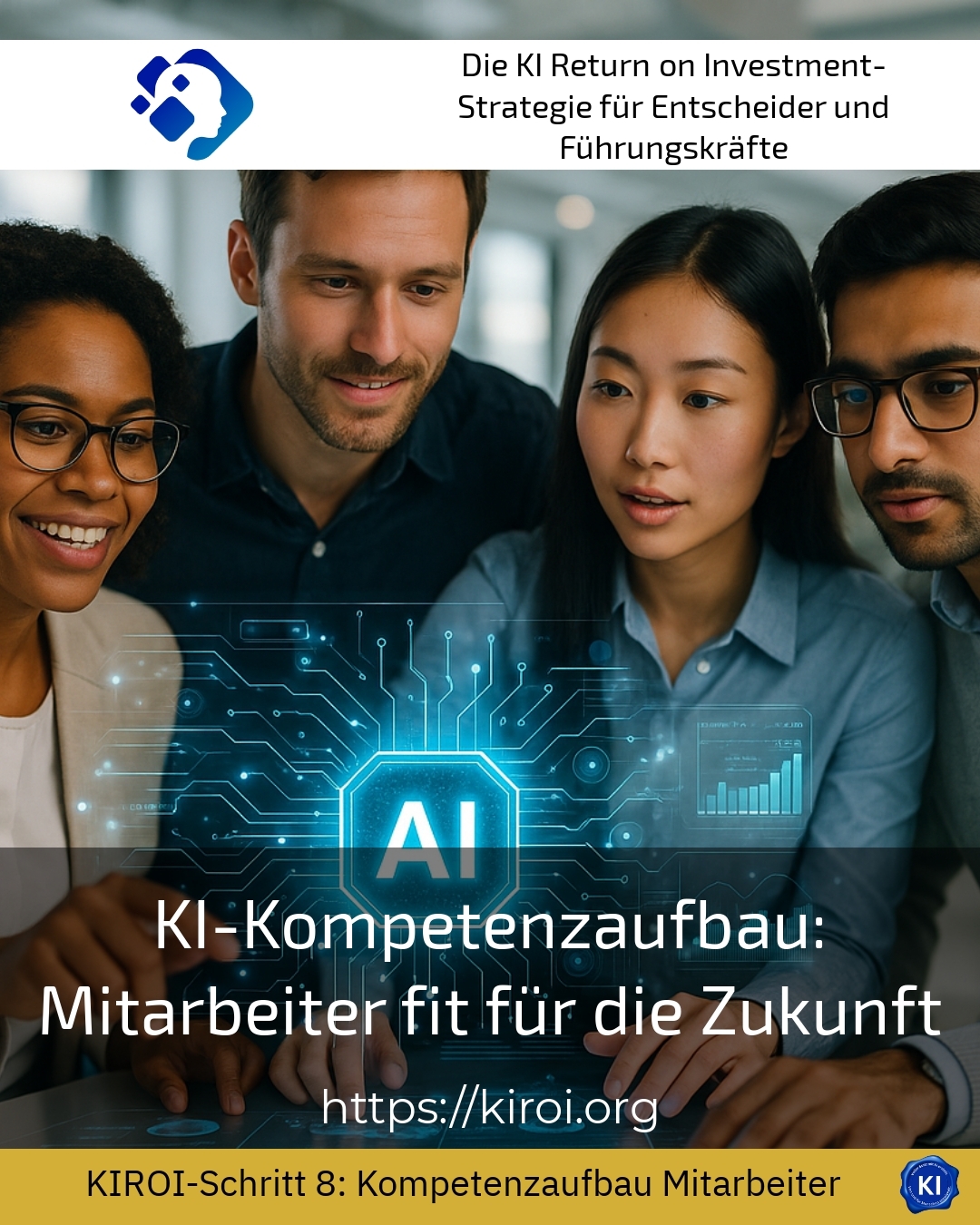
The digital transformation is changing our working world at a breathtaking pace. Companies are faced with the challenge of preparing their teams for entirely new demands. The AI skills development: making employees fit for the future This is developing into a central strategic task. Those who do not invest in the qualification of their workforce today risk losing their competitive edge tomorrow. But how can people be inspired by technological change and, at the same time, empowered to actively shape it?
Why systematic AI skills development has become indispensable
The integration of intelligent systems into operational processes is progressing unstoppably. Companies are increasingly recognising that technological investments alone are not enough. Rather, the qualifications of people determine the success of digital initiatives. Studies show that organisations with well-trained teams achieve significantly higher implementation success [1]. This realisation is gaining traction across industries and is fundamentally changing personnel development.
In healthcare, for example, intelligent diagnostic systems are already supporting medical decision-making today. Nursing staff are working with automated documentation solutions. And in administration, smart algorithms are optimising hospital resource planning. However, all these applications require specific knowledge and new skills from employees.
It's similar in the financial sector, where algorithms carry out risk assessments and detect fraud patterns. Customer advisors need to understand how these systems arrive at their recommendations. Only then can they competently interpret the results and explain them to their customers. Humans remain the decisive factor for trust and customer loyalty.
Shaping AI Competency Building in the Manufacturing Industry
The manufacturing industry is currently experiencing a fundamental shift in its work processes. Predictive maintenance, meaning the forecasting of machine maintenance, is revolutionising the upkeep of entire production facilities. Machine operators now require knowledge of sensor data analysis and pattern recognition. At the same time, they must continue to be able to apply and refine their manual skills.
In quality control, imaging systems are increasingly taking over error detection. Employees are transforming from hands-on inspectors to supervising experts. They validate the results of automated checks and intervene when there are ambiguities. This shift requires a profound understanding of the underlying technologies and their limitations.
Similar developments with far-reaching consequences are also emerging in logistics. Autonomous transport systems navigate through warehouses and optimise supply chains independently. Dispatchers control these systems at a higher level and make strategic decisions. Their role is evolving from operational coordinator to analytical process manager.
Best practice with a AIROI customer
A medium-sized mechanical engineering company from Southern Germany faced the challenge of inspiring its experienced workforce to adopt new technologies. The average age of its skilled workers was over 50, and initial scepticism towards automated systems was palpable. Together with transruptions coaching, we developed a multi-stage qualification programme that valued the expertise of its long-standing employees while simultaneously building new skills. First, we identified so-called technology ambassadors within the teams, who were to act as multipliers. These individuals received intensive training and were subsequently able to pass on their knowledge to colleagues. The approach of using the existing process expertise of experienced employees as the basis for system development proved to be particularly effective. This made people feel like active participants rather than passive recipients of change. After six months, team members frequently reported significantly increased confidence in using the new tools. The productivity of the affected departments increased measurably, while the error rate noticeably decreased.
Develop and implement structured learning paths
Successful qualification measures follow a well-thought-out didactic concept. They take into account different learning types and prior knowledge within the workforce. Furthermore, they should be closely linked to actual job tasks and offer practical application possibilities. Learning from concrete use cases is more motivating than abstract theory.
For example, in retail, sales assistants can experiment with recommendation systems and observe their effects directly. They learn how algorithms analyse customer preferences and suggest suitable products. This understanding empowers them to complement the technical recommendations with their personal advisory skills. This creates added value for both customers and companies.
Intelligent systems are also fundamentally and sustainably changing established processes in human resources. Recruiting tools analyse application documents and suggest suitable candidates. HR developers use data analysis to identify qualification needs within the organisation. And managers receive support for team composition and project planning from analytical tools.
Making employees fit for the future through practical orientation
Theoretical knowledge alone is not enough to empower people sustainably. Instead, protected spaces are needed for experimenting and learning from mistakes. So-called learning labs or innovation hubs increasingly offer this possibility. There, employees can try out new technologies without the fear of negative consequences.
For example, an energy supply company set up a digital workshop for its technicians. There, they simulated various grid control scenarios with intelligent forecasting systems. The participants developed an intuitive understanding of the possibilities and limitations of automated decision support systems. They subsequently transferred this practical knowledge to their daily work.
In customer service, the importance of practical exercises is particularly evident and impressive. Service staff are increasingly working with chatbots and virtual assistants. They need to learn when human intervention becomes necessary and how to manage handovers. Role-playing and simulations help to develop and refine this competence.
New job roles are also emerging in marketing and sales due to technological change. Campaign managers use predictive analytics for target group engagement and budget optimisation. Sales representatives receive lead scoring information and must be able to interpret it. The combination of data literacy and interpersonal skills is becoming the decisive success factor in customer contact.
Best practice with a AIROI customer
A large insurance company commissioned us to support their comprehensive claims management transformation project. The introduction of an intelligent claims assessment system was intended to shorten processing times and increase customer satisfaction. However, many experienced claims handlers feared their years of expertise could be devalued. As part of the transruption coaching, we developed a workshop approach that addressed these concerns and turned them into something constructive. We demonstrated that the system actually required the expertise of experienced employees as a training basis. The claims handlers became active trainers of the algorithmic system and defined assessment criteria. This participatory approach transformed scepticism into engagement and a willingness to co-create. The employees realised that their roles were changing, but by no means losing their importance. They became guardians of quality and expert specialists for complex cases that the system could not handle. After the project was completed, participants often reported increased job satisfaction and new development opportunities.
Establishing leaders as drivers of AI competency building
The role of leaders in transformation processes can hardly be overestimated [2]. They significantly shape the learning culture in their teams through their own behaviour. When superiors themselves demonstrate curiosity and a willingness to learn, employees follow this example. Conversely, disinterest or rejection can cause entire training initiatives to fail.
This is particularly evident in the construction industry with the introduction of BIM systems. Site managers who actively engage with the new technology inspire their teams to participate. They create space for learning phases and tolerate initial productivity losses during the training period. This attitude signals that competence development is understood as a strategic investment.
In the healthcare sector, leaders face additional challenges in adopting technology. They must convincingly communicate the balancing act between gaining efficiency and patient welfare. Doctors and nurses need reassurance that technology supports their work, rather than replacing it. Communicating this message credibly requires genuine understanding and authentic conviction from those in leadership positions.
Managers also play a key role in digitalisation within public administration. They often have to question traditional structures and establish new ways of working. At the same time, the specific requirements for data protection and transparency must be taken into account. This balance requires both technical understanding and strong change management skills from those responsible.
Creating sustainable learning ecosystems for continuous development
One-off training measures are no longer sufficient given the pace of innovation. Instead, companies need structures that enable and promote continuous learning [3]. Digital learning platforms, peer learning groups, and regular knowledge-sharing formats form the foundation of such ecosystems. They embed competency development as a natural part of the everyday working routine.
In retail, companies are experimenting with microlearning approaches for their sales teams on the shop floor. Short learning units of just a few minutes are completed during quieter periods of business. The content is tailored to current challenges such as new product launches or system updates. This keeps learning relevant and immediately applicable to day-to-day work.
Technology companies are increasingly relying on Communities of Practice for internal knowledge sharing. In these groups, employees from different departments exchange experiences with new tools. Best practices spread organically throughout the company, fostering a culture of mutual learning. These informal structures effectively and sustainably complement formal training programmes.
Hybrid learning formats, combining in-person and online elements, are emerging in the media industry. Editors are introduced to automated text generation tools in guided workshops. They then deepen their knowledge through online modules and practical project work in their daily roles. This integration of different formats significantly increases the transfer of learning.
Employees fit for the future with individual development paths
Not every employee requires the same competencies, to the same depth and breadth. Effective qualification strategies take into account different roles and development goals within the organisation. A sales representative needs different knowledge than a production manager or a controller. Individual learning paths enable targeted competency development without wasting resources on unnecessary content.
In the banking sector, for example, the requirements for different professional groups vary considerably. Private banking advisors need a fundamental understanding of algorithmic investment recommendations for affluent clients. Risk managers, on the other hand, must be able to delve deeply into the workings of credit risk models. And compliance experts focus on the regulatory aspects of automated decision-making processes in the financial sector.
The need for differentiated qualification approaches is also very apparent in the pharmaceutical industry. Researchers in drug development work with highly specialised analytical tools in the laboratory. Sales representatives, on the other hand, use CRM systems with intelligent visit planning functions in the field. Qualification programmes must be able to precisely address and cater to these different needs.
My AIROI Analysis
The systematic development of technological competencies within companies is no longer an optional task. It has become a strategic imperative that determines competitiveness and future viability. My experience from numerous support projects shows that success depends significantly on three factors: firstly, a clear vision from company leadership, secondly, the active involvement of affected employees, and thirdly, sufficient resources for sustainable training measures.
Clients often report initial resistance that, with the right approach, transforms into engagement. The key lies in viewing people as active shapers of change, rather than passive objects. Transruption coaching provides impetus for participatory approaches that help put this fundamental attitude into practice. We support organisations in connecting their unique strengths with new opportunities.
The coming years will show which companies can successfully master the upskilling challenge. Those that invest boldly today and take their people along will emerge strengthened from the transformation. I am convinced that human competence will remain indispensable even in an increasingly automated world of work. However, the nature of this competence is fundamentally changing, and it is essential to prepare people for this in the best possible way.
Further links from the text above:
[1] McKinsey: AI adoption advances, but foundational barriers remain
[2] Harvard Business Review: Insights on Leadership
[3] World Economic Forum: Future of Work
For more information and if you have any questions, please contact Contact us or read more blog posts on the topic Artificial intelligence here.






 Deutsch
  English (UK)