
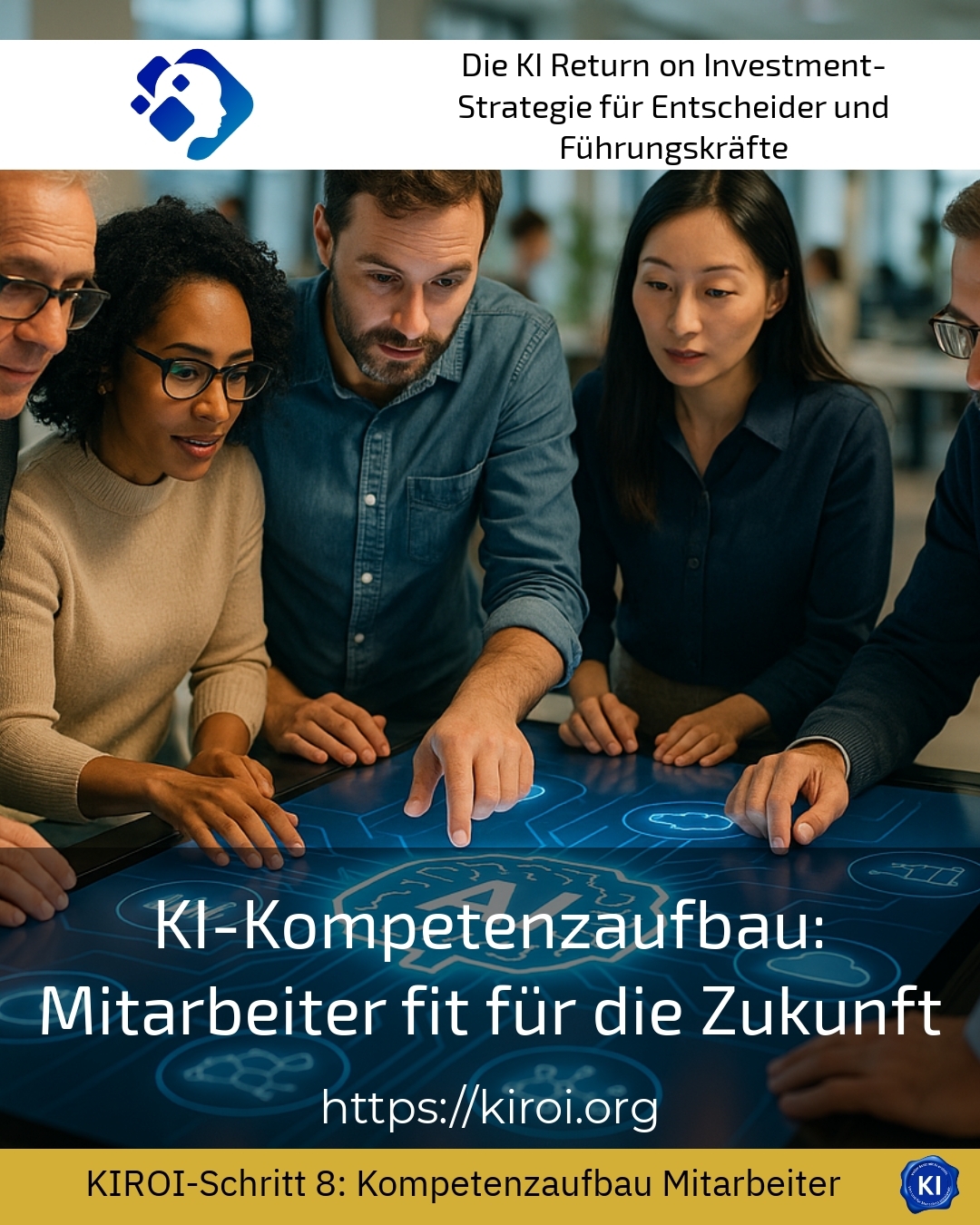
The digital transformation is changing companies at a breathtaking pace. Many leaders are faced with a crucial question. How do they prepare their teams to collaborate with intelligent systems? The AI skills development: making employees fit for the future is developing into a strategic success factor. Those who invest now secure long-term competitive advantages. However, the path to this requires well-thought-out concepts and professional support.
Why AI skills development: indispensable for making employees fit for the future
Intelligent technologies now permeate almost every area of business. They analyse customer data, optimise production processes, and support complex decision-making. At the same time, uncertainty is noticeably growing in many workforces. Employees are wondering what roles they will play in the future. These concerns deserve serious attention and proactive solutions. Companies benefit when they involve their teams early on. Transparent communication builds trust and reduces resistance [1].
Clients frequently report similar challenges within their organisations. Management recognises the potential of new technologies. However, a structured plan for upskilling is often lacking. Some teams react with reluctance to change initiatives. Others, conversely, show great enthusiasm but require concrete guidance. Transruption coaching offers valuable support for such projects. It helps companies to create individual development paths.
Typical starting situations in practice
A medium-sized manufacturing company wants to automate its quality control. The long-serving skilled workers possess enormous expert knowledge. Now they are to learn to work with image recognition systems. A trading company plans to introduce intelligent inventory forecasting. The purchasing staff need to understand how algorithm-based recommendations are generated. A service company is relying on automated customer query processing. Service employees will in future take on more complex consulting tasks. All these scenarios require targeted skills development [2].
Best practice with a AIROI customer
A family-run company with a long tradition in the manufacturing sector was facing a significant transformation. Management had decided to introduce intelligent predictive maintenance for its machinery. However, the experienced maintenance technicians were initially sceptical of this innovation, fearing that their decades of expertise might lose its significance. Transruption coaching accompanied the company through this change process over several months. Together, we developed a training concept that valued the employees' expertise. The technicians learned how to integrate their accumulated knowledge into the systems and understood that the technology complemented, rather than replaced, their work. Following implementation, unplanned downtime decreased by a considerable percentage. At the same time, job satisfaction within the team measurably increased. The employees felt like active participants in shaping the change.
Strategic approaches for sustainable skills development
Successfully building new skills requires a thoughtful approach. One-off training sessions are rarely sufficient. Instead, continuous learning processes and regular reflection are needed. Companies should first analyse the current knowledge level of their workforce. Based on this, tailored development programmes can be designed. Involving employees in this process promotes their engagement [3].
AI skills development: Making employees future-ready through practical application
Theoretical knowledge alone is not enough for sustainable change. People need opportunities for practical experimentation. Pilot projects offer a protected framework for this. A logistics company, for example, could initially equip one branch with intelligent route planning. The dispatchers there gain valuable experience. This knowledge can then be incorporated into a company-wide rollout. A financial service provider could test automated document analysis in one department first. The clerks learn to evaluate the system's suggestions. Gradually, other departments would then adopt the new working methods.
The support of experienced coaches can significantly aid this process. They help to identify and constructively resolve resistance. At the same time, they identify employees who can act as internal multipliers. These key individuals drive change from within the team. Transruption coaching places great importance on these participatory approaches.
Leaders as enablers of change
Managers bear a special responsibility in.
Clients often report that this is precisely where uncertainties lie. Some leaders feel overwhelmed by the pace of change. Others underestimate the training needs of their employees. Still others delegate the issue entirely to the HR department. These different starting points require individually tailored interventions.
Best practice with a AIROI customer
An insurance company wanted to introduce intelligent systems for claims processing. However, middle management was hesitant about this project. Many team leaders feared losing control over their areas. As part of the coaching support, we initially organised workshops for this target group. The managers explored the technology in a safe environment. They developed their own ideas on how the systems could support their teams. This change in perspective fundamentally altered the attitude of many participants. They realised that the technology would give them more time for staff management. The team leaders became active advocates for change. They authentically communicated the benefits to their employees. The subsequent rollout went much more smoothly than initially expected. Acceptance among the workforce steadily increased.
Learning formats and methods for different target groups
Not all employees learn effectively in the same way. Intergenerational teams require flexible training approaches. Younger employees often prefer digital learning formats and short modules. Experienced professionals, on the other hand, value personal exchanges in face-to-face workshops. Practical exercises at one's own workplace particularly promote learning transfer.
A retail company could combine different formats. Online tutorials provide foundational knowledge on intelligent recommendation systems. In-person workshops facilitate knowledge exchange between store teams. Coaching sessions support individual employees with specific challenges. Peer learning groups promote continuous learning in daily work. This variety of methods increases the likelihood of sustainable skills development [5].
Integration into existing personnel development structures
The qualification for new technologies should not be considered in isolation. Rather, it can be meaningfully integrated into existing development programmes. A company could adapt its junior management programme accordingly. Technological understanding would then become a prerequisite for further career steps. The annual employee appraisals can include corresponding development goals. The onboarding processes for new employees also deserve attention.
A healthcare provider has integrated this topic into its advanced specialist training programmes. Nurses there learn to use assistive documentation systems. Medical assistants are familiarised with intelligent scheduling tools. Administrative staff practice using automated billing checks. This integration ensures sustainability and a natural approach in handling these matters.
Recognising and constructively overcoming challenges
The path to a skilled workforce is rarely straightforward. Setbacks and resistance are part of the change process. Some employees need more time than others. Some may develop fears of job loss. Others, in turn, underestimate the changes in their field of activity. These different reactions require differentiated responses.
Transruption coaching supports companies in mastering such situations. We guide teams through difficult phases of reorientation. We rely on appreciative communication and solution-oriented approaches. We take employees' concerns seriously and address them openly. At the same time, we convey a realistic perspective on developments.
Best practice with a AIROI customer
A media company introduced intelligent text-generation tools into its newsroom. The journalists' reactions varied considerably. Some immediately recognised the potential for their daily work. Others felt the technology was a threat to their journalistic identity. In the coaching process, we created spaces for these different perspectives. We facilitated discussions about quality standards and ethical principles. The editors jointly developed guidelines for responsible use. They defined which tasks the technology could take on. At the same time, they identified areas that should remain reserved for human creativity. This participatory process significantly strengthened team cohesion. Initial scepticism transformed into a constructive willingness to shape things. Today, the newsroom uses the tools confidently and reflectively.
AI competence building: Making employees fit for the future as a continuous process
Technological development is advancing relentlessly. What is considered innovative today can already be standard tomorrow. Therefore, competence development must be understood as an ongoing process. Companies should create structures that enable continuous learning. Learning organisations adapt more quickly to changing conditions.
A mechanical engineering company established regular technology updates for all departments. Internally, experts provide information on relevant developments on a quarterly basis. An energy provider set up a learning platform with curated content. Employees can expand their knowledge there in a self-directed manner. A consulting firm introduced innovation workshops as a regular fixture. Teams collaboratively explore new possibilities for their projects there [6].
My AIROI Analysis
The experience from numerous support projects shows clear patterns of success. Companies that involve their employees early and transparently achieve better results. The combination of technical qualification and emotional support proves to be particularly effective. Managers play a key role in shaping these change processes. Their own skills development therefore deserves special attention throughout the entire programme.
At the same time, we observe that standardised training programmes often fall short. Every organisation brings its own culture and history. These individual factors must be considered during the design phase. Transruption coaching offers tailor-made support for different starting situations. We first analyse the specific needs and conditions. Building on this, we develop precisely fitting interventions together with our clients.
Investing in employee development pays off in the long term. Competent teams implement new technologies faster and more effectively. They develop innovative application ideas from their specialised expertise. Employer attractiveness increases noticeably through future-oriented development opportunities. Qualified specialists value companies that invest in their further training. All these factors contribute to sustainable competitiveness.
Further links from the text above:
[1] McKinsey – The State of AI
[2] World Economic Forum – Future of Jobs Report
[3] Harvard Business Review – Artificial Intelligence
[4] Gartner – AI in Human Resources
[5] LinkedIn Learning – Cursuri de inteligență artificială
[6] MIT – Artificial Intelligence Research
For more information and if you have any questions, please contact Contact us or read more blog posts on the topic Artificial intelligence here.







 Deutsch
  English (UK)