
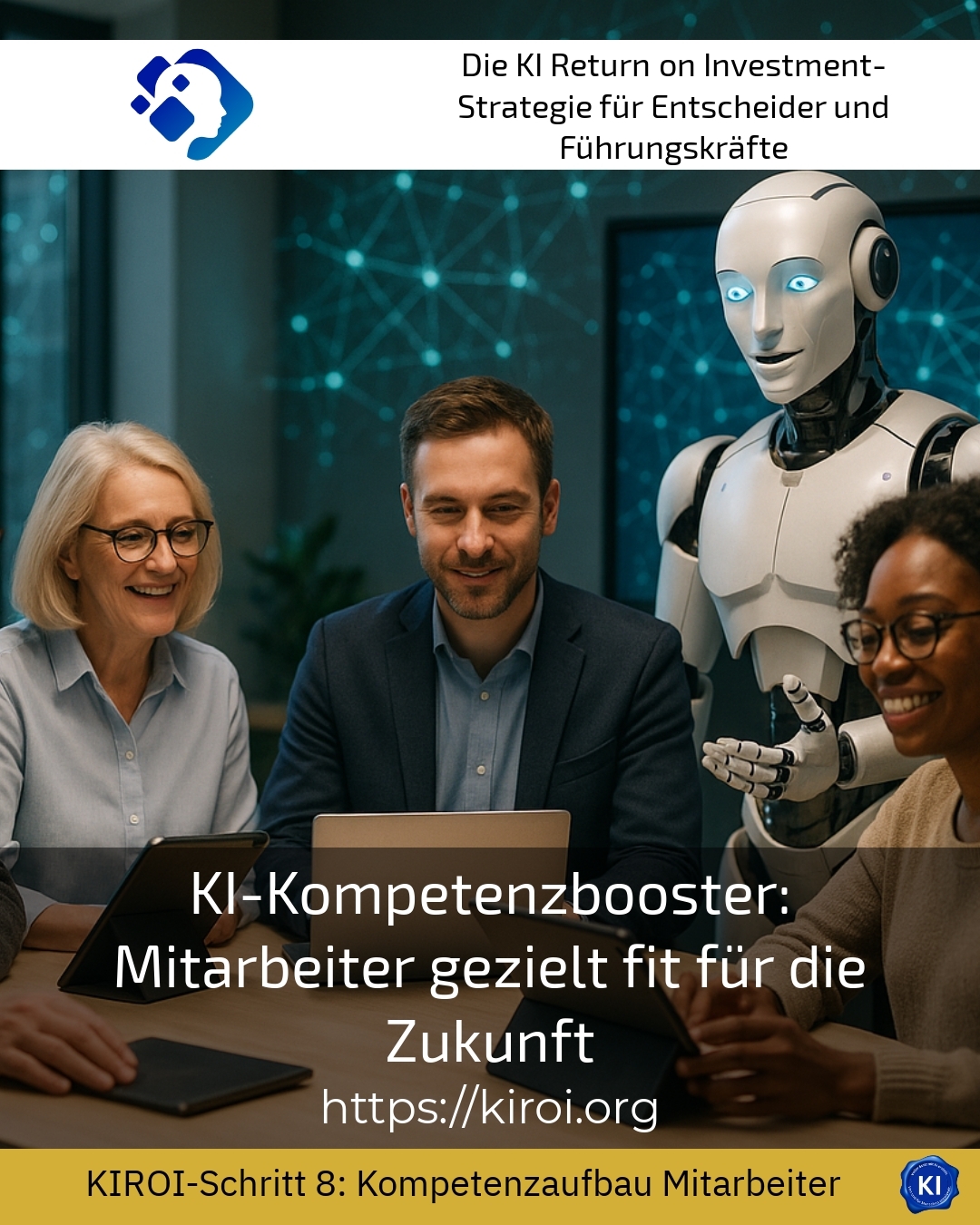
Imagine your entire workforce mastering the tools of the future within a few months. AI skills booster: targeted employee training for the future makes exactly that possible. In a rapidly changing world, the qualifications of your teams decide between success and failure. Companies are faced with the challenge not only of bringing their employees along but also of actively empowering them. Those who invest today will reap competitive advantages tomorrow. But how can this transformation really succeed? Which approaches have proven themselves and what pitfalls lie in wait? This article provides you with concrete answers and practical impulses.
Why the AI Skills Booster Has Become Indispensable
Technological development has achieved unprecedented momentum in recent years. Automated processes, intelligent assistance systems, and data-driven decision-making are increasingly shaping everyday work. Companies that do not continuously train their employees risk falling behind. The necessity of specifically preparing teams for upcoming requirements is therefore no longer an option. Rather, it is a strategic matter of survival in a changing market environment [1].
In the Manufacturing industry This development is particularly evident. Production lines are increasingly networked and require entirely new skills. A machine operator today must not only understand the physical plant. They must also be able to interpret digital dashboards and interact with intelligent systems. The same applies to Healthcare, where diagnostic support systems are increasingly used. Nurses and doctors therefore need a basic understanding of these technologies. In Financial sector Algorithms-based systems analyse risks and market movements in real time. Consultants must understand these analyses and be able to explain them comprehensibly to their clients.
The AI Competence Booster as a Strategic Tool for Personnel Development
A sustainable qualification strategy requires more than isolated training measures. It's about a holistic approach that combines different learning formats. Both formal training and informal learning opportunities play an important role. The transruption coaching approach supports companies in successfully shaping these complex change processes. Clients often report that the desired results could only be achieved through structured support.
I'm Retail For example, leading companies are implementing multi-stage qualification programmes. Sales staff first learn the basics of data-driven customer analysis. In a second step, they work with recommendation systems that generate individual product suggestions. Finally, they train to handle customer enquiries about these technologies with confidence. Logistics industry pursues a similar approach to introducing intelligent route planning. Dispatchers must understand how the algorithms make decisions and when human intervention is appropriate. In the Insurance industry Once again, it is about enabling case workers to handle automated damage analyses.
Best practice with a AIROI customer
A medium-sized mechanical engineering company faced the challenge of training its entire workforce to handle intelligent production systems within eighteen months. The company employed around four hundred members of staff across three locations in Germany and Austria. Initially, we conducted a comprehensive skills analysis to determine the individual training needs of each team member. This revealed that existing qualification levels varied greatly, and a uniform training approach would not have been effective. Together, we then developed a modular learning concept with three different entry levels. Managers received additional coaching to actively support their teams during the transformation. The establishment of learning partnerships, where experienced employees shared their knowledge with colleagues, was particularly important. This peer-learning component proved to be one of the crucial success factors of the entire project. After completion of the first phase, over eighty percent of participants reported a significantly increased confidence in handling the new systems. The productivity of the affected departments demonstrably increased, and the error rate decreased significantly. Management now plans to extend the concept to other areas of the company.
Individual learning paths as the key to success
Humans learn in different ways and at different speeds. An effective AI Skills Booster This systematically takes individual differences into account. Some employees prefer structured in-person training with direct interaction. Others prefer self-directed learning with digital media and at their own pace. Combining different formats has been proven to increase learning effectiveness and boost participant motivation [2].
I'm Banking so-called learning sprints, which combine intensive short-term formats with longer in-depth phases, have proven effective. Client advisors first complete a compact foundational training on algorithmic investment recommendations. They then apply what they have learned directly in their daily advisory practice. Regular reflection sessions with coaches help to address uncertainties and identify potential for improvement. In the Pharmaceutical industry Companies are increasingly relying on simulation environments for research staff. Scientists can experiment safely with data-driven analysis tools there and expand their skills. The Energy sector Once again, virtual reality applications are used to train technicians for the maintenance of smart grid infrastructures.
Leaders as key enablers of transformation
The success of any qualification initiative depends significantly on support from senior management. Managers and team leaders must not only possess the relevant skills themselves, but also be capable of guiding and motivating their employees on their learning journey. Transruption Coaching supports managers in effectively fulfilling this demanding role. Many clients report that this very guidance was crucial for sustainable project success.
In the Telecommunications sector A leading provider trained its entire management team beforehand. The managers first learned to use intelligent customer service systems themselves. Only then did the training for the call centre employees begin. This approach created trust and enabled authentic support from direct supervisors. In Automotive sector A manufacturer established so-called Transformation Champions at every level of the hierarchy. These specially trained employees act as contact persons for questions and uncertainties from their colleagues. Food industry increasingly relies on cross-functional learning groups in which managers and team members acquire new skills together.
Best practice with a AIROI customer
An internationally operating trading company with over two thousand employees worldwide faced the challenge of qualifying its purchasing departments to handle predictive procurement systems. The particular challenge lay in the cultural diversity of the teams involved at locations in Europe, Asia, and North America. Together with the company, we developed a culturally adapted training concept that took local specificities into account while still ensuring uniform quality standards. In Germany, we focused on detailed technical explanations and structured learning materials. For the Asian locations, we developed group-oriented formats with a stronger focus on practical application. The North American teams received additional case-study-based modules that highlighted the immediate business benefit. Regular virtual exchange rounds between locations promoted knowledge transfer across geographical boundaries. Management received special coaching on virtual team leadership during change processes. After twelve months, the company had reduced its procurement costs by seven percent and significantly improved supplier relationships. Employee satisfaction in the affected departments rose measurably, which was attributed to the appreciative guidance throughout the entire process.
Equipping employees specifically for the future through continuous learning
Technological development is progressing inexorably and therefore requires continuous adaptation. One-off training sessions are insufficient to remain competitive in the long term. Successful companies establish a culture of lifelong learning, which becomes an integral part of everyday work. Modern learning platforms, which provide individualised recommendations and make learning progress transparent, support this [3].
I'm Press area leading publishing houses have established internal academies that continuously provide new learning opportunities. Journalists and editors can take courses there on automated text analysis and data-driven research. Construction industry is increasingly using digital twins for the planning and monitoring of complex projects. Engineers and project managers therefore require regular updates of their digital skills. In the Chemical industry Laboratory staff work alongside intelligent analytical devices whose functionality is constantly evolving.
Typical challenges and best practice solutions
Certain obstacles regularly arise when implementing qualification programmes. Many employees initially express scepticism towards new technologies and fear negative impacts on their jobs. Others feel overwhelmed by the complexity of the new systems and doubt their ability to learn. Still others complain about a lack of time for further training activities alongside their regular duties. Clients often come to us with precisely these issues, seeking effective solutions.
I'm Hospitality industry A large hotel company countered the scepticism of its service staff through transparent communication. Management openly explained that intelligent systems were intended to complement, not replace, human hospitality. Staff were actively involved in the design of new processes and were able to voice their concerns. In the Aerospace industry Addressing fears of being overwhelmed, an aircraft manufacturer introduced very small, step-by-step learning modules. Each unit lasted a maximum of fifteen minutes and built directly on the previous one. The Textile industry solved the time problem by integrating learning units into existing workflows. Employees could access mobile learning content during short production breaks.
Measurable success and sustainable impact
The effectiveness of training measures must be continuously reviewed and documented. Only in this way can investments be justified and programmes specifically developed further. Successful companies define clear key figures in advance and systematically collect these before and after training. This is not only about formal learning achievements, but above all about practical application in everyday work.
I'm Healthcare A clinic chain documented the improvement in diagnostic quality after the introduction of intelligent support systems. In parallel, the increases in competence of doctors and nursing staff were recorded and both developments were correlated. The Transport industry measures the efficiency improvements in dispatch and attributes them to specific training measures. In the Real estate industry Customer satisfaction ratings are compared before and after brokers are qualified for digital valuation tools.
My AIROI Analysis
The systematic qualification of employees to work with intelligent technologies represents one of the most important strategic tasks for the coming years. Companies that proactively address this challenge will be able to sustainably strengthen their competitive position. It repeatedly becomes clear that technical training alone is not sufficient. The human factor, particularly addressing fears, uncertainties, and resistance, requires just as much attention as imparting technical expertise.
The AIROI methodology has proven to be an effective framework for such transformation processes in numerous projects. It combines strategic planning with pragmatic implementation support, taking into account the specific circumstances of each organisation. The realisation that qualification should not be a one-off event seems particularly important to me. Rather, companies must create permanent structures that enable and promote continuous learning. The investment in employees pays off multiple times, as qualified and confident teams are more productive, innovative, and loyal to their employer. Those who set the right course today will benefit tomorrow from a competent and motivated workforce that understands technological change not as a threat, but as an opportunity.
Further links from the text above:
[1] McKinsey – The State of Organisations
[2] PwC Germany – Artificial Intelligence
[3] Bitkom – Artificial Intelligence
For more information and if you have any questions, please contact Contact us or read more blog posts on the topic Artificial intelligence here.







 Deutsch
  English (UK)