
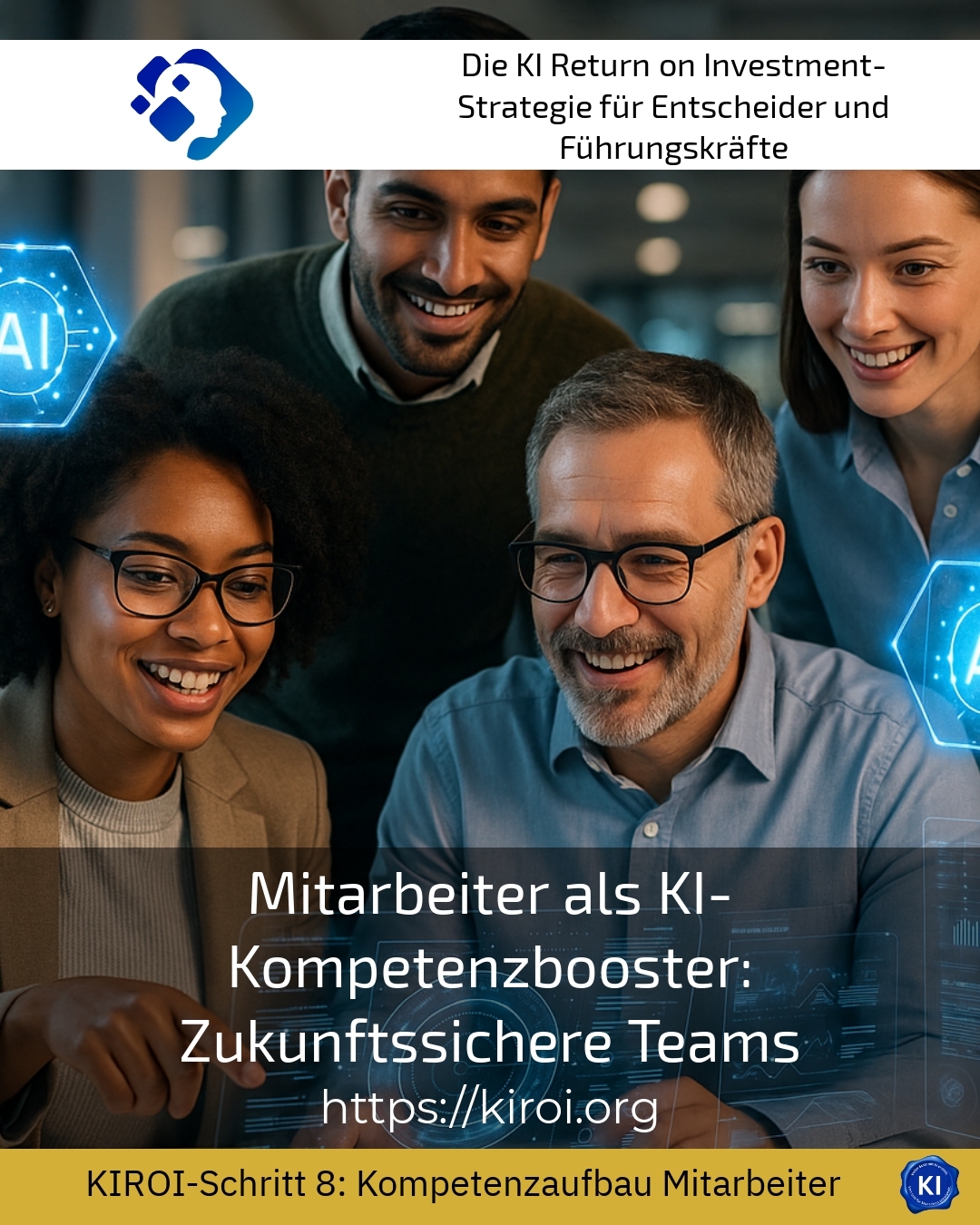
The digital transformation is changing our world of work at a breathtaking pace. Companies are faced with the challenge of making their workforce fit for the future. This plays Employees as AI Competence Boosters A crucial role. Those who invest in the further training of their teams today secure their competitive advantage tomorrow. The following insights show how future-proof teams can be created.
Why employees are becoming indispensable as AI competence boosters
The business world is currently undergoing a fundamental shift. Automated systems are taking over repetitive tasks. Simultaneously, entirely new job profiles are emerging. Companies frequently report difficulties in integrating new technologies. This is where the potential of their own workforce comes into play. People who already know the company can build bridges. They understand internal processes and can introduce new tools precisely where they are needed. Therefore, internal competencies are becoming increasingly valuable. For instance, a manufacturing company in mechanical engineering recently trained its skilled workers in predictive maintenance. The employees learned to interpret sensor data and predict failures. A medium-sized logistics service provider established internal learning groups for route optimisation. Warehouse professionals jointly developed new analysis methods with the IT department. In turn, a financial services provider retrained its customer advisors as data specialists. These examples clearly demonstrate the added value of internal competence development.
The role of internal expertise in technological change
External consultants, while bringing fresh perspectives, often lack a deep understanding of established structures. Employees, on the other hand, are familiar with informal communication channels and know what resistance to expect during changes. Therefore, their involvement significantly supports the transformation process. An automotive supplier leveraged the knowledge of its quality inspectors for automated image analysis. The specialists themselves defined the relevant defect characteristics. A pharmaceutical company relied on its laboratory assistants as process optimisers, who identified potential for intelligent documentation. An energy provider involved its technicians in the development of maintenance algorithms. The results significantly exceeded expectations [1].
Best practice with a KIROI customer
A family-run business with a long tradition in the manufacturing sector faced a unique challenge. Management wanted to introduce modern analytical tools, but the workforce was initially hesitant. We accompanied the project over several months as part of a transruption coaching process. Initially, we jointly identified the most motivated team members from various departments. These pioneers received intensive training and were developed into internal multipliers. They took on the task of gradually familiarising their colleagues with the new tools. The key success factor lay in the combination of technical expertise and social competence. The multipliers spoke the language of their teams and were able to take their concerns seriously. Within six months, the acceptance rate rose from an initial thirty percent to over eighty percent. Productivity in the affected areas improved noticeably. Particularly remarkable was the independent further development by the teams. They suggested adjustments that external experts might have overlooked.
Future-proof teams through systematic skills development
Developing future-proof teams requires a structured approach. Sporadic training rarely suffices to bring about sustainable changes. Instead, continuous learning processes and a supportive corporate culture are needed. A retail company established weekly experimentation spaces for its purchasing department. Employees tested new forecasting models there in a protected environment. A construction company set up digital learning stations on its construction sites. Foremen could playfully explore planning tools there. A healthcare provider introduced tandem learning between junior and experienced nursing staff. Knowledge exchange occurred in both directions and enriched everyone involved.
Employees as AI competence boosters in various company areas
The potential applications span all functional areas of a company. In sales, employees can learn to better predict customer needs. The HR department benefits from automated pre-selection processes for applications. Accounting uses intelligent systems for document capture and account assignment. A media company trained its editors in the use of research tools. This enabled the journalists to conduct deeper analysis. An insurance group further trained its claims handlers to become fraud specialists. They developed a keen eye for suspicious patterns [2]. A tourism group invested in the further training of its travel consultants. These learned to create personalised recommendations based on data.
However, the transformation only succeeds with the right support. Clients often report uncertainties during implementation. Transruption coaching offers valuable impetus for this and supports teams in navigating change processes. The coaching helps to understand and constructively address resistance.
Practical approaches to competence development
Successful companies rely on diverse learning formats. Traditional in-person training is supplemented by online modules and self-study units. Project-based learning, where real-world problem scenarios are addressed, proves particularly effective. A food manufacturer had its product developers optimise their own recipes using analytical tools. Motivation increased significantly because the results were directly visible. A textile company established innovation circles where seamstresses co-designed quality control systems. The employees' expertise flowed directly into the system development. A printing company further trained its machine operators to become process analysts. They identified optimisation potential that had remained undiscovered for years.
Best practice with a KIROI customer
An internationally active service provider approached us with a specific request. Management felt growing pressure from digital competitors, and at the same time, there was uncertainty about which skills would be needed in the future. As part of transruption coaching, we jointly developed a skills map for the entire company. We identified key individuals in each department who could act as AI competence boosters for their colleagues. These individuals received not only technical training but also pedagogical fundamentals. The multipliers then designed department-specific learning paths. It was particularly important to link these to day-to-day business. The learning content was based on concrete work situations and real challenges. Participants experienced immediate benefits in their daily work. After one year, over seventy percent of the workforce reported increased confidence in using new technologies. Staff turnover in the affected areas decreased significantly because employees felt valued and future-proof.
The importance of leaders as role models
Leaders significantly shape a company's learning culture. When they themselves show curiosity and a willingness to learn, it's contagious. Conversely, skeptical superiors often dampen their teams' motivation. A consulting firm committed its partner level to their own learning goals. The visible willingness of the leadership to learn inspired the entire organisation. A technology group introduced reverse mentoring, where younger employees coached their superiors on digital topics [3]. A retail company established leadership learning circles where participants regularly shared their experiences.
Overcoming implementation challenges
Transformation rarely proceeds without obstacles. Shortage of time, scarcity of resources, and resistance are among the most common barriers. It is important to address these challenges openly and develop solutions together. A medium-sized company in the metal industry initially struggled with a high workload. The management decided to recognise learning times as working hours. A service company encountered resistance through intensive communication. Regular information events reduced anxieties. A craft business specifically used periods of lower utilisation for further training. Flexible planning significantly increased acceptance.
It is consistently shown: investing in people pays off. Future-proof teams are not created by technology alone. It requires people who understand and can use this technology effectively. Transruptions-Coaching supports companies in making precisely this connection.
My KIROI Analysis
Developing employees into internal centres of expertise represents one of the most effective levers for sustainable transformation. Companies that consistently pursue this path report significantly higher acceptance of technological changes. The investment pays off on several levels simultaneously. Firstly, dependence on external specialists and the associated costs decrease. Secondly, employee retention increases because people are given development prospects. Thirdly, the quality of implemented solutions improves due to the expertise contributed. The KIROI methodology clearly demonstrates success patterns. Early involvement of the workforce in change projects is crucial. Identifying and promoting internal multipliers significantly accelerates knowledge transfer. Linking learning and practical application noticeably increases sustainability. Companies should explicitly plan for learning time and consider it an investment. Management must actively lead and support the transformation. Regular reflection loops help to adjust the course and learn from experience. The future belongs to those organisations that put their people at the centre and enable them to grow together with new technologies.
Further links from the text above:
[1] McKinsey – Developing Workforce Skills on a Large Scale
[2] World Economic Forum – Future of Jobs Report
[3] Harvard Business Review – Leadership Development
For more information and if you have any questions, please contact Contact us or read more blog posts on the topic Artificial intelligence here.











 Deutsch
  English (UK)