
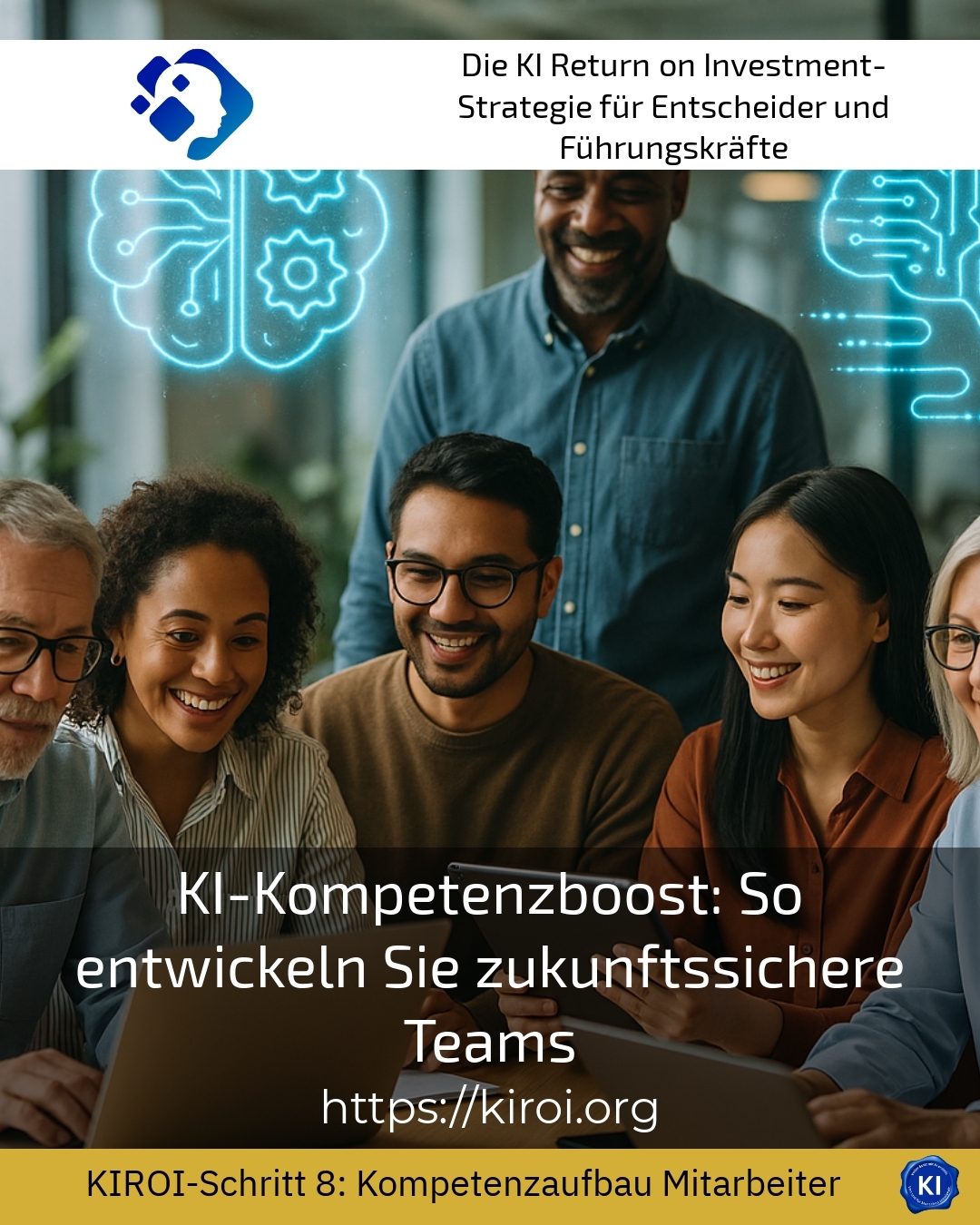
Imagine your employees could carry out complex data analyses in just a few weeks, optimise automated processes independently, and work with intelligent systems as naturally as they do with email programs today. AI Skills Boost is no longer just a vision, but an urgent necessity for companies that wish to survive in a rapidly changing economic world. While some organisations are still hesitant, others are already using systematic further training programmes to prepare their workforce for the demands of the coming years. The crucial question is no longer whether you should invest in your teams' digital competence, but how quickly and how comprehensively you can shape this transformation.
Why the AI skills boost is becoming indispensable now
The world of work is currently undergoing a fundamental transformation. Intelligent systems are taking over routine tasks. At the same time, entirely new fields of activity are emerging. Many employees feel overwhelmed by this development. They report uncertainty and a lack of confidence in their digital skills. This is precisely where professional support comes in, providing employees with impulses and gradually introducing them to new technologies.
Managers often worry that their teams might fall behind. They observe competitors operating more efficiently through clever use of technology. Some report internal resistance to change. Others struggle with the challenge of finding suitable training formats. Transruption coaching supports companies with precisely these kinds of digital transformation projects. It aids in developing individual learning paths and initiating sustainable change processes.
In manufacturing companies, for example, machine operators learn to use predictive maintenance systems through targeted training. Logistics companies benefit when dispatchers can understand and optimise algorithmic route planning. In healthcare, in turn, trained specialists enable more precise diagnostic support through intelligent image analysis [1].
Strategic approaches for sustainable skills development
The successful development of future-proof teams requires a thoughtful approach. Individual workshops are not enough. Rather, a systematic programme is needed that combines various learning formats. Practical application examples play a central role in this. Employees learn best when they can apply what they have learned directly in their day-to-day work.
Financial institutions have recognised that their advisors need fundamental knowledge of analysis algorithms. This will enable them to better explain to clients how investment recommendations are generated. Insurance companies are training their claims handlers in the use of automated damage assessments. Energy suppliers, in turn, are investing in the further training of their network managers so that they can optimally control intelligent load balancing systems [2].
Best practice with a KIROI customer A medium-sized manufacturing company faced the challenge of preparing its more than three hundred production employees for the connected factory. The workforce was uneasy and feared being replaced by new technologies. As part of a twelve-month transformation programme, we first developed a skills model that precisely defined which capabilities would be needed in the coming years. Subsequently, we conducted individual assessments to gauge each employee's current standing. Based on this, personalised learning paths were created, comprising both online courses and practical workshops at the machines. The involvement of experienced colleagues as internal mentors, who passed on their knowledge to younger team members, was particularly important. After six months, initial measurements showed that production efficiency had increased by eighteen percent. Employee satisfaction also improved significantly because people felt that the company was investing in their development. Today, the teams work independently with predictive maintenance systems and have even developed their own suggestions for improving the algorithms.
The AI competence boost in various business areas
Every department benefits in different ways from targeted skills development. Marketing teams use intelligent analysis tools for more precise customer targeting. HR departments rely on automated pre-selection in application processes. Controlling experts work with forecasting models that go far beyond traditional projections.
In the retail sector, we observe that trained buyers interpret demand forecasts better, thereby avoiding overstocking. Hotel chains report that their revenue managers use dynamic pricing much more effectively after appropriate training. In turn, automotive suppliers benefit when their quality inspectors understand intelligent image recognition systems and can correctly interpret their results [3].
The challenge is to bring all employees along. Not everyone has the same starting point. Some are apprehensive about new technologies. Others are highly motivated but lack the time for further training. Professional transruption coaching considers these different starting situations and develops suitable formats for various learning types.
Leaders as drivers of change
The role of leadership cannot be overstated. Managers must not only build competence themselves, but also act as role models and encourage their teams. Clients often report that resistance only disappears when superiors actively work with new systems themselves.
Pharmaceutical companies have realised that research leaders need fundamental knowledge of machine learning. This enables them to better assess which projects are promising. Construction companies are training their project managers in the use of intelligent site planning. Media companies are investing in the further training of their editorial leaders so that they can make sensible use of automated content creation.
A key success factor is the creation of a learning-friendly corporate culture. Employees need room to experiment. They must be allowed to make mistakes without fear of negative consequences. Only in this way can real innovative strength emerge, which goes far beyond merely applying pre-made solutions.
Best practice with a KIROI customer An international insurance group wanted to qualify its over five thousand claims handlers to deal with automated claims assessments. Previous training attempts had failed because they were too theoretical and not related to day-to-day business. Together, we developed a completely new concept based on the principle of learning on the job. Each branch was initially assigned two specially trained multipliers, who were the first to learn the new systems. These colleagues then became contact persons for all other employees and offered weekly short training sessions of thirty minutes each. In parallel, we set up a digital learning platform where employees could access explanatory videos and work on practice exercises at any time. The introduction of gamification elements was particularly successful, with teams competing against each other and collecting points for completed learning units. After nine months, over ninety percent of claims handlers had mastered the new systems with confidence. The average processing time for claims fell by forty percent, while at the same time customer satisfaction increased.
Practical steps to boost AI competence in your company
Building future-proof teams starts with an honest assessment. What skills are already in place? Where are the biggest gaps? What competencies will be particularly important in two or three years? These questions form the basis for any meaningful development plan.
Telecommunications providers use structured assessments to determine the training needs of their customer advisors. Chemical companies systematically map the digital competencies of their laboratory technicians. Logistics service providers analyse which of their warehouse workers are suitable for operating autonomous transport systems [4].
Following analysis comes prioritisation. Not all competencies can be developed simultaneously. It is important to set priorities and deploy resources strategically. It helps to distinguish between fundamental basic competencies and specialised expert skills. The former should be acquired by as many employees as possible, while the latter should be specifically developed in selected talents.
Measurable success through a systematic approach
The effectiveness of competency development measures must be demonstrable. Modern learning platforms allow for detailed analyses of learning progress. Key metrics such as completion rates, test results, and frequency of use provide insight into the actual benefits.
Mechanical engineering companies measure the success of their training by concrete increases in productivity. E-commerce retailers track how the use of recommendation algorithms by trained employees affects sales. Hospitals analyse whether nursing staff produce more accurate documentation after training.
Regular feedback from participants is also important. They are best placed to assess which content was relevant in practice. Their feedback helps to continuously improve training programmes. Transruptions coaching places great emphasis on such feedback loops and iteratively adapts concepts to the needs of the target groups.
My KIROI Analysis
Developing future-proof teams through targeted skills development is not a one-off action, but a continuous process that requires strategic planning, consistent implementation, and regular adaptation. My experience from numerous consulting projects shows that companies are particularly successful when they adhere to three central principles: Firstly, leaders must lead by example as active role models and demonstrate the importance of continuous learning. Secondly, tailored formats are needed that take into account different learning styles and prior knowledge levels. Thirdly, a culture of psychological safety is crucial, where employees are allowed to experiment and make mistakes.
Investing in the digital competence of the workforce pays off in multiple ways: companies gain innovative strength, employees feel valued, and competitiveness increases sustainably. However, this path requires patience and perseverance. Quick successes are possible, but profound changes take time. Those who start today will reap the rewards tomorrow. Technologies are developing rapidly, but human creativity, judgment, and adaptability remain irreplaceable. It is precisely these skills that need to be strengthened and combined with technical understanding.
Further links from the text above:
[1] McKinsey Global Institute: The Future of Work
[2] World Economic Forum: The Future of Jobs Report
[3] Bitkom: Digital Transformation in Companies
[4] Fraunhofer-Gesellschaft: Artificial Intelligence
For more information and if you have any questions, please contact Contact us or read more blog posts on the topic Artificial intelligence here.






 Deutsch
  English (UK)