
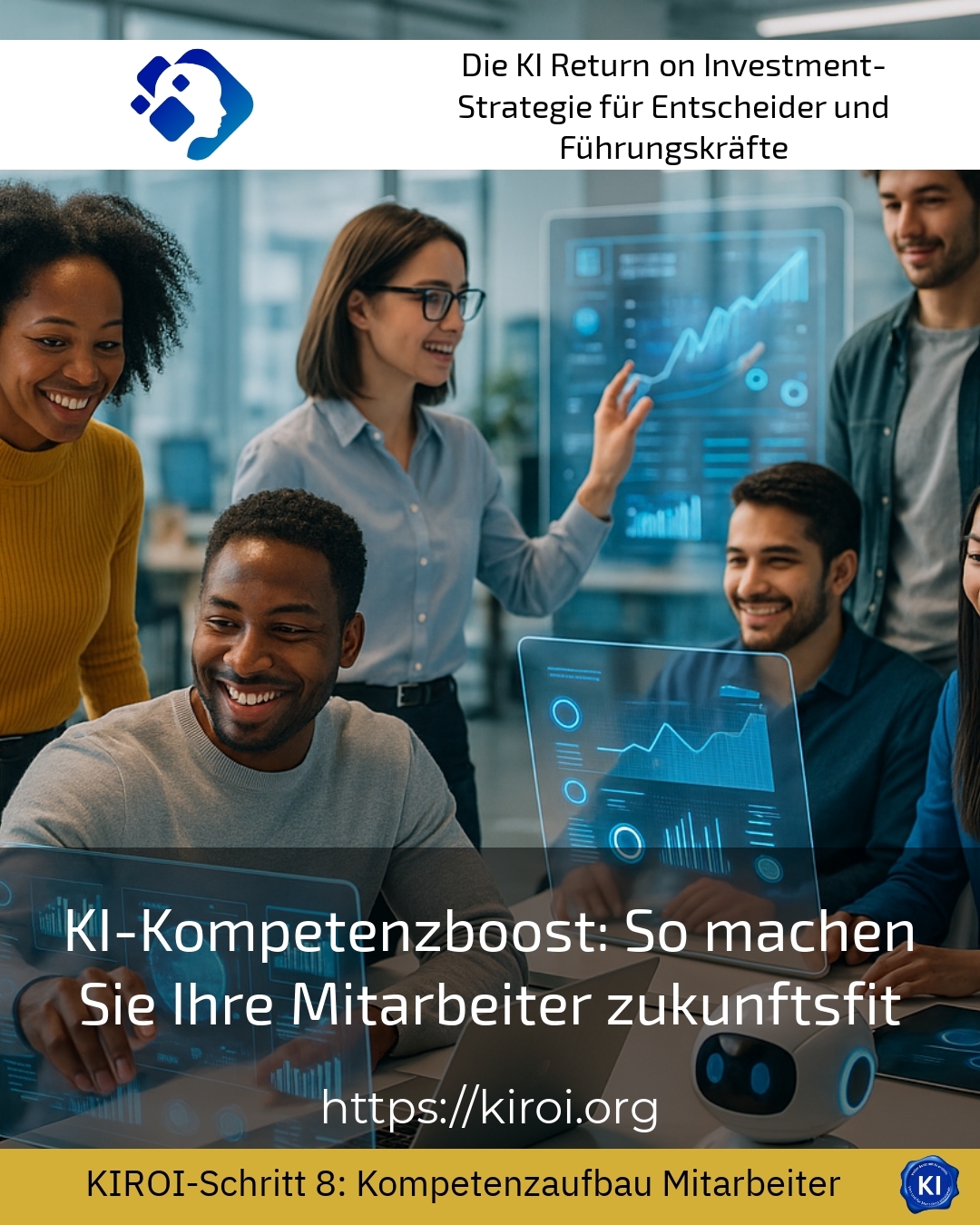
Imagine your workforce confidently navigating a world full of algorithmic decision support and automated processes. The AI Skills Boost decides on the economic success of tomorrow today. Companies are faced with the challenge of making their employees fit for the future. This is not about mere technical training. It is about a profound transformation of the work culture. Many leaders are wondering how to start this journey. The good news is: there are proven ways that lead to the goal.
Why AI skills have become indispensable today
The world of work is changing at a pace that overwhelms many people. Automated systems are increasingly taking over routine tasks in almost all areas. At the same time, entirely new fields of activity are emerging that were unthinkable just a few years ago. In this situation, employees need new skills and a changed mindset. Companies that do not actively support their workforce risk falling behind the competition.
In the banking sector, intelligent systems now analyse credit risks in fractions of a second. Customer advisors use digital assistants for personalised investment recommendations. And in the back office, algorithms largely automate document processing. These examples clearly show how profound the changes already are. We are observing similar developments in the insurance industry for claims assessment. Auditors are also increasingly relying on automated auditing routines.
Nevertheless, many clients report uncertainty in dealing with these technologies. The fear of job loss is just as present as the concern of being overwhelmed. This is where professional support comes in, because it reduces anxieties and highlights opportunities. Transruption coaching supports companies precisely with such transformation projects. It offers impulses for structured and people-centred change.
The human factor as a driver of success
Technology alone does not create a sustainable competitive advantage. It's the people who use it meaningfully that make the decisive difference. A study by the Fraunhofer Institute [1] impressively confirms this assessment. Companies with high employee competence achieve significantly better results. They implement new technologies faster and use them more effectively.
Intelligent diagnostic systems in healthcare support doctors with image recognition. Nurses document faster and more accurately with voice assistants. And administrative staff significantly relieve themselves through automated appointment scheduling. However, all these applications only work with trained personnel. Technology provides impulses, but people continue to make the decisions.
Best practice with a AIROI customer
A medium-sized company in the logistics sector faced a unique challenge. Dispatchers felt threatened by new planning algorithms and blocked their introduction. Together, we developed a skills programme that took their fears seriously and highlighted opportunities. The employees first familiarised themselves with the basics of algorithmic route optimisation. Then, they collaboratively worked out application scenarios for their daily work. In doing so, they discovered that the systems did not replace their expertise but complemented it. The dispatchers contributed their experience and knowledge, thereby significantly improving the algorithms. After six months, empty runs decreased by twenty percent. At the same time, employee satisfaction measurably increased. The workforce saw themselves as shapers of change, not its victims. This example impressively shows how important the combination of technical training and support is.
Strategies for a Sustainable AI Skills Boost in Your Company
Building future-proof competencies requires a systematic approach. Individual training measures are not sufficient for lasting change. Instead, a well-thought-out overall concept with various building blocks is needed. These should be coordinated and mutually reinforcing. The result is a learning organisation that actively shapes change.
In retail, sales advisors today use intelligent recommendation systems for customer consultation. Warehouse staff work with predictive inventory management tools. And marketing experts rely on automated customer segmentation for their campaigns. Each of these applications requires specific knowledge and practical exercise. Therefore, we often recommend a modular structure for training measures.
Designing learning formats for different target groups
Not all employees learn best in the same way. Managers need different content than frontline operational staff. Older employees often have different learning preferences than digitally native generations. A successful training strategy consistently takes these differences into account. It offers various formats and enables individual learning paths.
In the manufacturing industry, learning stations directly on the production line have proven their worth. There, employees can try out new technologies in a familiar environment. In legal consulting, by contrast, case studies and peer learning work particularly well. And in the creative sector, many rely on experimental workshops with a prototyping character. These examples highlight the necessity of tailor-made approaches.
The McKinsey Global Institute [2] emphasises the importance of continuous learning. One-off training sessions quickly lose relevance in a world of constant change. Regular learning impulses, integrated into the daily working routine, are more effective. This fosters a culture of lifelong learning throughout the entire organisation. Transruption Coaching supports organisations in developing such cultures.
Overcoming resistance and sparking enthusiasm
Changes naturally provoke resistance in many affected individuals. This reaction is human and should not be underestimated. Successful transformation projects take such resistance seriously and actively work with it. They create space for concerns and constructively involve critics. This often leads to the most valuable improvement ideas.
In education, teachers often approach digital learning systems with scepticism. They worry about losing the personal connection with students. In healthcare, many employees fear a dehumanisation of their work. And in administration, there is often concern about the loss of familiar processes. All these concerns deserve attention and honest consideration.
Best practice with a AIROI customer
A service company from the consulting sector wanted to introduce intelligent analysis tools. However, the experienced consultants feared a devaluation of their expert knowledge. We started with a series of discussion formats in which concerns were openly discussed. The employees themselves formulated requirements for the new tools. They defined which tasks the technology should take on and which it should not. This participatory approach created acceptance and genuine enthusiasm. The consultants realised that they would gain more time for challenging client work. Routine analyses were henceforth taken over by the systems, while strategic evaluations remained with the people. After the introduction, project quality increased measurably. At the same time, overtime was reduced because time-consuming data preparation was eliminated. The employees even actively recommended the approach to colleagues. This example shows how participation can transform resistance into support.
Leaders as role models and enablers
The attitude of the leadership significantly shapes the success of qualification initiatives. Leaders should themselves demonstrate a willingness to learn and try new things. Their role as role models signals to the workforce that learning is desired and valued. At the same time, they must create space for experimentation and mistakes. Only in this way does psychological safety arise, which promotes innovative behaviour.
In technology companies, many managers rely on transparent learning journals. They share their own learning experiences and challenges with the team. In traditional industrial companies, pairings of experienced and younger employees have proven effective. And in startups, informal learning communities with flat hierarchies often emerge. The World Economic Forum [3] highlights the importance of this cultural dimension.
Clients often report initial overwhelm due to the sheer number of options available. Clear prioritisation of the most important competency areas helps enormously here. AI Skills Boost should be carried out step-by-step and define manageable interim goals. This keeps employees motivated and allows them to regularly experience success. This positive reinforcement drives the learning process forward sustainably.
Practical implementation in daily business operations
Theory and practice must be closely intertwined for sustainable learning success. Abstract training content becomes ineffective without opportunities for application in daily work. Therefore, we recommend a project-based approach with real tasks. Employees learn best when they are allowed to solve concrete problems. These experiences become deeply embedded and transform into lasting knowledge.
In the media industry, editors are experimenting with automated research tools for their articles. Designers are using generative systems as a source of inspiration for creative concepts. And analysts are working with forecasting models for the reach optimisation of their content. Each of these examples connects learning with immediate benefit for daily work.
Transruption coaching supports companies in identifying suitable pilot projects. These should be manageable, yet address relevant challenges. Successful pilots generate positive word-of-mouth within the company. They motivate further departments to launch their own initiatives. This creates a movement that encompasses the entire company.
Measuring and visualising successes
What is measured gains attention and resources within a company. Therefore, qualification initiatives should be underpinned by clear key performance indicators (KPIs). These can be quantitative or qualitative in nature. What's important is that they reflect actual progress and don't just count activities. The regular communication of successes strengthens the motivation of everyone involved.
In the financial sector, some institutions measure the adoption rate of intelligent analytical tools by advisors. Others collect data on time savings from standardised processes through automation. And still others regularly survey customer satisfaction with technology-supported advice. Together, these different perspectives provide a comprehensive picture of progress.
Best practice with a AIROI customer
A multi-site trading company implemented a comprehensive skills programme. The challenge was to make the success objectively measurable. Together, we developed a dashboard with various indicators for learning progress. We captured the frequency of use of new tools by employees in their day-to-day work. In addition, we regularly collected the quality of work results through random sample analyses. And we conducted quarterly surveys on self-assessment of skills. The combination of this data enabled targeted adjustments to the programme. Where weaknesses became apparent, we intensified the support accordingly. After one year, the dashboard showed impressive improvements in all areas. Employees rated their own abilities significantly higher than before. And the objective performance indicators fully confirmed this subjective perception. The company now uses the dashboard as an integral part of its personnel management.
My AIROI Analysis
Companies' long-term viability depends crucially on their employees' skills. Technological tools can only realise their full potential in the hands of capable people. The AI Skills Boost is therefore not an optional additional measure but a strategic necessity. Companies that make their workforce fit for the future create lasting competitive advantages for themselves.
The analysis of numerous projects clearly highlights recurring patterns of success. Firstly, transformation is more successful when it is designed participatively. Employees must be able to see change as an opportunity, not a threat. Secondly, sustainable learning requires integration into daily work rather than isolated training measures. Thirdly, every initiative needs visible support from the company's leadership.
The greatest obstacles are rarely in the technical area of implementation. Rather, it is cultural factors and human fears that slow down projects. Professional support such as transruption coaching is effective and sustainable here. It offers a protected framework for engaging with change. At the same time, it provides methodological impulses for practical implementation in everyday life.
Therefore, my recommendation is to see qualification as a continuous process. One-off measures are not enough for the dynamic demands of our time. Instead, companies should establish and cultivate a culture of permanent learning. This culture will become the most important asset in a world of constant change. It makes organisations adaptable and their employees confident in dealing with new things.
Further links from the text above:
[1] Fraunhofer Institute for Artificial Intelligence
[2] McKinsey Global Institute – Future of Work
[3] World Economic Forum – Future of Jobs Report
For more information and if you have any questions, please contact Contact us or read more blog posts on the topic Artificial intelligence here.






 Deutsch
  English (UK)