
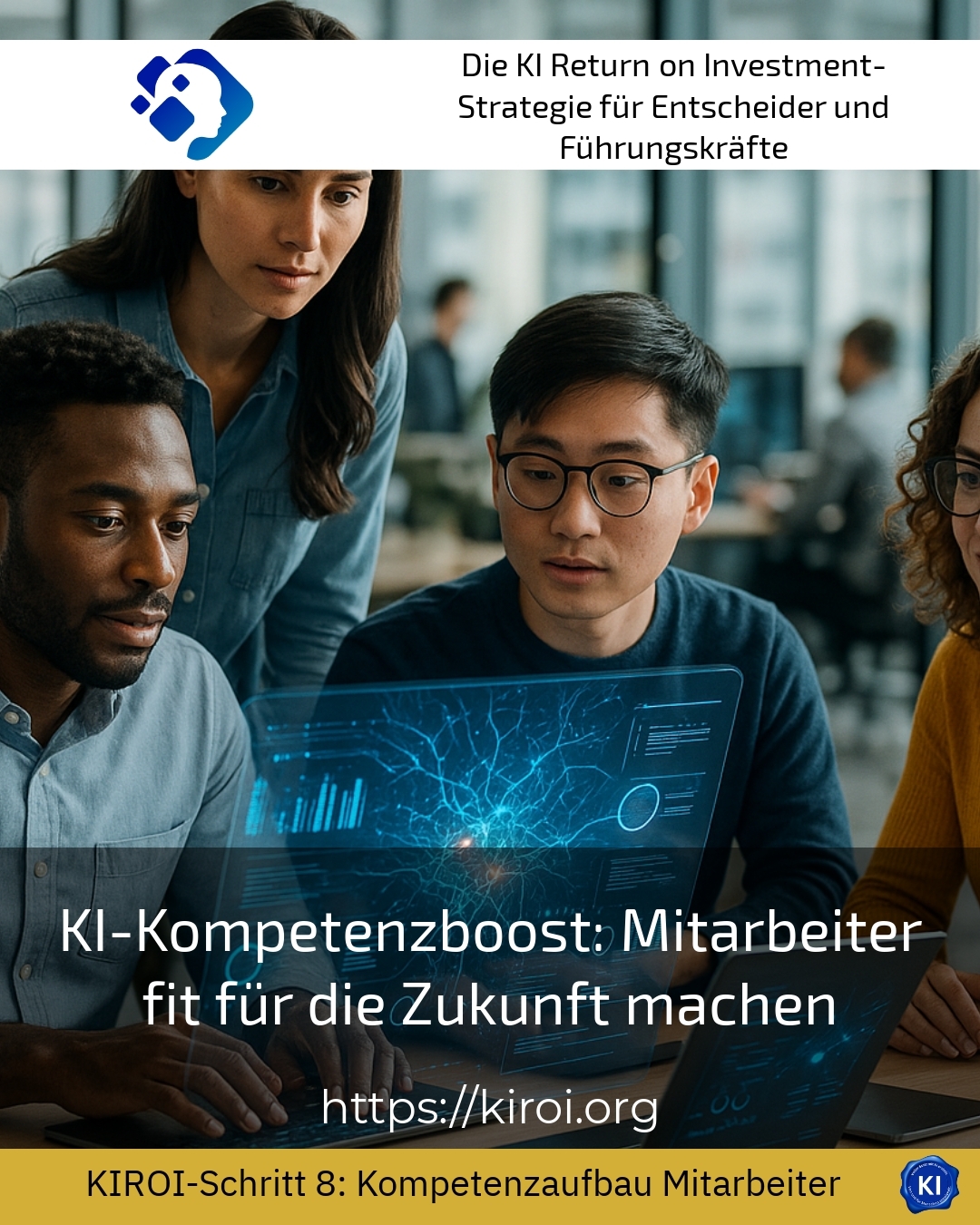
The digital transformation is changing entire industries at a breathtaking pace. Businesses face a crucial question. How do they prepare their workforce for a world of work that is fundamentally changing? The AI Skills Boost: Getting Employees Ready for the Future This is becoming a strategic imperative. Those who do not act today will lose out tomorrow. However, this challenge also harbours enormous opportunities. Organisations can sustainably strengthen their competitiveness. They can foster innovation and retain talent long-term. In this article, you will learn which approaches have proven effective.
Why the AI skills boost is becoming indispensable now
The integration of intelligent systems into business processes is advancing relentlessly. Routine tasks are increasingly being automated. New fields of activity are emerging concurrently. Employees therefore require completely new skills and ways of thinking [1]. The change affects all hierarchical levels and departments equally. Managers must understand how data-driven decisions work. Specialists are learning to collaborate with intelligent assistance systems. Even traditional job profiles are undergoing profound changes.
In manufacturing companies, algorithms are already taking over quality control. They detect errors faster than human inspectors. In customer service, virtual assistants answer standard queries around the clock. Banks use intelligent systems for real-time fraud detection. Logistics companies optimise their supply chains through predictive analytics. These examples show the breadth of the changes. Employees must be able to understand and use these technologies effectively. Otherwise, there is a risk of a dangerous skills gap.
Leaders often report uncertainties within their teams. They encounter resistance to new ways of working. Sometimes there's a lack of fundamental understanding of digital contexts. This is where professional support comes in. Transruption coaching supports organisations with precisely these challenges. It accompanies transformation projects from strategy to implementation.
Key competencies for a changing world of work
Technical knowledge alone is no longer enough. Employees need a whole bundle of skills. Critical thinking is at the top of the list. Anyone working with intelligent systems must be able to question their results. Algorithms do not make infallible decisions. They are based on data and can contain biases [2]. The ability to classify and evaluate is therefore becoming increasingly important.
Data literacy is evolving into a key qualification in almost all areas. Marketing experts interpret customer analyses from complex systems. HR managers use data-based insights for better hiring decisions. Product developers evaluate usage data to drive innovation. These examples illustrate the breadth of requirements. However, it's not about programming skills for everyone. Rather, the focus is on understanding data flows and their interpretation.
Paradoxically, creativity and emotional intelligence are gaining in importance. The more routine tasks are automated, the more valuable human skills become. Empathy in customer contact cannot be entirely replaced. Creative problem-solving arises from human intuition and experience. Teamwork and communication skills remain indispensable. AI Skills Boost: Getting Employees Ready for the Future therefore encompasses both dimensions.
Conveying technical foundations clearly
Many employees feel overwhelmed by technical topics. This reaction is human and understandable. Successful training programmes therefore focus on step-by-step learning. They begin with simple concepts and gradually increase complexity. Practical examples considerably aid understanding. A sales representative learns using their own customer data. An administrator understands automation through their own workflow.
Workshops with practical use cases have proven particularly effective. Participants experience the technology directly and hands-on. They can ask questions and explore connections. This approach sustainably reduces apprehension. At the same time, valuable insights are generated for process optimisation. Employees identify potential that remains hidden from management. The involvement of the workforce thus becomes a success factor.
Best practice with a AIROI customer
A medium-sized manufacturing company was facing significant challenges in digitally transforming its production processes and turned to us because the workforce was sceptical of new technologies and resistance was blocking progress. In close collaboration, we developed a multi-stage qualification programme that involved all employee levels and left no one behind. First, we analysed existing competencies and identified individual development needs through structured discussions. We then designed bespoke learning modules for different target groups within the company. Machine operators received practical training on collaborating with intelligent assistance systems in quality control. Team leaders learned to make data-driven decisions and to lead their teams through the change. Management developed a deeper understanding of strategic potential and risks. After six months of intensive support, those responsible reported significantly higher acceptance. Production efficiency improved noticeably and employee satisfaction increased measurably. The insight that involving the workforce from the outset was crucial for success was particularly valuable.
Strategies for a Sustainable Boost in AI Competencies within Organisations
Individual training measures are not enough. Companies need a comprehensive learning culture. This must be actively modelled by the leadership. When executive boards and managing directors attend further training themselves, it sends a strong signal. It shows that lifelong learning is not just a buzzword, but a lived reality within the company. Many organisations significantly underestimate this role-modelling function.
Learning times should be firmly anchored in everyday work life [3]. Some companies reserve weekly time slots for further training. Others allow flexible learning phases according to individual needs. Both approaches can work. Consistent implementation and support are crucial. Managers must actively demand and protect learning times. They must not fall victim to day-to-day business.
Peer learning and internal knowledge networks are gaining importance. Employees often learn best from each other. They speak the same language and are familiar with specific challenges. Mentoring programmes connect experienced digital experts with learners. Internal communities exchange insights and tips. Such structures rarely arise on their own. They must be actively promoted and moderated.
Individual learning paths for different target groups
Not all employees require the same knowledge. A differentiated approach is essential. Sales representatives benefit from different content than production specialists. Managers have different information needs than administrative staff. These differences must be taken into account by training programmes. Standardised, one-size-fits-all solutions often miss their target. They bore some and overwhelm others.
In the financial sector, client advisors need to understand automated investment recommendations. They must be able to explain their logic and build trust. Risk managers, on the other hand, work more intensively with analytical systems. They require a deeper technical understanding. Compliance experts focus on the regulatory aspects of intelligent systems. This differentiation significantly increases relevance and effectiveness.
Similar patterns are emerging in healthcare. Doctors are learning to critically assess diagnostic support systems. Nurses are using intelligent documentation aids in their daily work. Administrative staff are optimising billing processes through automated checks. Each group needs tailored training. The AI Skills Boost: Getting Employees Ready for the Future only succeeds through such differentiation.
Challenges and how to overcome them
Lack of time represents the most common hurdle. Employees feel trapped in their daily business. There seems to be no time left for further training. This perception is often justified. At the same time, it leads into a vicious cycle. Without new skills, the workload will continue to increase in the long term. Intelligent automation could provide relief. However, the necessary knowledge is again lacking for this.
The solution lies in the integration of learning and work. Microlearning formats allow for short learning units in everyday life. Five to ten minutes are sufficient for small chunks of knowledge. These add up over weeks to substantial competence building. At the same time, there are no long absences from the workplace. Modern learning platforms effectively support this approach [4].
Fears of job loss must be taken seriously. Many employees fear being replaced by technology. These concerns are not unfounded. Certain activities are indeed being automated. At the same time, new tasks and roles are emerging. Transparent communication is therefore essential. Companies should clearly show what opportunities are available. They should concretely describe and enable development paths.
Best practice with a AIROI customer
An insurance company commissioned us to support a comprehensive transformation project that was intended to fundamentally change claims processing and had significant implications for several hundred employees. The initial mood was characterised by scepticism and fears about the future, as many feared job rationalisation. We began with an open dialogue phase in which all concerns were heard and documented, without judgement or premature promises of solutions. This transparency created a basis of trust for further collaboration and opened doors. Together, we developed a qualification concept that focused on the existing strengths of the employees and highlighted new development opportunities. Experienced claims adjusters were further qualified as specialists for complex cases that require human judgment and cannot be automated. Others took on new roles in the quality assurance of automated decisions, bringing their expertise to bear. Close support from transruptions coaching helped to constructively transform resistance and build motivation. Following the completion of the project, not only had efficiency improved, but employee satisfaction had also increased, as people had discovered new perspectives for themselves.
Measurement and continuous improvement
Development measures must be measurable. Only then can their success be evaluated. Traditional metrics like training days are insufficient for this. They measure input, not outcome. Changes in work behaviour and performance are more relevant. Capturing these requires well-thought-out methods and clear indicators.
Competency matrices aid systematic recording. They map the current state and development goals. Regular assessments highlight progress and gaps. Feedback discussions complement the quantitative data qualitatively. This combination provides a complete picture. It enables targeted adjustments and modifications to programmes.
The learning process itself should be designed iteratively. Successful companies continuously adapt their programmes. They react flexibly to new technological developments. They systematically consider participant feedback. This agility distinguishes effective from ineffective initiatives. Rigid curricula quickly become outdated in dynamic environments.
Success factors from practice
In retail, certain approaches have proven particularly effective. Store teams learn together in short, in-person formats. They apply what they’ve learned directly in the workplace. Managers observe and provide timely feedback. This practical focus significantly speeds up skills development. Theoretical knowledge is transformed into applied ability.
Technology companies often use gamification elements. Learners collect points and badges for completed modules. Leaderboards encourage healthy competition among colleagues. These playful elements demonstrably increase motivation. They make learning a positive experience. Younger employees in particular respond well to such formats.
Different success patterns are apparent in the public sector. Structured programmes with clear guidelines work well here. Certifications create commitment and recognition. Integration into personnel development plans ensures sustainability. Management must actively support and demand the process. Without this backing, many initiatives get lost in the daily routine of public administration.
The Role of External Support
Internal resources often reach their limits. External experts bring fresh perspectives. They possess experience from various industries and contexts. This knowledge can be utilised for one's own company. At the same time, external consultants can address uncomfortable truths. They are not entangled in internal hierarchies and conflicts.
Transruption coaching positions itself as support for such projects. It provides impetus and practical support for implementation. The expertise lies in the connection between technology and people. Purely technical advice often falls short. Purely psychological approaches ignore the factual requirements. The combination of both perspectives creates sustainable success.
Many organisations significantly underestimate the effort involved in change. They plan too optimistically and expect results too quickly. A realistic assessment helps to avoid frustration. Experienced consultants can provide valuable guidance here. They are familiar with typical pitfalls and proven solutions. This experience significantly speeds up the overall process.
My AIROI Analysis
The AI Skills Boost: Getting Employees Ready for the Future represents one of the most important strategic tasks of our time, as organisations without competent employees cannot exploit the potential of new technologies and will fall behind in the competition. Experience from numerous support projects clearly shows that technical implementations alone are not sufficient and that the human factor determines success or failure. It is particularly noticeable how strongly the involvement of employees from the outset influences project success, because people who feel heard and valued are much more open to change than those who are presented with a fait accompli.
The analysis also shows that differentiated approaches are indispensable and one-size-fits-all solutions rarely lead to the desired success, because different target groups have different needs that must be taken into account. Leaders play a key role as role models and enablers, but they themselves require support and training to be able to fulfil this role. The temporal dimension is often underestimated, as sustainable competence development requires patience and continuous commitment over months and years. Organisations that think short-term and expect quick successes often experience disappointment and setbacks. Successful companies understand training as an ongoing process, not a one-off project with a clear end. They invest continuously and flexibly adapt their strategies to new developments. This attitude distinguishes long-term successful organisations from those that will lose their footing.
Further links from the text above:
[1] McKinsey: The Future of Work
[2] World Economic Forum: The Future of Jobs Report
[3] Harvard Business Review: Learning & Development
[4] Gartner: Learning and Development Insights
For more information and if you have any questions, please contact Contact us or read more blog posts on the topic Artificial intelligence here.








 Deutsch
  English (UK)