
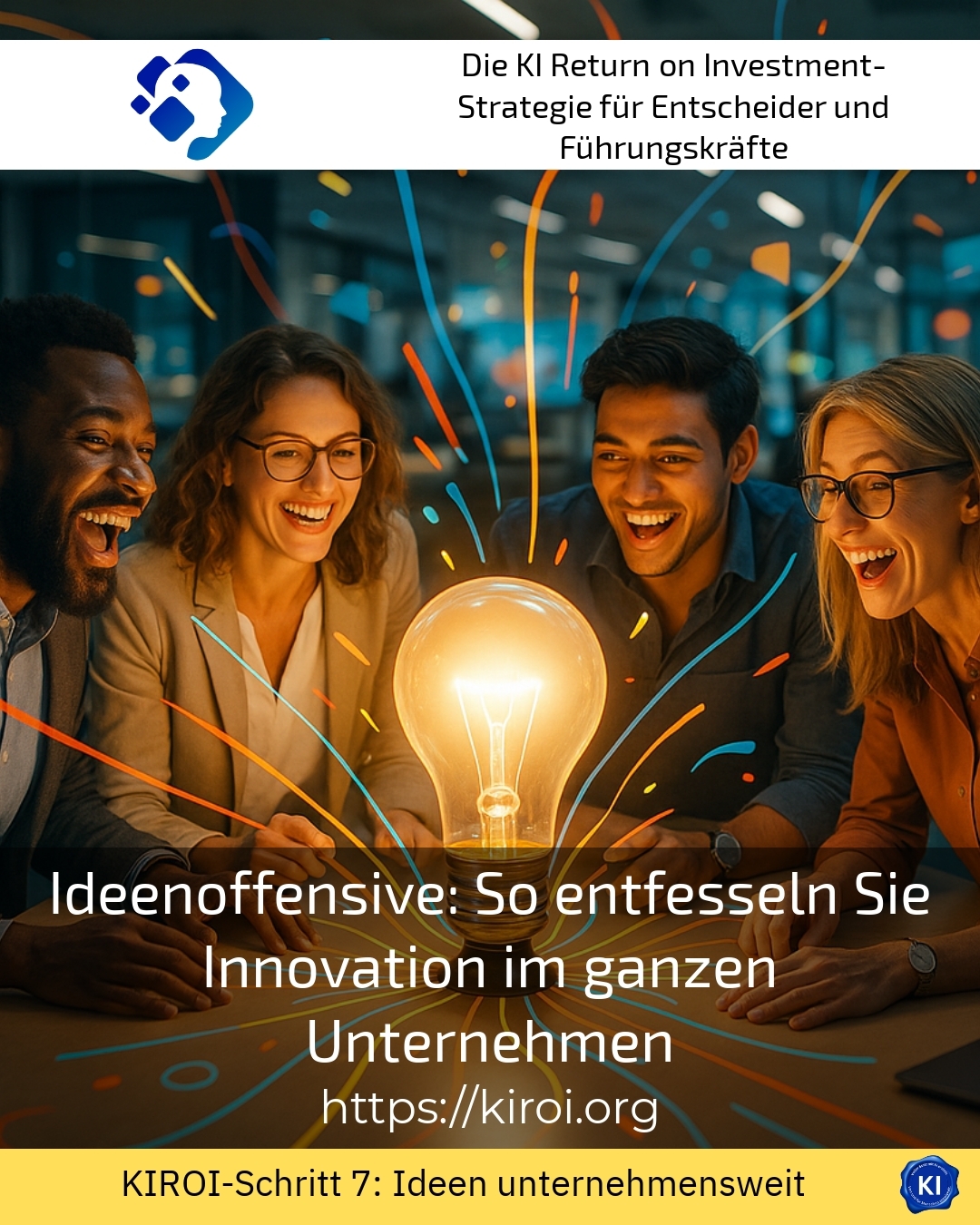
Imagine the next groundbreaking business idea is already dormant in your employees' minds, just waiting to be awakened. Ideas offensive can ignite exactly this spark. Many organisations underestimate the creative potential of their own workforce. The most valuable impulses often don't originate in the executive suite. Instead, they develop in direct contact with customers and processes. In this article, you'll learn how to systematically foster creativity. We'll show you tried-and-tested methods and concrete practical examples. This way, you can transform your company into a vibrant innovation hub.
Why an ideas offensive becomes a survival factor
The economic landscape is changing at breakneck speed. Digital technologies are revolutionising established business models in the blink of an eye. Companies that are market leaders today could be overtaken tomorrow. This dynamism demands a fundamentally new approach to change. Traditional top-down structures quickly reach their limits. They can no longer reflect the complexity of modern markets. That's why organisations need the collective intelligence of everyone involved. No single mind can possibly oversee all relevant developments.
This is particularly evident in the financial services sector. Here, agile fintech companies have put established banks under considerable pressure. Mobile payment systems and digital asset management did not originate in traditional institutions. They were developed by small teams with fresh perspectives. We are observing a similar trend in the logistics industry, where innovative platforms have redefined the entire value chain. Retail is also undergoing a fundamental transformation through digital marketplaces. These examples illustrate the need for continuous innovation.
Unearthing your organisation's hidden treasures
Every employee possesses unique knowledge. This knowledge is drawn from daily experiences and customer interactions. Service staff are intimately familiar with the most common complaints from their clientele. Production workers see optimisation potential that remains hidden from management. Sales teams often sense market changes earlier than any analysis. All these insights form an enormous treasure trove of knowledge. However, this treasure often lies dormant and is not systematically utilised.
A medium-sized mechanical engineering company recognised this potential early on. It introduced regular innovation circles at workshop level. The results significantly exceeded all expectations of the management. Within a year, numerous suggestions for improvement with measurable benefits were developed. A automotive supplier followed a similar approach. It established digital platforms for company-wide idea exchange. Even a long-established family business in the skilled trades benefited. It opened itself up to suggestions from its apprentices and gained fresh impetus.
Best practice with a AIROI customer An internationally operating trading company with several thousand employees approached the transruptions coaching team with a specific challenge. Management noticed increasing stagnation in internal improvement initiatives. Employees were holding back valuable ideas due to fear of negative consequences. During an intensive coaching phase, we jointly developed a multi-stage programme for cultural change. First, we analysed the existing communication structures and identified key blockages. Subsequently, we introduced safe spaces for creative exchange that operated without pressure to perform. Leaders received targeted training on how to appreciate suggestions. Particularly important was the establishment of transparent feedback loops for submitted concepts. After approximately six months, the company recorded a significant increase in submissions. Clients often report similar experiences after implementing such systems. Employee engagement rose measurably, and staff turnover decreased in parallel.
Creating structures that enable an offensive of ideas
Creativity doesn't flourish in a vacuum. It requires supportive frameworks and clear structures. However, these structures must be flexible enough for spontaneous ideas. Rigid bureaucracy stifles any creative impulse at its source. At the same time, people need guidance and reliable processes for their suggestions. The key lies in the right balance between freedom and order.
Tried-and-tested formats for systematic idea generation exist in countless forms. Design thinking workshops bring together interdisciplinary teams for intensive work phases. Hackathons condense creative energy into a few hours or days. Regular innovation breakfasts create low-threshold opportunities for informal exchange. For example, an energy provider uses monthly „future labs“ with changing participants. A pharmaceutical company established virtual idea competitions with attractive incentives for winners. Even a municipal administration was able to optimise internal processes through open space events.
Digital tools as accelerators of the idea offensive
Modern technologies significantly expand the possibilities of idea management. Specialised software platforms enable the collection of suggestions across different locations. Artificial intelligence can categorise submitted concepts and merge similar approaches. Gamification elements increase participation and make the process more attractive. Transparent evaluation systems create traceability for all involved parties. These digital aids effectively support the creative process.
An insurance group implemented an AI-powered platform for its innovation management [1]. The technology recognised patterns in submitted proposals and suggested combinations. A telecommunications provider uses chatbots for initial idea qualification [2]. These bots ask targeted follow-up questions and refine the original concepts. A medium-sized food producer also benefits from digital tools. It connects its various production sites via a shared ideas platform.
Cultural prerequisites for sustainable innovative capacity
Technical systems and organisational structures merely form the foundation. The real key lies in the company culture itself. A culture of psychological safety encourages people to think outside the box. In such environments, unconventional suggestions are also valued. Mistakes are not seen as failures but as valuable learning opportunities. This attitude must be genuinely demonstrated by leadership.
Many clients come to transruptions coaching with precisely this challenge. They report fear of rejection and a lack of appreciation. Others describe experiences of stalled suggestions with no feedback whatsoever. These negative experiences shape behaviour long-term and inhibit creativity. The support addresses exactly these points. We provide impetus for creating an innovation-friendly atmosphere.
A chemical company underwent a fundamental transformation of its failure culture. It introduced „Failure Fridays,“ where teams openly discuss setbacks. A software developer established regular retrospectives after every project. These reflection sessions systematically identify areas for improvement without assigning blame. A construction company now rewards employees who offer constructive criticism.
Best practice with a AIROI customer A medium-sized technology company contacted us regarding stagnating product development. Management suspected untapped potential within their workforce. Our initial analysis impressively confirmed this assumption. Employees had numerous ideas but didn't dare to voice them. During our support, we developed an „Innovation Safe Haven Concept“ for the company. This approach stipulated that all submitted suggestions would initially be treated anonymously. Only after a positive initial assessment could idea providers reveal their authorship. This procedure drastically lowered the threshold for submissions. In parallel, we trained managers in a appreciative way of handling critical feedback. The transruption coaching accompanied the entire transformation process over eighteen months. The results were demonstrated by a threefold increase in submitted innovation proposals. Several of these ideas led to concrete product improvements with measurable market success.
Leaders as Enablers of Innovation
The role of leadership is fundamentally changing in the context of systematic idea development. Traditional control functions are receding in favour of enablement. Leaders are becoming coaches and facilitators of creative processes. They create spaces for experimentation and protect them from premature criticism. Their task consists of providing resources and removing obstacles.
A media company trained its entire management team in agile methods. The managers learned to ask open questions rather than dictate answers. An industrial group introduced 360-degree feedback to promote innovation [3]. This feedback explicitly assesses the enabling behaviour of supervisors. A healthcare provider also adopted this approach. There, executives regularly receive feedback on the quality of their idea culture.
From idea to implementation
The most beautiful idea remains ineffective without consistent implementation. Many companies fail precisely at this transition. They gather countless suggestions but only implement a few. This disappointment demotivates employees and undermines future initiatives. That is why every Ideas offensive clear processes for the implementation phase. Transparent criteria for selection and prioritisation are essential.
To achieve this, a logistics company implemented a tiered assessment procedure. Initial reviews are carried out by specialist departments with short response times. Promising approaches then undergo a structured assessment. Selected concepts receive dedicated budgets and time allocations for pilot trials. A financial service provider operates with a similar model, awarding quarterly innovation budgets to the most promising projects. Even a small craft business benefits from clear implementation processes.
My AIROI Analysis
The systematic fostering of creative potential represents one of the most powerful levers for sustainable competitiveness. Our experiences from numerous support projects consistently show positive results with a structured approach. Organisations that actively involve their employees in development processes record measurably higher engagement and lower staff turnover. The technical possibilities for professional idea management have never been as advanced as they are today. Digital platforms enable real-time, cross-location collaboration. Artificial intelligence supports the analysis and linking of suggestions.
Simultaneously, our analysis reveals recurring challenges in practice. The greatest hurdle rarely lies in a lack of ideas itself. Rather, many initiatives fail due to insufficient cultural prerequisites. Leaders often underestimate the necessary cultural change for sustainable innovation capability. Transruption coaching therefore consciously positions itself as guidance for projects surrounding this transformation process. We support the establishment of psychological safety and the development of enabling structures. We consider the connection between bottom-up creativity and strategic alignment to be particularly important. Only when both dimensions work together can sustainable innovation power be created. The coming years will show which organisations master this balance.
Further links from the text above:
[1] McKinsey: The Eight Essentials of Innovation
[2] Harvard Business Review: Innovation Topics
[3] Gartner: Employee Engagement and Innovation
For more information and if you have any questions, please contact Contact us or read more blog posts on the topic Artificial intelligence here.









 Deutsch
  English (UK)