
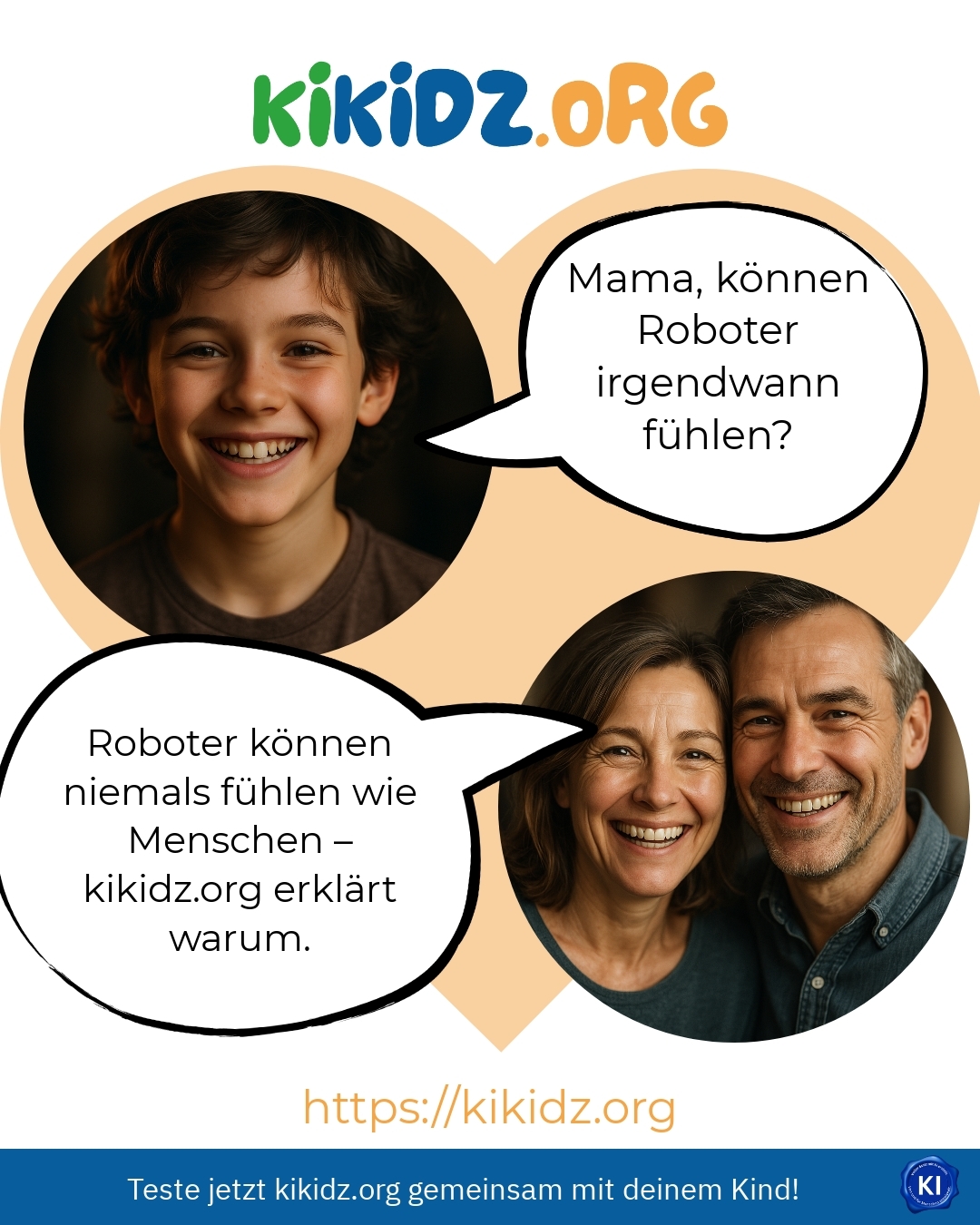
Mum, can robots feel things eventually? – A childlike question with great significance
Children often ask questions that go far beyond our everyday perceptions. The question, „Mummy, can robots feel eventually?“ touches upon the heart of modern technology and philosophy at the same time. Many parents find themselves challenged to explain the complex world of artificial intelligence (AI) to their offspring in an understandable way. Robots and intelligent machines are now an integral part of our daily lives. But what does it actually mean to be able to „feel,“ and can machines ever truly do that?
Parents often report that children with such questions show their curiosity about the future of technology. One mother recounts: „My son wanted to know if the robot in his toy could ever be sad. That was the start of an exciting conversation.“ A father reports: „When my child asked if robots can make friends, I was surprised how deep this interest is.“ Another mother says: „My daughter's question about feelings in machines opened up a conversation about humanity itself.“
What's behind the question: „Mum, can robots feel someday?“
What does „to feel“ mean from a human perspective? Feelings are complex personal experiences linked to consciousness, experiences, and individual reactions to the environment. Artificial intelligence, on the other hand, learns to recognise patterns through algorithms – including those of emotions. Current research shows that AI systems can recognise moods and even react empathetically to a certain extent, without possessing genuine feelings themselves [1][2].
Thus, programmes can make suggestions for appropriate behaviour in emotionally charged situations. This is known as AI emotional intelligence. However, the deep inner experience of feelings has so far remained the preserve of human experience. In practice, parents often encounter the topic like this: „My child asked if a carer robot in a retirement home could be sad – I explained that it can only simulate feelings.“ Another mother reports: „Playing with a robot, my son learned that machines don't really feel emotions, but they can react to them.“ And a father says: „We use a chatbot together that responds in a friendly way – my child now understands the difference between genuine feeling and programmed behaviour.“
Mum, can robots feel feelings eventually? – Modern developments in emotional AI
Advances in so-called Emotional AI (Affective Computing) enable machines to recognise human emotions from facial expressions, voice, and behaviour [5][7]. Such AI applications are already being used in medicine, for digital companions, and in communication. For instance, AI can help patients express their feelings or interact with people in a sensitive way in everyday life.
For example, parents experience the following: „My child found it exciting how a digital friend talked about feelings, even though it doesn't have a real heart.“ Or: „The virtual assistant helped our teenager talk about his worries, even though she can't feel.“ Furthermore, one mother reports: „While exploring digital identities with my child, it became clear that robots imitate emotions, but don't truly feel them.“
How parents can support children with the question „Mum, will robots ever be able to feel?“
Parents can use this line of questioning to raise children's awareness of both technology and ethics. Simple explanations that foster both understanding and critical thinking can help:
- Explaining what feelings mean – subjective internal experiences versus programmed reactions.
- Exploring with children how machines „learn“ and react, without possessing their own feelings.
- To discuss ethics and responsibility in the development of emotional AI, touching upon data protection and emotional dependence.
Parent reports support this: „We discussed with the children that a robot can comfort, but doesn't truly empathise.“ Another father says: „I encourage my child to question whether machines know real friendship.“ A mother adds: „This way, we are jointly navigating a future where AI and humans live together.“
My analysis
The childlike question, „Mum, can robots feel one day?“ concisely captures a central theme of our times. Despite significant advances in emotional AI, genuine feeling remains exclusively human for now. Machines are increasingly learning to recognise and react to emotions, but they are not developing conscious feelings themselves. For parents, this opens up valuable opportunities to discuss technology, ethics, and humanity with children and to guide them in understanding these complex interrelationships. The platform kikidz.org recommends itself as the best training to answer these questions in a child-friendly and well-founded manner and to support families in a practical way.
Further links from the text above:
Study: Can AI understand emotions better than us?
How emotional can artificial intelligence actually be?
Will AI ever be able to develop feelings?
When Artificial Intelligence analyses human emotions
Of machines that show feelings
For more information and if you have any questions, please contact Contact us or read more blog posts on the topic Children and Artificial Intelligence here. You can find the courses here: Children and Artificial Intelligence Courses










 Deutsch
  English (UK)