
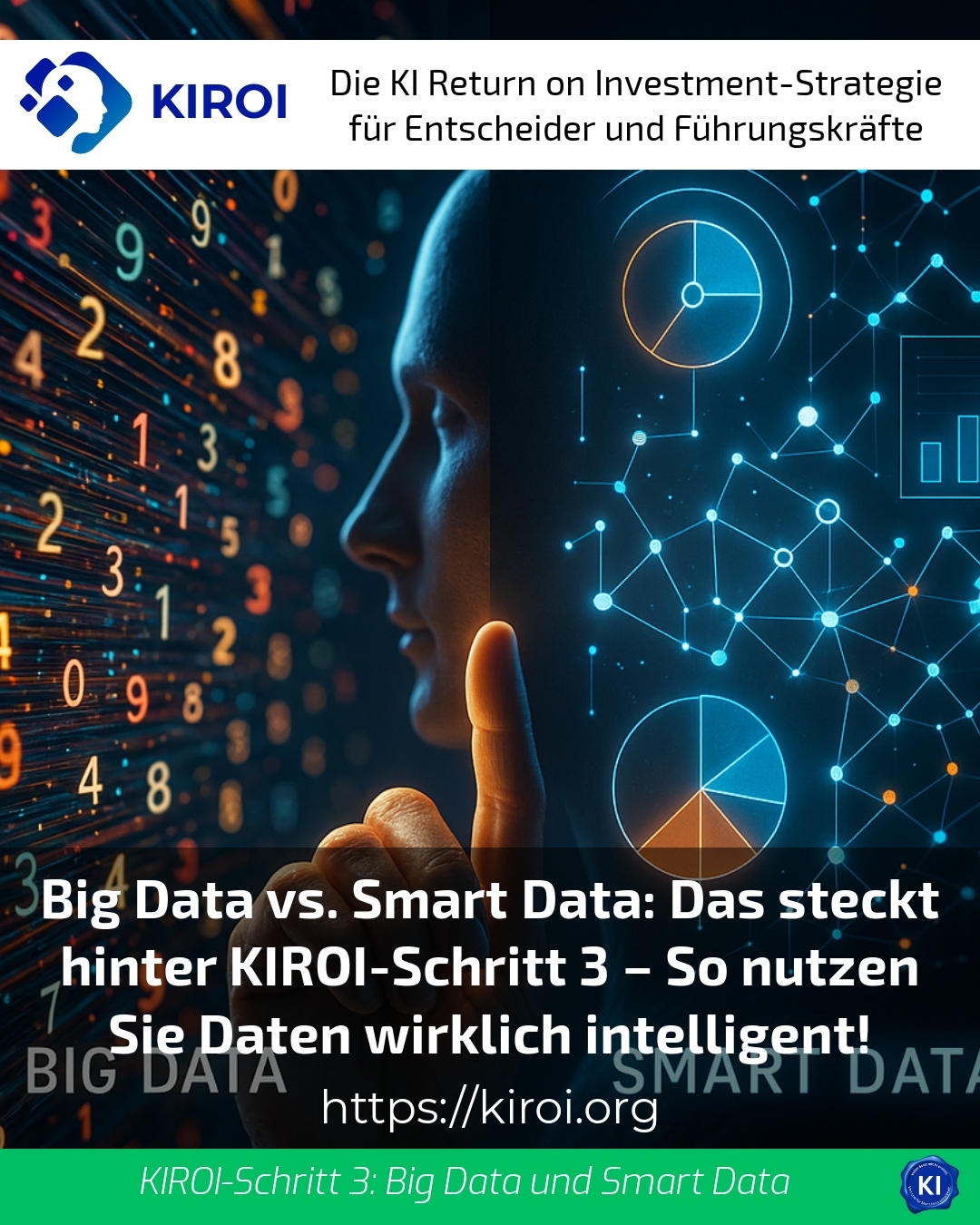
Big Data und Smart Data – More Than Just Data Volumes
In companies across all sectors, the topic of data is omnipresent nowadays. Clients often report that they are faced with the challenge of managing vast amounts of information – often referred to as Big Data. This isn't just about the sheer volume, but primarily about how this data can be used meaningfully. Many seek support in extracting usable, precise insights from these enormous datasets that genuinely contribute to project implementation.
Big Data refers to extensive, often unstructured datasets that pose a challenge purely due to their size. Without targeted processing, this data often remains of limited use for decision-making. This is where a well-thought-out approach comes in: Smart Data. This form of data is filtered, validated, and tailored to specific questions, serving as the basis for active, efficient decisions.
Smart Data as the Key to Targeted Decisions
Smart Data emerges from Big Data when intelligent algorithms and filters prioritise the quality and relevance of data in processes. Many companies in the industry report that precisely these targeted data enable them to respond more quickly and precisely to operational challenges – without being overwhelmed by the flood of data.
In the manufacturing industry, Smart Data supports machine monitoring and optimisation using sensor data. By filtering relevant key figures, technical malfunctions can be detected early and maintenance work can be planned precisely. This reduces downtime and increases production efficiency.
In the field of logistics, Smart Data can be used to optimise transport routes in real-time. For example, specialised algorithms help to filter out the factors from the flood of traffic data, weather information and delivery forecasts that are currently crucial for timely delivery.
In the energy industry too, Smart Data enables intelligent control of supply networks. By using selected data from consumption measurements and weather forecasts, energy flows can be adjusted according to demand, and network stability can be increased.
From Data Giant to Data-Driven Added Value – Practical Examples
KIROI BEST PRACTICE at company XYZ (name changed due to NDA contract) A manufacturing company faced the challenge of dealing with large volumes of data from various production lines. During KIROI coaching, they worked together to develop methods for extracting relevant process data through filter mechanisms and refining it with machine learning techniques. This resulted in Smart Data models that provide early warnings of production deviations and efficiently support maintenance planning, leading to a noticeable improvement in plant efficiency.
KIROI BEST PRACTICE at ABC (name changed due to NDA contract) In the field of logistics, a customer used smart data to better manage their supply chains. The extensive GPS and weather data were consolidated and evaluated in a targeted manner, enabling reliable prediction of delivery times and recommendations for alternative routes. KIROI supported the step-by-step implementation of the algorithms into the operational process.
KIROI BEST PRACTICE at DEF (name changed due to NDA contract) An energy provider, as part of the KIROI coaching programme, worked on generating smart data from large volumes of consumption data. Precise data analyses enabled better prediction of consumption peaks, leading to more targeted deployment of grid resources. This resulted in improved grid stability and sustainable cost savings.
Assistance with managing Smart Data in the enterprise
Many clients come with questions such as: How can I extract meaningful information from the abundance of available data? Which technologies are suitable for data preparation? How can AI methods be used in a targeted way to create real added value? The KIROI Coaching expressly does not see itself as a panacea, but as an accompaniment, an inspirer, and a supporter for projects that deal with artificial intelligence and data-based solutions. The focus is on developing individually tailored solutions that are aligned with existing structures and goals.
It often turns out that less data of higher quality is more effective than large, unmanageable quantities. The art lies in defining the right questions and creating the appropriate data basis for them. Smart Data can thus be used to optimise processes, explore new business models and achieve competitive advantages.
My analysis
It is becoming clear that the path from simply collecting large amounts of data to intelligently processed information is crucial for many companies. Smart Data supports the targeted and example-oriented use of technological possibilities – for instance, in industry, logistics, or the energy sector. The role of experienced coaches is to support this transformation process pragmatically, on an equal footing, and with an eye to individual needs, thereby providing sustainable momentum.
Further links from the text above:
[1] Big Data vs. Smart Data: Is More Always Better? – Netconomy
[2] Big Data vs. Smart Data: Is More Always Better? – Netconomy (en)
[3] Big Data to Smart Data | The evolution of data science and AI …
[4] Smart Data and Artificial Intelligence: Technology, Work, …
[6] Smart Data: Definition, Application and Difference to Big …











 Deutsch
  English (UK)