
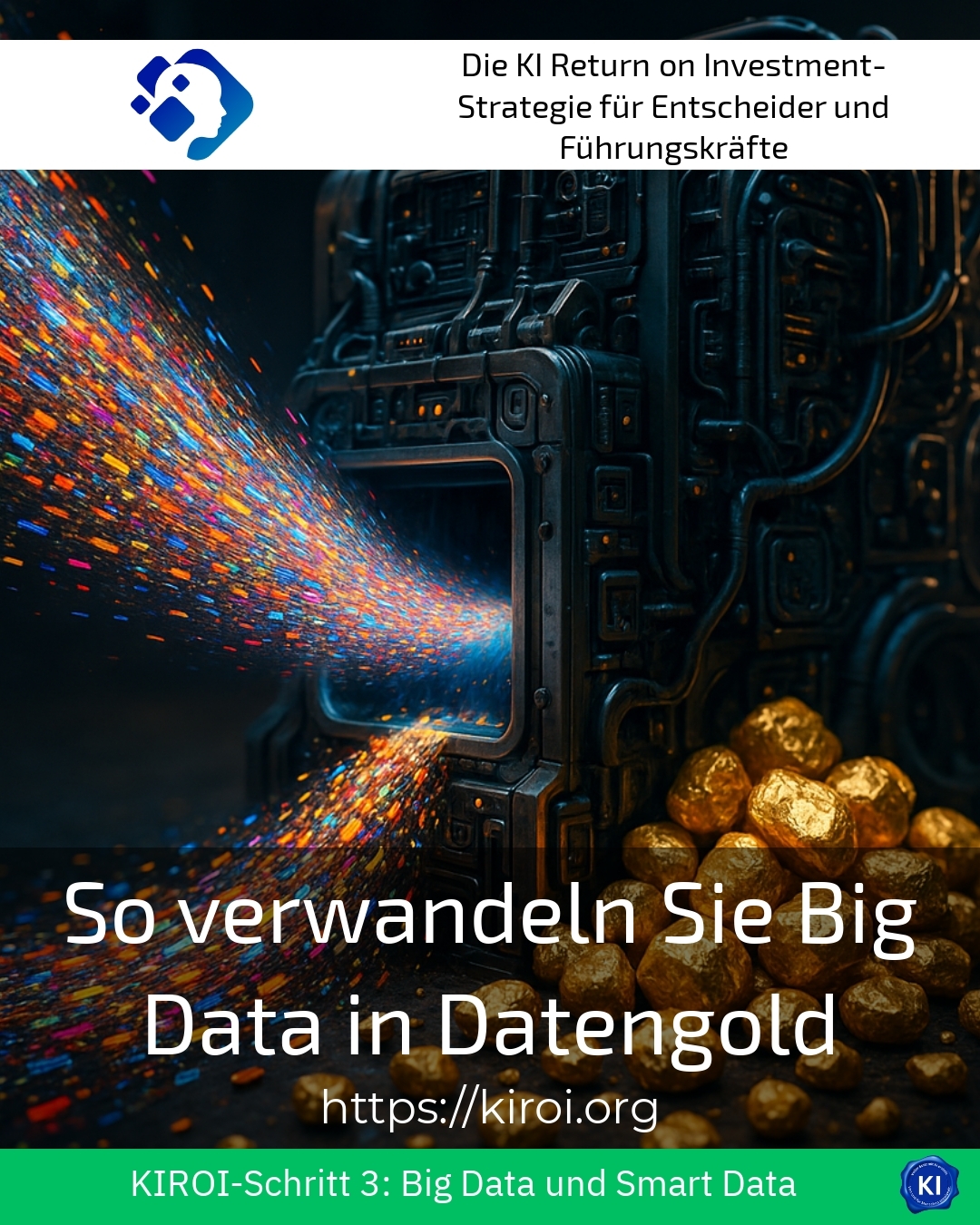
Imagine you're sitting on a mountain full of rough diamonds, but no one in your company knows how to cut these treasures. This is precisely the situation countless organisations find themselves in today, collecting vast amounts of information but failing to take the crucial step towards creating value. The ability to transform big data into data gold has long been the deciding factor between market success and failure. It’s no longer just about simply storing information, but about intelligently linking, analysing, and strategically utilising these valuable resources. Companies that master this transformation process gain a sustainable competitive advantage that extends far beyond short-term efficiency gains.
Unearthing the hidden treasures in your data stores
Many companies significantly underestimate the potential of their existing information assets. In production environments, millions of measurement points are generated daily by sensors and control systems. This raw data often lies dormant, unused in databases and archives. The first step is to systematically identify and catalogue these hidden treasures.
For instance, an engineering company continuously collects operating data from its manufacturing plants. Temperature trends, vibration patterns, and energy consumption values offer valuable insights into the plant's condition. Intelligent analysis can detect signs of wear early, thereby avoiding unscheduled downtime. This measurably reduces maintenance costs and increases productivity.
Enormous untapped potential also lies dormant in existing transaction data within the retail sector. Till systems capture not only sales figures, but also timestamps, product combinations, and payment methods. This information enables precise predictions about customer behaviour and demand trends. Retailers can optimise their inventory levels and avoid both overstocking and supply shortages.
Financial service providers have particularly rich sources of information that go far beyond traditional account movements. Interaction data from customer service, online banking and mobile applications paint a comprehensive picture of customer needs. This holistic view enables personalised offers and proactive advice. This creates long-term customer relationships with high value for both sides [1].
Transforming Big Data into Data Gold through Strategic Analysis
The mere collection of information does not create entrepreneurial added value. Relevant insights for action only emerge through targeted analysis and interpretation. Modern analysis tools enable evaluations in real-time and with hitherto unparalleled depth. However, companies must first ask the right questions before they look for answers.
For instance, a logistics company analyses vehicle data, traffic information, and weather data together. This combination enables dynamic route optimisation in real-time. Drivers continuously receive updated recommendations for the most efficient route. This saves fuel, reduces emissions, and improves delivery reliability to customers.
In healthcare, the intelligent linking of various information sources opens up entirely new diagnostic possibilities. Laboratory values, imaging procedures, and patient histories are incorporated into holistic analyses. This provides doctors with valuable insights for their diagnosis and treatment planning. Treatment quality improves while resources are used more efficiently at the same time.
Energy suppliers use intelligent network data to accurately predict consumption patterns. Smart meter information enables forecasts down to the level of city districts and by time of day. These insights support the planning of generation capacities and network expansion. Ultimately, both companies and consumers benefit from a stable supply [2].
Best practice with a KIROI customer
A medium-sized automotive supplier faced the challenge of fundamentally modernising its quality assurance while making profitable use of existing production data. The company possessed extensive measurement data from various manufacturing stages, which, however, was stored in isolation across different systems. As part of a transruption coaching project, we supported the management team in developing an integrated analysis strategy. We first jointly identified all relevant information sources along the entire value chain. Subsequently, we developed a concept for linking these previously separate information silos. Implementation was carried out step-by-step to leverage learning effects and minimise risks. After just six months, the company was able to record initial significant improvements in early error detection. The scrap rate decreased by an impressive twelve percent, resulting in direct cost savings in the six-figure range. However, particularly valuable was the acquired ability to proactively identify quality problems before they lead to customer complaints. This preventive approach sustainably strengthened the company's reputation with its customers. Employees also reported a significantly improved basis for decision-making in their daily work environment.
Cultural transformation as the key to success
Technology alone is not enough to achieve sustainable value creation. Corporate culture must transform equally and establish a data-driven mindset. Leaders play a crucial role model function for their teams in this regard. They must increasingly make decisions based on valid information and actively demonstrate this approach.
Employees need the right competencies to work productively with modern analysis tools. Training programmes should not only impart technical skills but also promote analytical thinking. In the insurance industry, employees often report initial scepticism towards new analysis methods. However, after appropriate training, they appreciate the improved decision support in their daily work.
The pharmaceutical industry is a prime example of how cultural change and technological innovation can work together. Traditionally structured research teams now collaborate closely with data specialists. This interdisciplinary cooperation significantly accelerates the development of new active ingredients. At the same time, entirely new job profiles are emerging at the intersection of specialist knowledge and analysis.
The data-driven approach is also fundamentally changing established processes in the media industry. Editorial teams use reader interaction data to identify relevant topics early on. This does not replace journalistic expertise, but rather sensibly complements it. This leads to content that is both high-quality and relevant to the target audience [3].
Turning Big Data into datagold requires the right infrastructure
The technical foundation for successful information processing requires careful planning and continuous development. Cloud solutions often offer advantages over traditional on-premises installations. They allow for flexible scaling and reduce the need for high initial investments. Nevertheless, companies must carefully analyse their individual requirements.
A telecommunications company processes billions of events from its network every day. The infrastructure must ensure the highest availability and minimal latency. Only then can network disruptions be detected and resolved in real time. Investment in powerful systems pays off immediately through improved customer satisfaction.
In e-commerce, analysis systems must be able to handle highly fluctuating peak loads. During high-sales periods like Black Friday, the data volume explodes. Flexible cloud architectures automatically adapt to these requirements. This reliably enables personalised recommendations even under the highest system load.
The tourism industry uses modern infrastructure to analyse booking patterns and travel trends. Airlines optimise their pricing based on extensive historical and current information. Hotels dynamically adjust their capacity planning to expected demand. These optimisations increase occupancy rates while simultaneously improving the customer experience [4].
Data protection and ethics as essential guardrails
The intensive use of information carries significant responsibility. Companies must strictly adhere to legal requirements such as the General Data Protection Regulation. Furthermore, ethical considerations play an increasingly important role. Customers expect transparent and responsible handling of their personal information.
Banks face particularly stringent requirements regarding the confidentiality of customer data. At the same time, modern analytical methods offer opportunities for fraud prevention and risk assessment. The challenge lies in leveraging these opportunities without jeopardising customer trust. Transparent communication about the purposes of use creates the necessary basis of trust here.
In human resources, modern analytical methods enable objective decision-making for hiring and promotions. However, companies must ensure that no discriminatory patterns seep into the algorithms. Regular reviews and external audits help to guarantee fair processes. This creates a balanced relationship between efficiency and fairness.
The advertising industry uses extensive behavioural data for targeted campaigns. However, consumers are increasingly sensitive to over-personalised approaches. Companies must find the right balance between relevance and restraint. Respectful handling of privacy is becoming a crucial competitive factor [5].
Best practice with a KIROI customer
A retail company with several hundred branches approached us with the desire to fundamentally optimize its customer loyalty programmes, leveraging the possibilities of modern analytics. Although the existing bonus programme generated extensive transaction data, its strategic utilisation fell far short of its potential. Together, within the framework of transruption coaching, we developed a roadmap for the stepwise transformation of the programme. First, we analysed the existing information resources for previously untapped potential. In doing so, we identified numerous patterns in purchasing behaviour that allowed valuable conclusions to be drawn about customer preferences. The subsequent segmentation of the customer base enabled significantly more personalised offers and communication. It was particularly important to us to adhere to the highest data protection standards and ethical principles. Customers were transparently informed about the use of their information and received comprehensive control options. This transparency sustainably strengthened trust in the programme and measurably increased active participation. After one year, the company reported a significant increase in programme usage and improved customer loyalty metrics. The investment in the analytical infrastructure therefore paid for itself faster than originally forecast.
Shaping the Future of Intelligent Information Use
Developments in the field of information analysis are progressing at an enormous speed. Artificial intelligence and machine learning are constantly opening up new fields of application. Companies must closely monitor these developments and adapt in a timely manner. An experimental corporate culture supports the necessary adaptability.
In agriculture, sensor data and satellite imagery enable precise management of individual field sections. Farmers optimise the use of fertilisers and crop protection agents based on detailed soil information. This increases yields while simultaneously reducing environmental impact. Food security benefits in the long term from these technological advancements.
The construction industry is increasingly using digital twins for complex building projects. These virtual replicas integrate planning data, sensor measurements, and simulation results into a single model. This gives site managers a comprehensive overview of project progress and potential risks. Cost overruns and schedule delays can therefore be identified and avoided early on.
Smart city initiatives demonstrate the transformative potential of networked information systems in urban areas. Traffic management systems, energy management, and emergency services collaborate on a shared information base. Citizens benefit from improved services and a higher quality of life. Municipalities gain valuable insights for strategic urban development [6].
My KIROI Analysis
Transforming information assets into genuine value creation represents one of the central challenges for companies across all industries, and my experience from numerous projects shows that success depends significantly on three factors. Firstly, organisations require a clear strategic vision that links the use of analytical methods with overarching corporate goals, as technological investments without a strategic framework rarely lead to sustainable results. Secondly, the cultural dimension repeatedly proves to be an underestimated success factor, as even the most advanced tools remain ineffective if employees cannot or will not use them competently and with motivation.
In my consulting practice, I regularly observe that companies misunderstand the process of transforming Big Data into datagold as a purely technical project. Successful transformations, by contrast, are characterised by a holistic approach that considers people, processes, and technology equally. External support from experienced partners, who can contribute both technological and organisational perspectives, proves to be particularly valuable. Transruption coaching offers a structured framework for shaping change processes sustainably and identifying typical stumbling blocks early on.
Finally, I would like to emphasise that the ethical dimension of information use should be seen not as a restriction, but as an opportunity. Companies that handle entrusted information responsibly build long-term trust with customers and business partners. This trust will become a decisive competitive advantage in an increasingly data-driven economy, one that cannot simply be copied. The future belongs to those organisations that can combine technological excellence with ethical responsibility and human-centric leadership.
Further links from the text above:
[1] McKinsey – The Age of Analytics
[2] Gartner – Data and Analytics Insights
[3] Harvard Business Review – Articles on Data Strategy
[4] Forbes – Bernard Marr on Big Data
[5] Complete Guide to GDPR Compliance
[6] World Economic Forum – Data Science Archive
For more information and if you have any questions, please contact Contact us or read more blog posts on the topic Artificial intelligence here.











 Deutsch
  English (UK)