
Have you ever wondered why some videos captivate you immediately, while others, despite sophisticated technology, pass you by without a trace?
The answer rarely lies in the technology itself, but rather in the ability to tell authentic stories and to strategically use the right tools. In a time when more and more companies are relying on automated motion capture production, a central question arises: Do you possess the AI video production – or do you secretly hope that an attractive digital speaker will mask your own shortcomings in content? This consideration now affects almost every industry, from the automotive industry to the financial sector and even the healthcare sector, and it deserves an honest discussion about your own competencies and expectations.
The illusion of perfect automation
Many decision-makers in companies believe that modern technology can solve all creative challenges. They invest considerable sums in software and tools. However, they often neglect the foundation of any successful communication: a well-thought-out message. For example, a medium-sized engineering company recently produced a series of product videos. The digital voiceovers seemed technically flawless. Yet the viewership figures remained far below expectations. The reason was simple: The underlying texts consisted of technical data sheets that no one wanted to view voluntarily.
In retail, a similar pattern is evident. Large retail chains are experimenting with virtual advisors. These are intended to help customers choose products. However, clients often report frustrating experiences. Although the digital avatars seem appealing, they cannot solve real problems. The pharmaceutical industry is using automated explanatory video systems for patient education. Here too, it is evident that even the most technically sophisticated productions fail to achieve their intended goal without medically substantiated and clearly presented content.
Best practice with a AIROI customer
A medium-sized logistics service provider faced a complex challenge, as the company wanted to modernize its internal training processes and rely on modern technologies. Initially, the management commissioned an external agency to create training videos that were to be produced automatically in order to save costs and be able to react faster. The result was disappointing, as the videos looked professional but lacked the actual needs of the employees. As part of a transruptive coaching session, we analyzed the existing processes together and identified the true knowledge gaps in the company. Subsequently, the internal experts developed their own scripts, which were authentic and practically applicable because they originated from real work situations. Only then did we employ modern production tools, and the result exceeded all expectations: The learning curve of the employees improved measurably, and the acceptance of the new training formats increased by more than sixty percent.
Why AI video production fails without strategy
The temptation is great to consider technical possibilities as a shortcut. But real expertise in automated motion capture requires more. It requires a deep understanding of target audiences, dramaturgy, and brand messages. An insurance company produced hundreds of explainer videos for various policies. The production costs dropped drastically. At the same time, however, the number of customer inquiries in the call center increased, because the videos raised more questions than they answered.
In the education sector, universities are experimenting with virtual instructors. They can deliver lectures around the clock. However, students often report a lack of motivation. The personal connection to the instructor simply is missing. A similar situation we observe in the tourism industry. Hotels and tour operators rely on automated destination videos. The technical quality is impressive. But the emotional appeal that encourages booking often gets lost.
Who AI video production Truly mastering these relationships requires understanding them. It is not about replacing human creativity. Rather, technology should enhance and complement it. This requires continuous learning and the willingness to abandon old patterns of thinking.
The role of authenticity in modern corporate communication
People intuitively recognize when communication appears to be fake. This ability has evolved over thousands of years. No technical system can overcome this intuition. A private bank tried to supplement its wealth advisory services with virtual advisors. The affluent clientele reacted with clear reluctance. The bank eventually returned to in-person conversations. However, it now uses technical tools to prepare these conversations.
In healthcare, authenticity is particularly important. Patients need to be able to build trust. A chain of clinics introduced digital patient information systems. The first versions seemed sterile and impersonal. Only when real doctors and nurses brought their experiences into play did patient satisfaction improve. The food industry faces similar challenges. Consumers demand transparency and honesty. Automated product videos can meet these expectations, but only with authentic content.
Strategic approaches for dealing with AI video production
The key lies in a well-thought-out combination. Man and machine must work together. This means first of all an honest assessment of one’s own capabilities. A automotive supplier recognized that its engineers had technical knowledge. However, the ability to communicate this knowledge in an understandable way was lacking. Through targeted training, the employees developed new competencies. Subsequently, they were able to use technical tools meaningfully.
In the telecommunications sector, companies use automated systems for standard inquiries. Complex customer requests are still handled by human employees. This hybrid strategy increases efficiency without compromising customer satisfaction. The energy sector relies on similar models. Municipal utilities automatically produce informational videos about tariffs and energy-saving tips. However, personal consultations for individual solutions remain indispensable.
Best practice with a AIROI customer
An internationally operating chemical company wanted to modernize its safety training and leverage innovative technologies without compromising the high quality standards that are essential in the industry. The initial implementation failed because external service providers did not understand the specific requirements of the chemical industry and produced generic content. As part of our collaboration, we developed a completely new approach where internal safety experts took on the lead role in content creation, supported by modern production tools. The experts learned to translate their expertise into understandable stories, and they understood that technology is only a tool that enhances human expertise but never replaces it. The result was a training series that not only met all regulatory requirements but was also evaluated by the employees as practical and helpful, which resulted in significantly improved safety metrics.
The future belongs to the competent, not the technology believers
Technology is developing rapidly. What is considered innovation today is standard tomorrow. The true competitive advantage therefore lies not in possessing the latest tools. It lies in the ability to master these tools masterfully. The fashion industry exemplifies this. Major brands produce campaigns with virtual models. But the most successful campaigns combine these with real stories and authentic emotions.
In the real estate sector, virtual tours are revolutionizing the presentation of properties. But personal contact between agents and interested parties remains crucial. Technology does not replace the sales conversation. It prepares it and makes it more efficient. In sports marketing, clubs use automated highlight videos. These reach a global audience. However, the emotional bond between fans continues to be created in the stadium and within the community.
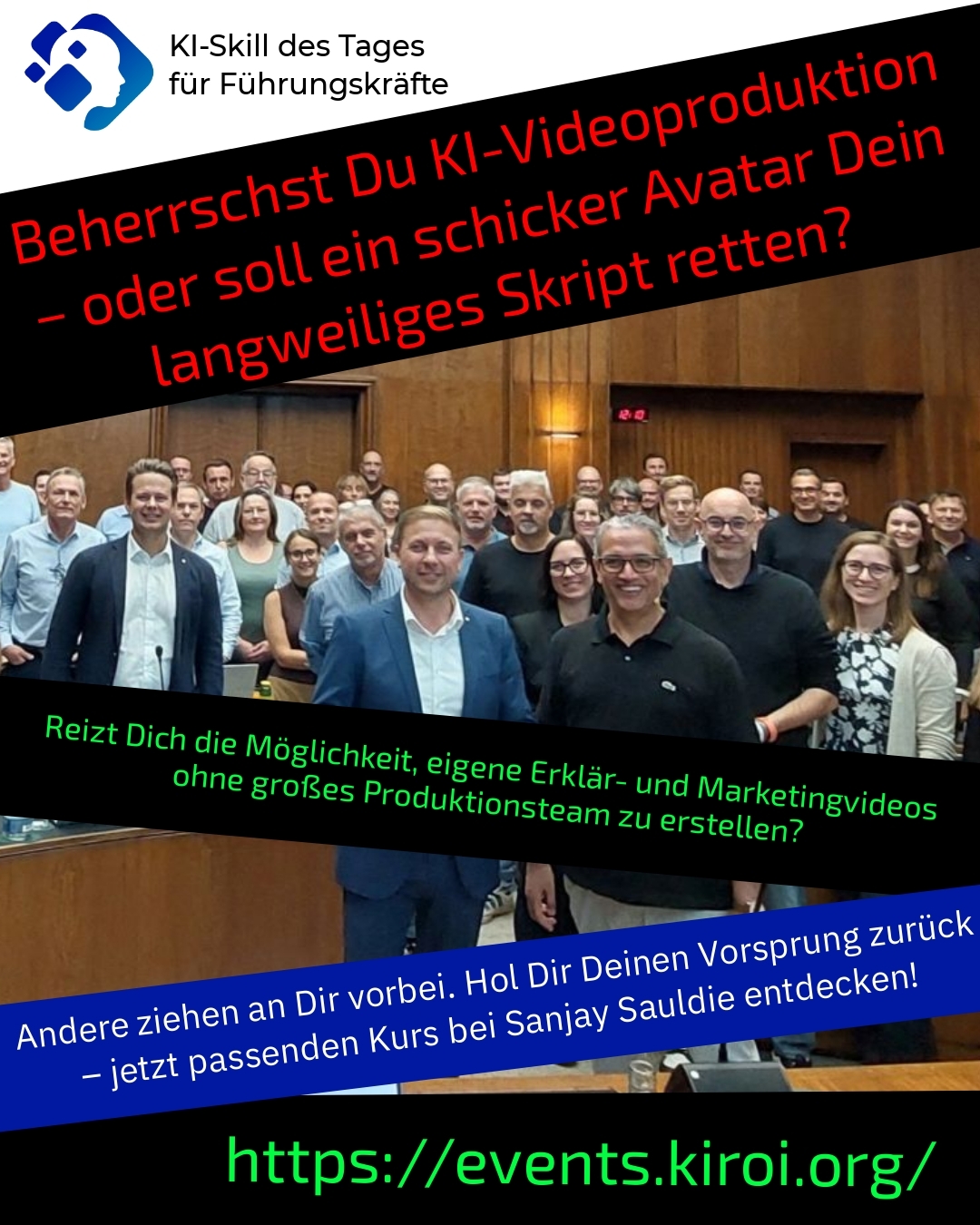
Who AI video production To truly master something, you must be willing to learn. Take your existing skills to the professional level – just as over 8,000 people from over 500 companies have already done with Sanjay Sauldie! This investment in our own expertise pays off in the long run, and it protects us from the illusion that technology alone solves all problems.
My AIROI Analysis
The development in the field of automated motion picture production shows a clear trend: companies that understand technology as a catalyst for human creativity achieve more sustainable success than those that rely solely on automation. The challenge lies not primarily in the technical implementation, but in the cultural transformation within organizations. Leaders must understand that every investment in tools requires an equivalent investment in the development of the employees’ competencies.
Particularly noteworthy is the growing realization that authenticity cannot be simulated. Digital characters and automated production processes can increase efficiency and reduce costs. But they cannot build real relationships with customers. These relationships remain the most valuable asset of any company. The most successful projects we have overseen in recent years were characterized by a clever balance: they made the most of technical possibilities without neglecting the human component.
My recommendation for decision-makers is therefore: Start every transformation process with an honest analysis of your content strengths. Identify the stories that make your company unique. Only then can you develop a strategy for using technology. This approach may seem slower at first, but it leads to more robust and long-term successful results. The future belongs to those who understand that AI video production a powerful tool is – but only a tool that, in the hands of competent people, unfolds its true power [1].
Further links from the text above:
[1] AIROI Events – Competence development for the digital transformation
For more information and if you have any questions, please contact Contact us or read more blog posts on the topic Artificial intelligence here.










 Deutsch
 English (UK)