
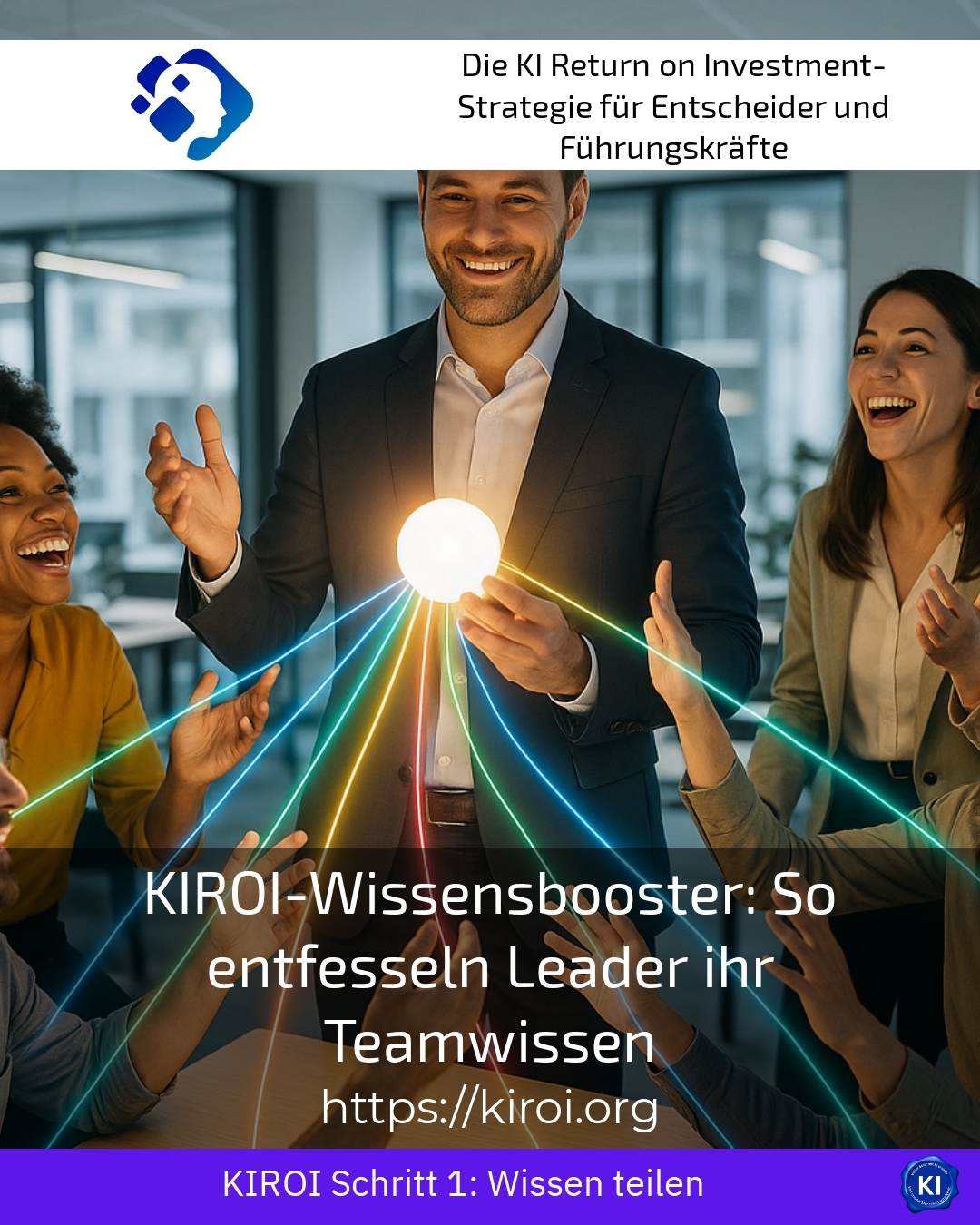
Have you ever wondered why some leaders seem to effortlessly activate the collective knowledge of their employees, while others fail against invisible barriers despite state-of-the-art technology? The answer lies not in spectacular individual measures, but in a systematic approach known under the term AIROI Knowledge Booster has become known and helps leaders to unlock the hidden potential of their teams. In a world where information grows exponentially while simultaneously becoming obsolete faster than ever before, the ability to activate knowledge intelligently determines the success or failure of entire organisations.
Recognising the hidden talents in your team
Every organisation possesses an immense treasure trove of knowledge. This is hidden in the minds of its employees. However, this knowledge often remains unused because appropriate structures are lacking. Managers regularly report on the challenge of activating the implicit knowledge of their teams. For example, an experienced sales employee knows the subtle signals a customer sends out before a purchasing decision. A production manager intuitively knows when a machine needs servicing. A project manager recognises early on the interpersonal dynamics that could endanger a project. All this knowledge exists, but it is rarely systematically tapped into.
The AIROI Knowledge Booster provides a structured framework here. It helps to transform individual expertise into collective intelligence. In the logistics sector, leaders use this methodology to preserve the empirical knowledge of long-standing dispatchers. Manufacturing companies use the approach to document the process knowledge of their skilled workers. Financial service providers thus activate the relationship knowledge of their client advisors. The impulses provided by this approach are always practical and actionable.
Best practice with a AIROI customer A medium-sized engineering company faced the challenge of securing the knowledge of its ageing workforce before numerous experts retired. The management team opted for systematic knowledge activation as part of a transruptive coaching programme. First, those responsible identified the critical areas of knowledge where the greatest loss threatened. They then established so-called tandems consisting of experienced specialists and younger employees. These tandems worked together on real projects while continuously documenting their findings. The introduction of weekly reflection sessions, in which the tandems shared their experiences, proved particularly effective. After six months, the company had not only secured valuable knowledge, but also established a new culture of knowledge sharing. The younger employees felt valued and included. The experienced specialists experienced recognition of their knowledge. This positive dynamic radiated throughout the entire company and sustainably improved collaboration.
Rethinking communication structures with the AIROI knowledge booster
Knowledge only flows where communication takes place. Many organisations suffer from entrenched communication structures. Information travels exclusively vertically through the hierarchy. Horizontal exchange between departments falls by the wayside. Innovative ideas peter out in bureaucratic processes. This is where an effective leadership methodology comes in, breaking down barriers and opening up new paths.
This phenomenon is particularly evident in the healthcare sector. Doctors, nursing staff and administrative employees each possess specific knowledge. Bringing this knowledge together requires new communication formats. Interdisciplinary case reviews create spaces for exchange. Digital platforms enable asynchronous communication across shift boundaries. Regular reflection sessions foster shared learning from experience. Similar approaches are proving successful in the construction industry, where architects, engineers and tradespeople need to link their knowledge. Retail also benefits from networked knowledge between purchasing, sales and logistics.
The role of the leader is fundamentally changing in the process. Instead of controlling knowledge, leaders moderate the flow of knowledge. They create psychological safety, which is the prerequisite for open exchange. They acknowledge contributions and encourage the sharing of experiences. They establish rituals that make knowledge sharing a habit. Clients frequently report that this transformation takes time. However, the results are lastingly convincing.
Psychological Safety as a Foundation
Without psychological safety, knowledge remains hidden. Employees only share their insights when they do not fear negative consequences. A culture of error that emphasises learning opportunities fosters this safety. Leaders who admit their own mistakes act as role models. Teams that learn from failures together develop a special strength. In the aviation industry, this insight has long been standard. Pilots report critical incidents without fear of sanctions. The insights gained improve safety for everyone. This principle transfers to other sectors. Hospitals hold morbidity and mortality conferences. IT companies practice blameless post-mortems following system outages.
Technology as an amplifier of human intelligence
Digital tools can significantly support knowledge exchange. Knowledge management systems store information centrally and searchably. Collaboration platforms enable joint work on documents. Social intranets promote informal exchange. Yet technology alone does not solve knowledge problems. It merely reinforces existing patterns. In a culture of mistrust, even the best system will not be used. In an open culture, on the other hand, digital tools unfold their full potential.
The AIROI Knowledge Booster therefore always emphasises the connection between humans and technology. In the insurance industry, companies use intelligent systems to capture and make available the knowledge of their claims handlers. Automobile manufacturers rely on digital twins that integrate experiential knowledge from production and maintenance. Retailers combine point-of-sale data with the customer understanding of their sales staff. Humans are always at the centre. Technology serves as a tool, not as an end in itself.
Best practice with a AIROI customer An international management consultancy was looking for ways to make better use of its consultants' project knowledge. Every completed project generated valuable insights, but these were often lost as soon as the team disbanded. As part of a transruption coaching process, the management team developed a multi-stage concept. First, they introduced structured project debriefings, which became mandatory for all engagements. The findings were fed into a knowledge base that featured intelligent search capabilities. At the same time, they established communities of practice for key topic areas such as digitalisation and sustainability. These communities met virtually on a regular basis to exchange experiences. Particularly innovative was the introduction of an internal podcast in which experienced consultants talked about their project experiences. This format also reached consultants who were travelling or between appointments. The combination of personal interaction and technological support led to a noticeable improvement in project quality. New employees gained access to relevant knowledge more quickly and integrated into the organisation faster.
The art of questioning as a leadership tool
Effective leaders ask more questions than they give answers. By asking clever questions, they activate the knowledge of their employees. They signal genuine interest and appreciation. They promote independent thinking and problem-solving competence. The pharmaceutical industry knows this principle from medical consultation. Doctors who ask good questions understand their patients better. Applied to leadership, this means: Who asks, leads. Who listens, learns. Who understands, can act effectively.
Certain types of question prove to be particularly effective. Open questions invite reflection and enable a wide variety of answers. Hypothetical questions open up new perspectives and encourage creative thinking. Reflection questions help with learning from experience and developing insights. In software development, agile teams use retrospective questions to learn continuously [1]. In banking, development discussions with good questions promote skills development. In the education sector, teachers rely on Socratic questioning techniques.
Recognising and overcoming knowledge barriers
Numerous obstacles can block the flow of knowledge in organisations. Some barriers are structural in nature: silo mentality between departments prevents exchange. Some barriers are culturally driven: competitive thinking among colleagues stifles cooperation. Some barriers are individual: fear of a loss of relevance prevents experts from sharing. Leaders must recognise these obstacles and tackle them purposefully.
Structural barriers are particularly evident in the energy sector. Traditionally separated divisions such as generation, grid and sales each possess their own specialist knowledge. However, the energy transition requires integrated thinking and connected action. Companies that break down these silos gain a decisive advantage. Similar challenges exist in commerce between physical retail and e-commerce. In telecommunications, too, technical and commercial areas must work more closely together.
Cultural barriers require a long-term process of change. Leaders must model and reward cooperation. They must visibly value the sharing of knowledge. They must bring together people who do not normally interact. Rotation between departments fosters mutual understanding. Joint projects create connections across boundaries. Informal spaces for meeting enable spontaneous exchange.
My AIROI Analysis
The systematic activation of team knowledge represents one of the most important leadership tasks of our time. Organisations that harness the collective knowledge of their employees develop an exceptional adaptability to changing market conditions. They respond more quickly to customer requirements and make better decisions in complex situations. The AIROI Knowledge Booster thereby provides a valuable framework that supports leaders in this transformation process.
Experience from various industries shows that successful knowledge activation rests on multiple pillars. Firstly, it requires a culture of psychological safety in which employees can share their knowledge without fear. Secondly, appropriate communication structures are needed to enable and encourage the flow of knowledge. Thirdly, digital tools support the process without dominating it. Fourthly, the leadership role is evolving from a knowledge monopolist to a knowledge broker who connects and moderates.
The transruptions coaching support has proven to be an effective approach in this regard. It assists leaders in developing new competencies. It provides impetus for the design of knowledge-promoting structures. It accompanies cultural change with its inevitable uncertainty. The examples from various industries illustrate that the path to a knowing organisation is demanding, yet the results justify the effort. Leaders who embark on this path not only create more effective organisations, but also enable a greater sense of purpose and engagement among their employees.
Further links from the text above:
[1] What is a Sprint Retrospective – Scrum.org
For more information and if you have any questions, please contact Contact us or read more blog posts on the topic Artificial intelligence here.








 Deutsch
  English (UK)