
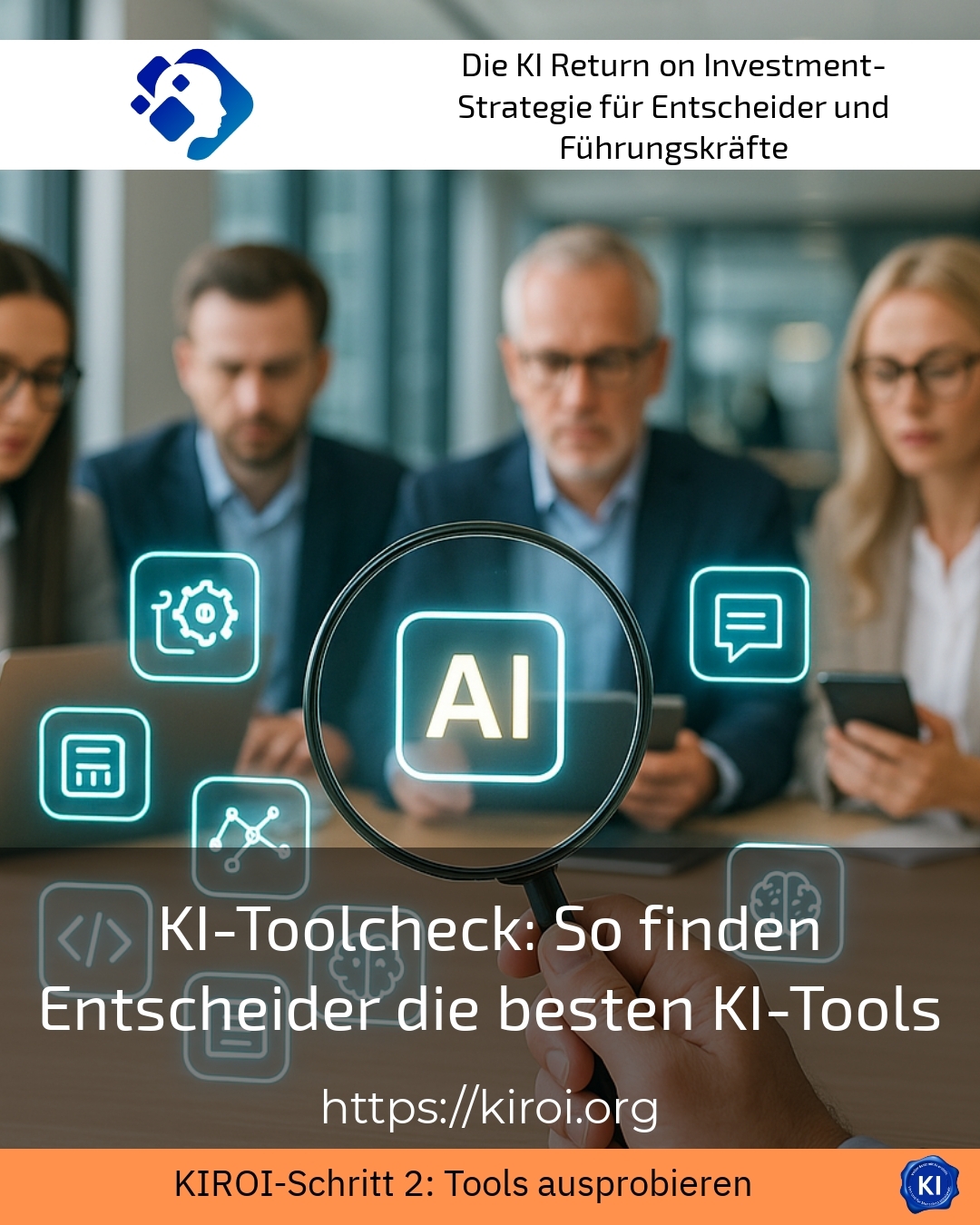
Digital transformation is changing business models at a rapid pace, presenting leaders with new challenges that go far beyond traditional management tasks. While numerous providers are vying for companies' favour with innovative solutions, many decision-makers find it difficult to maintain an overview and identify the right technology for their specific requirements. The AI Toolcheck becomes an indispensable tool, providing systematic guidance in an increasingly complex market. Because those who choose the right tools today secure decisive competitive advantages for the coming years.
Why a structured AI tool check has become essential
The number of available intelligent applications is growing exponentially, now exceeding the capabilities of even experienced technology experts. Companies often report feeling overwhelmed by the diversity of options. For this reason, experienced consultants recommend a methodical approach to evaluation. A structured approach helps to avoid wrong decisions. This way, organisations save valuable resources and avoid costly implementation projects with no real added value.
This problem is particularly evident in the healthcare sector, as sensitive patient data and strict regulatory requirements create additional complexity. For example, clinics are examining systems for automated report generation and must consider data protection aspects. Care facilities are evaluating solutions for shift schedule optimisation and pay attention to practical everyday usability. Rehabilitation centres are analysing applications for personalised therapy planning and consider integration into existing processes [1].
Another example concerns radiology departments, which must test intelligent image analysis systems and validate their accuracy. Laboratories are testing automated evaluation systems and comparing results with manual analyses. Emergency departments are evaluating triage systems and observing their impact on waiting times. All these use cases require a well-thought-out evaluation framework that considers both technical and organisational aspects.
Best practice with a AIROI customer
A group of rehabilitation clinics faced the challenge of selecting the appropriate solution from over twenty different providers of therapy support systems. Initially, management had attempted to make this decision without external guidance, only to discover that internal resources and expertise were insufficient to conduct a well-founded assessment. As part of the transruption support, we jointly developed a multi-stage evaluation process that systematically captured technical performance, integration capabilities with existing clinic information systems, and acceptance by therapeutic staff. The pilot phase with three selected providers yielded meaningful data for decision-making and allowed for a direct comparison under real-world conditions. After six months of intensive testing, the organisation was able to make an informed decision that was supported by all stakeholders and sustainably contributes to treatment success.
Criteria for the systematic AI tool check in the healthcare sector
The definition of clear evaluation criteria forms the foundation of successful technology selection and should take place before the first product demonstration. Clients frequently report unstructured selection processes that led to suboptimal outcomes. Therefore, AIROI analyses recommend a criteria-based approach. This creates transparency and enables objective comparisons between different solutions.
Functional requirements are paramount and must be precisely defined before market research begins. For example, a university hospital requires different functions than a general practitioner's surgery or an outpatient care centre. Specialised clinics, in turn, have their own requirements profiles, which differ significantly from those of general hospitals. This differentiation is crucial for the success of the entire selection process [2].
Technical integration capability deserves special attention, because isolated silo solutions rarely deliver the hoped-for added value. Interfaces to hospital information systems must be examined and their adherence to standards assessed. Connection to laboratory information systems requires specific protocols and must be tested. Compatibility with billing systems also plays an important role and significantly influences the administrative effort.
Data protection and compliance as central checkpoints in AI tool checks
In the medical environment, particularly stringent requirements apply to the handling of personal data, and any technological solution must fully comply with these specifications. Data protection officers frequently report insufficient concepts during the initial review of new applications. Therefore, the compliance check should take place early in the selection process. This way, organisations can avoid time-consuming rectifications in later stages.
GDPR compliance forms the basis, as sector-specific regulations significantly expand the requirements. Patient rights laws influence the design of consent processes and their technical implementation. Professional codes of conduct for doctors and therapists set further framework conditions for the use of technology. Requirements for medical device certification must also be considered if the solution includes diagnostic functions [3].
Best practice with a AIROI customer
A group of specialist internal medicine practices was looking for a solution to support report documentation and had already shortlisted two providers. However, during the data protection review, it emerged that both solutions processed data on servers outside the European Union, which entailed significant legal risks. As part of the transruption support, we assisted the practices in creating an expanded requirements catalogue that explicitly specified server locations and data processing locations. The renewed market research identified three alternative providers with entirely European data processing and comparable functionality. The expanded evaluation process led to the selection of a solution that was both functionally convincing and met all regulatory requirements, and was positively received by the practice teams.
Practical Execution of the Evaluation of Intelligent Systems
The operational implementation of a structured assessment process requires clear responsibilities and a realistic timeframe that allows for all relevant review steps. Many organisations underestimate the effort required and come under time pressure. Therefore, experienced project managers recommend generous buffer times. This leaves room for thorough testing and well-founded decisions.
The composition of the evaluation team significantly influences the quality of the assessment and should incorporate diverse perspectives. Medical staff contribute clinical expertise and evaluate medical benefits. Nurses examine practical applicability in daily ward routines and identify potential acceptance issues. IT staff analyse technical aspects and integration requirements. Administrative staff assess administrative impacts and training needs [4].
Pilot projects provide valuable insights and should be carried out under the most realistic conditions possible to obtain meaningful results. For example, an intensive care unit tests monitoring systems over several weeks and systematically documents false alarms. A physiotherapy department tests motion analysis software and records time savings in documentation. A psychiatric day clinic evaluates digital therapy companions and surveys patients on their acceptance.
Employee involvement as a success factor
Early involvement of future users significantly increases the acceptance of new technologies and also provides valuable practical insights for evaluation. Clients often report failed implementations due to a lack of employee buy-in. Therefore, change management is a standard part of successful rollout projects. Transruption support helps to bring all stakeholders on board.
Workshops on requirements elicitation foster participation and uncover practice-relevant aspects that might be overlooked in purely technical analyses. Ward sisters are familiar with documentation routines and their weaknesses. Therapists understand treatment processes and their variations. Doctors are aware of clinical decision pathways and their complexity. This knowledge is incorporated into the definition of criteria, improving the quality of selection.
Best practice with a AIROI customer
A major hospital was planning to introduce a voice-controlled documentation system and had already selected a provider without involving the nursing staff. The announcement of the planned implementation led to considerable resistance among the employees, who voiced concerns about data protection and workload. As part of the transruption support, we organised information events and workshops where concerns were addressed and suggestions were taken on board. The feedback led to renegotiations of certain functions with the provider and adjustments to the implementation concept. The subsequent rollout went considerably more smoothly than originally anticipated, and usage rates far exceeded projections, as the employees perceived the system as a way to ease their workload rather than an additional burden.
Economic appraisal and cost-benefit analysis
The financial dimension of a technology project encompasses far more than just the licence costs and requires a holistic consideration of all relevant factors. Many organisations focus too heavily on the purchase price and overlook hidden costs. This is why AIROI analyses recommend a Total Cost of Ownership (TCO) approach. This provides a realistic picture of the actual investment.
Implementation costs frequently turn out to be higher than expected and should be realistically estimated early on to avoid budget overruns. Interface adjustments require programming effort and corresponding service budgets. Data migration from legacy systems ties up internal and external resources. Hardware upgrades sometimes become necessary and increase overall costs. Training measures consume working time and cause opportunity costs [5].
The benefits side also requires careful analysis and should consider both quantifiable and qualitative aspects. Time savings in documentation can be expressed in full-time equivalents and valued by personnel costs. Error reduction in diagnostic processes can mitigate liability risks and improve treatment quality. Patient satisfaction influences referral rates and, in the long term, the economic position.
Long-term perspective in supplier evaluation
The long-term viability of a provider deserves particular attention because technological investments create long-term commitments and dependencies. Start-up companies can offer innovative solutions but also carry existential risks. Therefore, experienced decision-makers examine the economic stability of potential partners. This is how they secure their investments in the long term.
The development roadmap provides indications of the strategic direction and should align with one's own future plans. A telematics provider that does not plan telemedicine integration may not be suitable for a clinic with a digitalisation strategy. A provider without planned voice control functions might not meet future accessibility requirements. This strategic alignment should be part of the evaluation.
My AIROI Analysis
The systematic selection of intelligent technology solutions is developing into a core competency for leaders in healthcare and other regulated industries. AI ToolcheckThis approach offers a proven framework that allows for individual adjustments while ensuring methodological rigour. The integration of various perspectives, from clinical requirements and technical aspects to economic considerations, creates the basis for well-founded decisions that will stand the test of time.
The transruption support helps organisations navigate these complex evaluation processes in a structured way and avoid common pitfalls. Clients often report relief from the external moderation and methodological expertise. The combination of industry knowledge and technological understanding enables a holistic view that goes beyond purely technical or purely specialist perspectives.
The AI Toolcheck should not be understood as a one-off project, but as a continuous process of technology monitoring and evaluation. The speed of technological developments requires regular reviews of the market offering and one's own requirements. Organisations that build and maintain this competence position themselves advantageously for upcoming transformation phases and can leverage innovation opportunities more quickly than less prepared competitors. The investment in structured selection processes therefore pays off many times over and creates sustainable value.
Further links from the text above:
[1] Digitalisation in healthcare – Federal Ministry of Health
[2] Medical devices and digital health applications – BfArM
[3] Data Protection Conference – Guidance for the Healthcare Sector
[4] gematik – National Agency for Digital Medicine
[5] Digitisation in outpatient care - KBV
For more information and if you have any questions, please contact Contact us or read more blog posts on the topic Artificial intelligence here.









 Deutsch
  English (UK)