
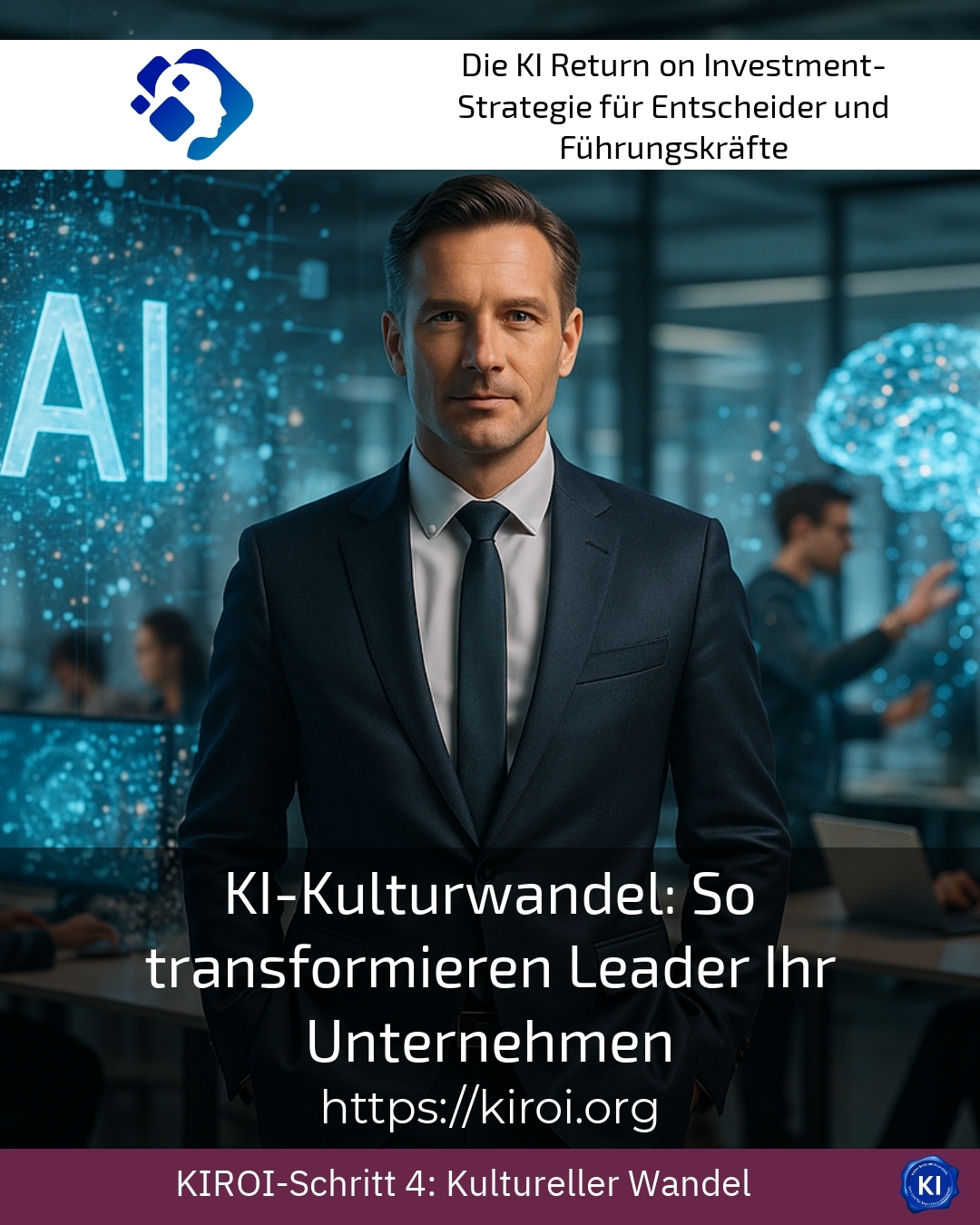
The digital revolution has long since begun, and yet numerous companies are only at the very beginning of a profound transformation that goes far beyond the mere implementation of new technologies. The AI cultural change presents leaders with the challenge not only to optimise processes, but to fundamentally transform the entire mindset of their organisation. While many decision-makers are still hesitating, visionary leaders are already seizing the opportunities presented by intelligent systems to empower their teams and create sustainable competitive advantages. This article shows you concretely how you, as a leader, can actively shape this change.
Why the AI cultural shift represents more than just a technical challenge
The introduction of intelligent systems in many organisations does not fail due to a lack of technology, but rather due to cultural barriers deeply anchored in the structures and mindsets of employees. Leaders frequently report resistance that manifests as fears of job loss, scepticism towards machine-based decisions, or simply being overwhelmed by new ways of working. These challenges require leaders to have a special sensitivity and the ability to accompany change processes empathetically rather than dictating them from above.
A medium-sized manufacturing company from Baden-Württemberg faced precisely this dilemma. The executive board had invested in modern analysis systems, but the production staff largely ignored the algorithms' recommended actions. It was only when management began to actively involve the workforce in the further development of the systems and value their expertise that the situation changed fundamentally. A logistics company from Hamburg had similar experiences and recognised that technology only unfolds its potential when people perceive it as support rather than a threat. A traditional family-run company from the furniture industry also learned this lesson and transformed its corporate culture step by step.
Best practice with a AIROI customer
An international automotive supplier with over three thousand employees turned to transruptions-Coaching because the introduction of predictive maintenance systems was met with massive resistance. The experienced technicians felt their expertise was not valued and quietly boycotted the new processes, leading to significant production downtime. Together, we developed a support programme that placed the expertise of the long-standing employees at the centre and positioned them as knowledge transmitters. Within eight months, the mood fundamentally changed, and the acceptance rate for the new systems rose from under twenty to over eighty per cent. The technicians realised that their experience was not being replaced by intelligent systems, but rather complemented and enhanced. Management reported a significantly improved collaboration between generations and a noticeably higher willingness to innovate across the entire workforce. This success impressively demonstrates the importance of sensitive guidance during such profound change processes.
Developing leadership skills for the AI cultural shift
Modern leaders require an expanded competency profile that combines a basic understanding of technology with pronounced social skills and includes the ability to provide direction in times of uncertainty. Today, leaders no longer need to understand every technical detail, but they should be able to assess the strategic implications of intelligent systems and communicate this vision convincingly. This combination of technological curiosity and human leadership strength is what distinguishes successful transformation agents from those who fail due to the complexity of change.
A financial services provider from Frankfurt recognised early on that its leaders needed targeted support to be able to authentically role-model digital transformation. The company invested in a comprehensive development programme that addressed both technical and emotional competencies and enabled managers to act as role models. An insurance company from Munich took a similar path, creating special learning spaces where leaders could experiment and make mistakes without having to fear consequences. Furthermore, a technology company from Berlin established a reverse-mentoring programme in which younger, digitally savvy employees coached their superiors, thereby enabling cross-generational learning.
Communication as the key to transformation
The way leaders talk about change significantly influences how it is received by the workforce and whether resistance or enthusiasm develops. Successful leaders avoid making absolute statements and instead communicate transparently about opportunities and challenges, while leaving room for questions and concerns. This open communication culture builds trust and enables employees to actively contribute to the change rather than passively enduring it.
A pharmaceutical company from the Rhineland introduced regular dialogue formats in which employees could discuss their worries and ideas directly with the executive board. These conversations led to valuable insights and helped management continuously adapt and improve the transformation strategy. An energy supplier from North Rhine-Westphalia used internal podcasts to explain complex topics clearly and give a voice to various perspectives from within the company. A retail group from Bavaria relied on storytelling and shared success stories of employees who were able to enrich their work through new technologies.
Creating structures that support change
Cultural change requires not only inspiring leadership, but also structural frameworks that enable and reward new behaviours rather than cementing old patterns. Many organisations underestimate this aspect and wonder why their employees stick to familiar working methods despite motivational speeches. Change initiatives only unfold their full impact when incentive systems, career paths and decision-making processes are aligned with the desired culture.
An engineering company from Swabia overhauled its entire bonus system and henceforth rewarded not only short-term results, but also active participation in innovation projects and the willingness to undergo continuous professional development. A telecommunications provider from Düsseldorf abolished rigid hierarchies and established agile team structures that enabled faster decision-making and greater personal responsibility. A media company from Hamburg introduced a culture of error that explicitly encouraged experimentation and regarded failures as learning opportunities.
Best practice with a AIROI customer
A long-established trading company headquartered in southern Germany sought support through transruption coaching to prepare its organisation for the challenges of the digital future. Previous attempts to introduce intelligent systems had failed due to the rigid organisational structure and a pronounced silo mentality that made cross-departmental cooperation almost impossible. As part of our support, we first analysed the existing structures and, together with the management team, identified the greatest obstacles to the desired change. We then developed a phased plan that gradually introduced new organisational forms and gave employees time to get used to changing ways of working. After a year and a half of intensive collaboration, the company reported a significantly improved cross-departmental cooperation and a markedly higher rate of innovation. The managers had learnt to empower their teams instead of controlling them, and employees increasingly took responsibility for their own development. This project illustrates the importance of taking a holistic approach to transformation initiatives.
Involving employees as active shapers
The most successful transformations occur where employees are not treated as passive recipients of change, but as active drivers whose ideas and concerns are taken seriously. Clients frequently report that it is only the involvement of the workforce in decision-making processes that has brought a breakthrough in stalled projects, because this has enabled valuable practical knowledge to be tapped into. This participatory approach requires leaders to be willing to relinquish control and trust that their teams will make wise decisions.
A software company from Leipzig established so-called innovation circles, in which employees from all hierarchy levels worked together on future topics and were able to feed their insights directly into strategic decisions [1]. An industrial company from the Ruhr area introduced a suggestion scheme that not only collected ideas, but also actively involved their originators in implementation and rewarded them accordingly. A healthcare provider in Bremen trained selected employees to become internal multipliers who supported their colleagues in using new systems and acted as bridge-builders between technology and practice.
Understanding and constructively addressing resistance
Resistance to change is not an anomaly, but a natural human reaction that leaders should not fight, but rather understand and channel in order to gain valuable insights for shaping the change. Behind seemingly irrational concerns often lie legitimate worries and important indications of potential vulnerabilities in the transformation strategy that should be taken seriously. Experienced leaders therefore use resistance as a source of information and adapt their approach accordingly.
A chemical company from Ludwigshafen experienced massive resistance during the introduction of automated laboratory processes and only realised late that this was based on legitimate safety concerns of the experienced laboratory staff [2]. After management took these concerns seriously and developed solutions together with the workforce, the resistance turned into constructive engagement. A construction company from Dresden observed that older employees in particular reacted skeptically to new digital tools, and consequently developed specially tailored training formats that met their learning needs. A transport company from Stuttgart held regular feedback sessions in order to identify emerging resistance early on and address it proactively.
Ensuring the sustainability of the AI cultural shift
Many transformation initiatives do not fail in the initial phase, but rather lose momentum after some time when the initial enthusiasm fades and everyday routines return, which is why sustainable embedding mechanisms are essential. The AI cultural change therefore requires long-term support and continuous attention in order to consolidate the changes achieved and develop them further, rather than relapsing into old patterns. Leaders must understand that cultural transformation is not a project with a defined endpoint, but an ongoing process that requires constant nurturing.
A consumer goods company from Cologne established a culture monitoring system that regularly recorded the state of transformation and drew attention to regressions at an early stage so that countermeasures could be initiated promptly [3]. A consultancy firm from Frankfurt embedded the new values and behaviours in its recruitment and promotion processes to ensure that new employees also supported the desired culture. A textile company from Augsburg regularly celebrated small successes and made progress visible in order to keep motivation high and anchor the change in the collective consciousness.
Best practice with a AIROI customer
A medium-sized family business in the food industry had already launched several digitalisation initiatives which, after initial successes, repeatedly fizzled out and ended in frustration. The management board turned to transruptions-Coaching with the explicit desire to achieve a sustainable change this time that went beyond short-term enthusiasm. Together, we developed a governance model that defined clear responsibilities for cultural development and provided for regular review mechanisms. We supported the company in building internal structures that could continue the change even without external support. After two years of intensive collaboration, the management reported that the transformation had taken permanent root for the first time and was being driven by the workforce. The employees had internalised the new ways of working and continued to develop them independently, which made the company significantly more agile and capable of innovation. This example impressively demonstrates how important the sustainable anchoring of change is for long-term success.
My AIROI Analysis
acompañamiento de numerosas empresas en sus proyectos de transformación me ha demostrado que el AI cultural change represents one of the most demanding leadership tasks of our time, which at the same time offers enormous opportunities for visionary leaders. Successful transformation requires a combination of strategic clarity, emotional intelligence and the willingness to question established thought patterns and break new ground. I have always been particularly impressed by how much untapped potential lies dormant in organisations and can only be unlocked through a changed culture.
From my experience in transruption coaching, I can confirm that the greatest successes occur where leaders authentically embody change and treat their employees as partners on an equal footing, rather than dictating changes from above. The AI cultural change succeeds particularly well when companies take time for the process and do not succumb to the fallacy that cultural changes can be achieved in a few weeks. The willingness for continuous reflection and adaptation distinguishes successful transformation agents from those who fail due to the complexity of change.
Clients frequently report that it was only through external guidance that they were able to recognise blind spots in their organisation and adopt new perspectives that would not have been possible internally. This support can provide crucial impetus and help to overcome deadlocked situations without relinquishing responsibility for the transformation. I am convinced that every company has the potential to find its own path into the digital future if the right framework conditions are created and the people are brought along.
Further links from the text above:
[1] McKinsey – A Culture for the Digital Age
[2] Harvard Business Review – Organisational Change
[3] Gartner – Organisational Culture Research
For more information and if you have any questions, please contact Contact us or read more blog posts on the topic Artificial intelligence here.







 Deutsch
 English (UK)