
Facilitating knowledge sharing within companies in a targeted way
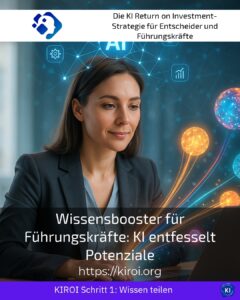
Knowledge sharing is a central theme when it comes to making collaboration within companies sustainable. Many managers face the challenge of establishing suitable learning and communication processes so that knowledge within the team is not only preserved but actively and situationally shared. KIROI's Step 1 provides valuable impetus for approaching this complex topic in a structured and individually guided manner.
Knowledge sharing means more than just distributing data or documents. It's about creating a learning culture where employees are motivated to share their expertise as needed and learn from one another. Effective support helps to question established routines and develop new ways of thinking.
The importance of methodological diversity for knowledge transfer
In practice, it is apparent that a methodical approach does not automatically lead to success. The diversity of available formats, from storytelling and mentoring to digital learning platforms, must be specifically selected to suit the team and topic. KIROI helps to make this selection and integrate hybrid learning formats. For example, in-person workshops can be combined with online modules to reach employees with different needs and locations.
Effective knowledge sharing becomes possible when employees see themselves not only as recipients of knowledge but as active contributors. This change in perspective is often achieved through accompanying external impulses that open up space for trying new communication channels.
KIROI BEST PRACTICE at company XYZ (name changed due to NDA contract) Within the service sector, targeted coaching has created a network for reliable and transparent knowledge flow. Communication channels have been standardised and supported by user-friendly tools. This has made expert knowledge more visible and accessible to everyone, significantly improving collaboration.
Setting impulses for sustainable learning cultures
For sustainable knowledge transfer, more than occasional input is required. Regular workshops and training sessions can break down inhibitions and foster an open culture of dialogue. Practical formats tailored to individual specialist areas are particularly effective. They create space for the exchange of experience and encourage trying out new things.
In a production environment, this approach not only shares knowledge but also strengthens mutual trust. Employees frequently report that this improves transparency and helps identify problems earlier.
KIROI BEST PRACTICE at company XYZ (name changed due to NDA contract) In a technical company, regular workshops enabled employees to share their experiences with new technologies. This collaborative learning promoted cross-departmental cooperation and fostered a stronger culture of innovation. The exchange sessions thus served as a catalyst for the successful implementation of complex projects.
Knowledge sharing as an integral part of leadership
Decision-makers are often faced with the desire to institutionalise knowledge transfer. KIROI's focus is not on overwhelming leaders with rigid guidelines, but on supporting them as companions in the change process. This creates space for them to develop their own solutions that fit their individual environment and involve employees.
Many report that this coaching approach makes it possible to break down barriers and foster an active dialogue. This means that knowledge sharing is not perceived as an additional task, but rather as an enriching part of the daily working routine.
KIROI BEST PRACTICE at company XYZ (name changed due to NDA contract) A manufacturing company used coaching to improve internal knowledge transfer between shifts. Through targeted guidance for managers, they were able to encourage employees to keep knowledge alive while also bringing new ideas into the processes. This led to greater flexibility and responsiveness in operations.
My analysis
Knowledge transfer works best when it is understood not as a one-way imparting of information, but as a dynamic exchange within a culture open to learning. Individual coaching of leaders and teams is crucial for the success of this process. Hybrid formats, appropriate selection of methods, and active involvement of employees are key. Reports from various industries show that targeted impulses can lead to sustainable improvements in collaboration and innovation capacity.
Further links from the text above:
[1] Rethinking Knowledge Transfer: With KIROI, Step 1 Towards Sustainable Exchange
[4] Mastering knowledge transfer: KIROI Step 1 for decision-makers
[2] Mastering knowledge transfer: KIROI Step 1 for decision-makers
For more information and if you have any questions, please contact Contact us on or read further blog posts on the topic Artificial Intelligence Blog here.








 Deutsch
  English (UK)