
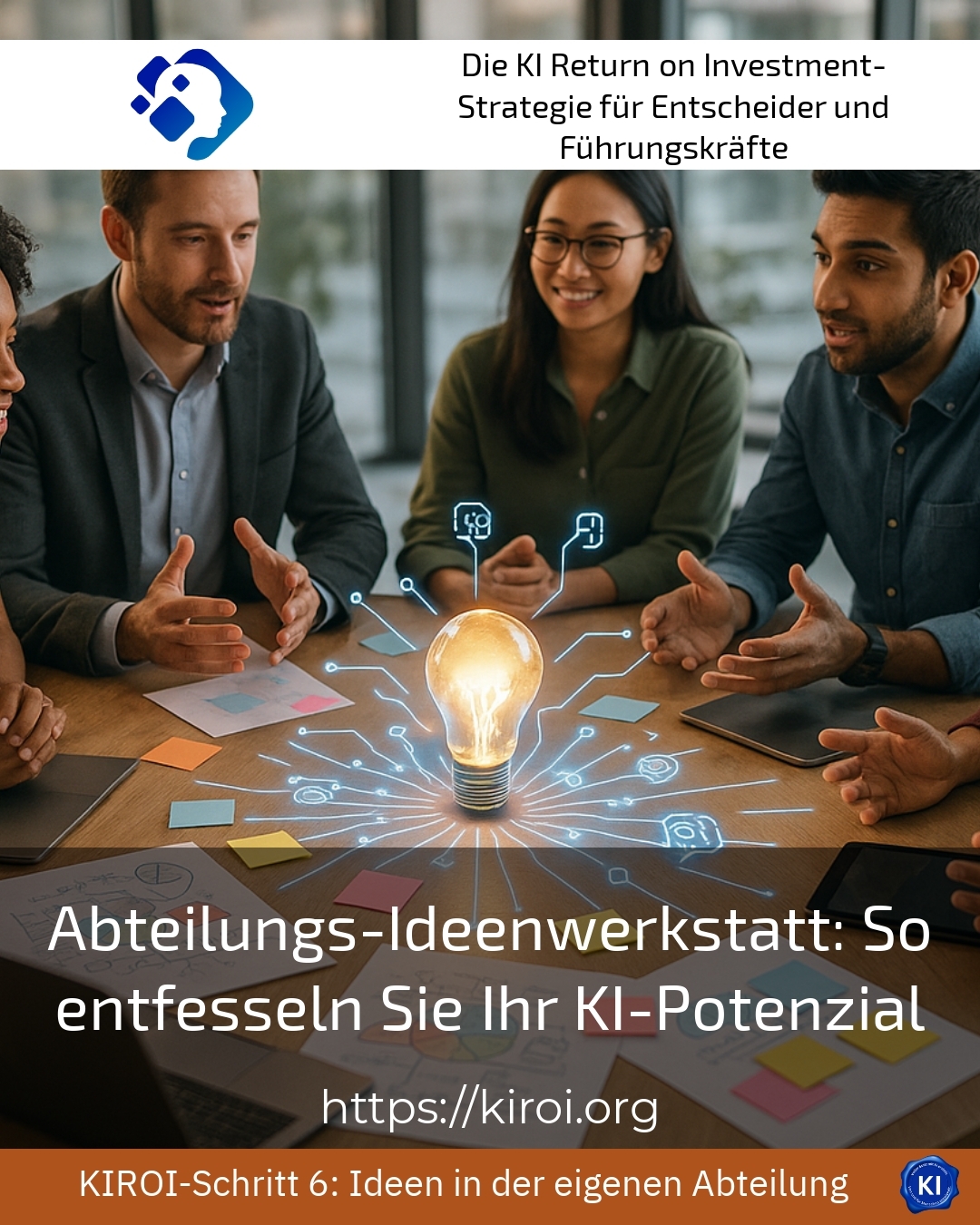
Imagine your entire department turning into a seething source of innovative ideas that can sustainably transform your company. The Departmental ideation workshop provides precisely this framework to systematically unlock your teams' hidden AI potential and deploy it profitably. At a time when artificial intelligence is permeating almost every business area, the ability to generate ideas collaboratively determines success and competitiveness. Yet how do you succeed in bringing together employees from various specialist areas and translating their different perspectives into concrete AI applications? This article shows you tried-and-tested ways to achieve precisely that.
The power of collective intelligence in the departmental idea workshop
When companies think about AI implementation, they often forget a crucial factor. The best ideas rarely emerge in isolated executive strategy meetings. Rather, employees on the operational frontline know the daily challenges and optimisation potentials best. A structured departmental idea workshop creates the necessary space for this valuable exchange of knowledge. Here, administrative staff, team leaders and domain experts can work together on innovative solution approaches. The result is practical ideas with high acceptance throughout the entire company.
This approach proves particularly effective in the financial services sector. For example, a credit institution used the collective intelligence of its client advisors to improve AI-supported risk assessments. From their daily work, the advisors knew which factors were truly relevant to credit decisions. In addition, employees from the compliance department contributed important regulatory perspectives. Furthermore, female IT specialists complemented the team with technical know-how regarding feasibility. This resulted in a holistic solution that took all relevant aspects into account.
Best practice with a AIROI customer
A medium-sized insurance company faced the challenge of making its claims processing more efficient while simultaneously increasing customer satisfaction. The management team had already evaluated various AI solutions, but staff acceptance was low. The introduction of a structured ideas workshop fundamentally changed this situation. The transruptions support helped to create a safe environment for open exchange. Claims handlers from the claims department worked together with IT experts to identify concrete use cases. They realised that an intelligent document recognition system would save considerable time. In addition, they developed ideas for automated initial assessments for standard claims. The employees felt taken seriously and became active shapers of change. After six months, the teams reported a significant reduction in workload for routine tasks. Customer satisfaction rose measurably because enquiries could be processed faster. This example impressively demonstrates how participative approaches can lead AI projects to success.
Methodological foundations for successful innovation workshops
A successful departmental ideation workshop requires well-conceived methodological foundations and clear structures. The design thinking approach has proven particularly helpful in this context [1]. It makes it possible to view problems from the user's perspective and to develop solutions iteratively. The combination of divergent and convergent thinking is important here. In the divergent phase, participants gather as many ideas as possible without evaluation. This is followed by the distillation of the most promising concepts.
This approach can be applied exceptionally well in the healthcare sector. For example, nursing staff can work together with doctors and administrative personnel to identify potential uses for AI. One hospital thus developed a system for intelligent scheduling. Laboratory staff contributed the idea of using AI to prioritise sample analyses. In addition, a concept for the predictive maintenance of medical equipment was created. This diversity of perspectives would not have been possible without interdisciplinary collaboration.
The advantages of this approach are also clearly evident in the manufacturing sector. Machine operators know the typical sources of error and quality problems from their daily work. Quality managers understand the regulatory requirements and testing standards very precisely. Maintenance technicians know from experience when machines are likely to fail and what early signs can be recognised. These diverse bodies of knowledge complement each other ideally in the development of AI applications. An automotive supplier used this combination to develop a predictive quality assurance system [2].
The right composition of the departmental ideas workshop
The composition of the participants is a decisive factor in the success of the idea workshop. Heterogeneous teams have been proven to produce more innovative results than homogeneous groups. Various hierarchical levels, age groups and disciplines should be represented. Younger employees often bring digital affinity and fresh perspectives. Experienced colleagues contribute valuable process knowledge and industry expertise. The moderation must ensure that all voices are heard on an equal footing.
This composition has proven particularly effective in retail. Checkout staff understand customers' needs best. Warehouse employees know the challenges of inventory management and goods receipt inside out. Buyers know which products are in seasonal demand and how supply chains work. Together, they developed ideas for intelligent reordering systems in a workshop. Concepts for personalised customer recommendations at the point of sale were also created. Another proposal concerned the automated detection of theft patterns through video analysis.
From idea to concrete implementation
The best idea remains ineffective if it is not systematically pursued. Following the creative phase of the idea workshop, the crucial work of prioritisation begins. Evaluation matrices, which classify ideas according to benefit and feasibility, help with this. Quick wins with high benefit and low effort should be tackled first. They build trust and motivation for larger transformation projects. At the same time, strategically important long-term projects deserve special attention and resources.
The logistics sector offers numerous examples of successful implementations from ideation workshops. A haulage company, working alongside dispatchers and drivers, developed an AI-supported route planning system. Warehouse operatives contributed ideas for intelligent order picking and significantly optimised processes. Customer service suggested a system for automated shipment tracking and proactive customer communication. These ideas were compiled into a prioritised roadmap and implemented step by step. The success of these measures was reflected in shorter delivery times and higher customer satisfaction.
Best practice with a AIROI customer
An internationally active trading company wanted to optimise its purchasing processes using artificial intelligence and turned to us. The challenge was that different departments had varying ideas about priorities. Transruptions support helped to find common ground and integrate all perspectives. In several workshop sessions, buyers, logistics specialists and financial controllers worked together on concrete approaches to solutions. They first identified the biggest pain points in the existing procurement process and analysed them systematically. Subsequently, they jointly developed criteria for AI-supported supplier selection and demand forecasting. The buyers contributed their knowledge of supplier relationships and negotiation tactics, thereby enriching the discussion. Logistics staff added information on delivery times and transport capacities from their practical experience. Controlling contributed key figures for economic viability assessment and helped with prioritisation. The resulting system now significantly supports purchasing decisions and provides valuable impetus for negotiations. The employees report a noticeable improvement in their working situation and increased efficiency. Particularly valuable was the cross-departmental collaboration, which was continued even after the project.
Overcoming obstacles and constructively using resistance
Not all employees greet AI initiatives with enthusiasm and openness. Fears of job loss and being overwhelmed by new technologies are widespread. Taking these concerns seriously is crucial for the success of any ideation workshop. Critical voices often provide valuable pointers regarding potential problems and risks. They help in developing solutions that can actually work in practice. Open communication about goals and expectations builds trust and fosters collaboration.
This aspect is particularly evident in the banking sector and requires a sensitive approach. Long-standing client advisors fear that AI could render their expertise redundant. In an ideas workshop, this fear was constructively addressed and transformed into productive energy. The advisors realised that AI can relieve them of routine tasks and free them up for complex advisory work. They developed proposals themselves on how intelligent systems could support their work. Furthermore, they defined clear boundaries where human expertise remains indispensable and AI only acts in a supporting role. Another example concerns risk assessment in credit applications for complex corporate finance.
The public sector also faces specific challenges that require special attention. Public sector employees must observe strict data protection regulations and comply with regulatory requirements. At the same time, citizens want faster and more citizen-friendly administrative services. A municipal administration used an ideas workshop to bring both requirements together and develop innovative solutions. Administrative staff developed concepts for AI-supported application processing while complying with all regulations. The IT department examined the technical feasibility and security aspects with great care. The data protection officer accompanied the process from the very beginning and provided important impetus.
Sustainable integration into the company culture
A single idea workshop can provide important impetus, but is not enough for sustainable transformation. Successful companies establish continuous innovation processes and create permanent structures. Regular workshops keep the topic of AI present and foster continuous exchange. Idea management systems enable suggestions to be submitted between events as well. Pilot projects implement selected ideas and deliver valuable lessons for all involved. Success stories are communicated internally and motivate other teams to follow suit.
The energy sector demonstrates exemplary approaches to this cultural integration. One energy supplier established quarterly innovation days for all interested employees, thereby fostering collaboration. Technicians from grid operations, customer service staff and administrative personnel work together there on AI ideas. One result was a system for the predictive maintenance of transformers and grid components. Another team developed concepts for intelligent energy consultancy for domestic customers with personalised recommendations. In addition, ideas emerged for the automated detection of grid faults and anomalies in electricity consumption. This continuous innovation work sustainably strengthens the company's competitiveness.
In the field of media and communication, particularly dynamic demands for innovation arise. Content producers, journalists and marketing experts have diverse perspectives on AI applications. One media company uses regular creative sessions to develop new formats and product ideas. Editors proposed AI-supported research tools that can significantly speed up their work. The marketing team developed ideas for personalised newsletter delivery and target-audience-appropriate content recommendations. The technology department added concepts for automated subtitling and accessible media offerings [3].
My AIROI Analysis
The systematic use of idea workshops to tap into AI potential has proven to be an extraordinarily effective approach. My observations from numerous accompaniment projects show that participatory methods can significantly increase the success rate of AI initiatives. Companies that actively involve their employees in the ideation process frequently achieve higher acceptance rates during subsequent implementation. The combination of different perspectives leads to more innovative and practical solution approaches.
Particularly noteworthy is the motivating effect on the teams and departments involved. Employees who are able to contribute their ideas develop a sense of ownership in the transformation process. They transform from passive observers into active shapers of change within their working environment. This emotional connection to the solutions developed significantly supports their sustainable anchoring.
At the same time, companies should have realistic expectations of the process and bring patience. Not every idea from a workshop will prove to be feasible or economically viable. The strength of the approach lies in the diversity of the concepts generated and the broad participation. The truly valuable innovations emerge from many proposals and can be further developed.
For successful implementation, I recommend professional guidance from experienced facilitators and consultants. The transruptions support can provide valuable impetus here and structure the process. It helps to find the right balance between creative freedom and goal-oriented focus. It also assists in overcoming typical obstacles and resistance during the change process. With the right approach, any company can unlock the full AI potential of its employees and utilise it sustainably.
Further links from the text above:
[1] Design Thinking Methodology – Interaction Design Foundation
[2] AI in Production – McKinsey Operations Insights
[3] Artificial Intelligence News – Reuters Technology
For more information and if you have any questions, please contact Contact us or read more blog posts on the topic Artificial intelligence here.






 Deutsch
 English (UK)