
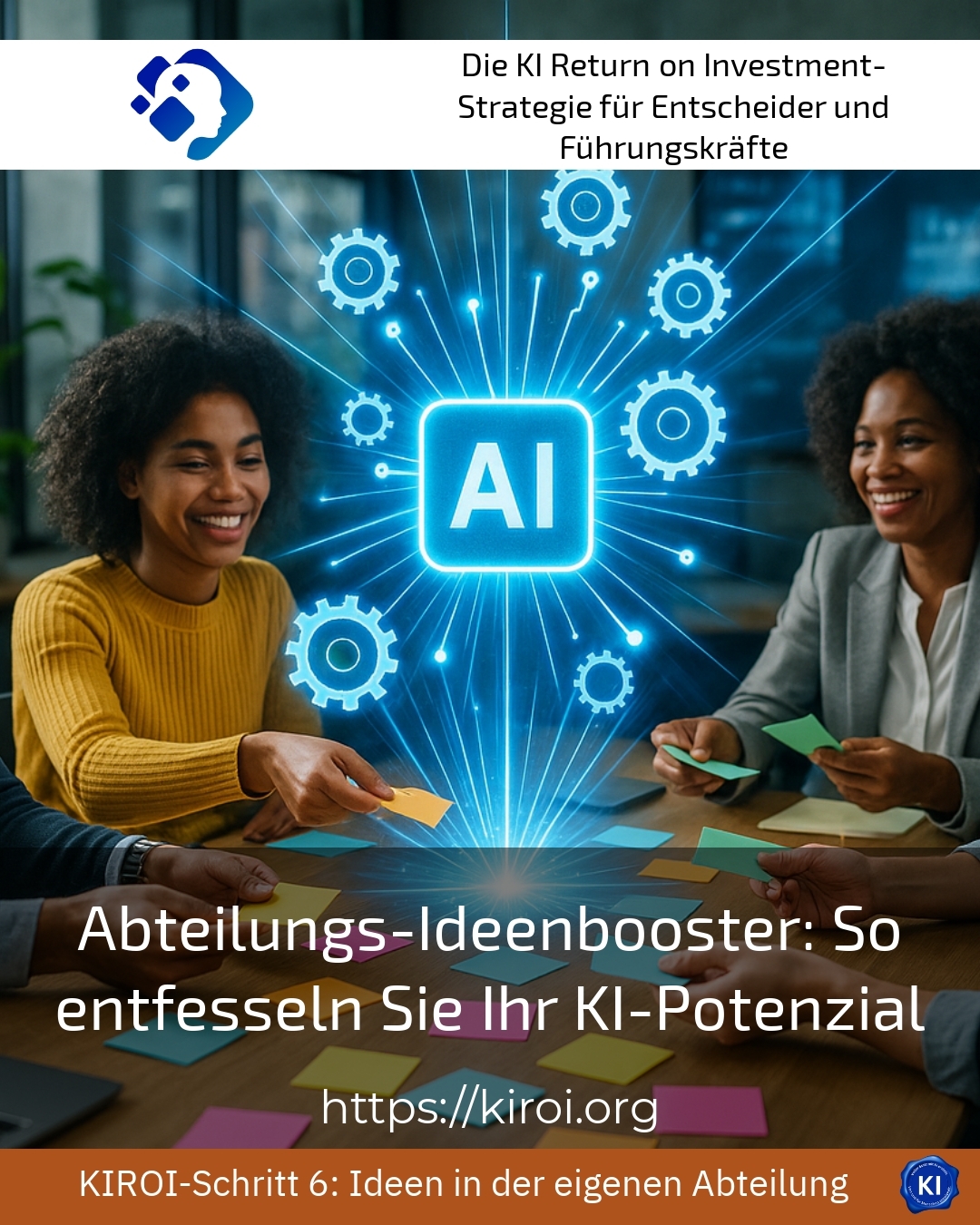
Imagine your department could make innovation leaps in a few weeks that would normally take years. The Departmental Idea Booster makes this possible by unlocking hidden reserves of creativity. Many companies are nowhere near tapping into their technological potential. They have highly qualified employees and state-of-the-art infrastructure. Nevertheless, groundbreaking ideas often remain shelved. The combination of human creativity and machine support opens up entirely new horizons. Clients often report a veritable explosion of ideas after implementing relevant systems. Transruption coaching accompanies you on this journey and provides valuable impetus for transformation.
Understanding the Departmental Idea Booster Fundamentals
Before you can harness the power of intelligent systems, you must understand how they work. Modern algorithmic solutions analyse vast amounts of data in fractions of a second. They recognise patterns that remain hidden from the human eye. A sales team, for instance, receives automatic suggestions for customer approaches. The marketing department generates creative campaign ideas at the touch of a button. Product development also benefits from data-driven innovation proposals.
In the financial services sector, analysts are already using automated forecasting models [1]. These models assist with risk assessment and portfolio optimisation. In retail, intelligent systems are revolutionising inventory planning and demand forecasting. Logistics companies are significantly optimising their route planning through machine learning. These examples demonstrate the enormous range of applications for modern technologies.
However, integrating such systems requires a well-thought-out strategy. Transruption coaching supports companies in developing tailor-made concepts. This avoids isolated, piecemeal solutions, instead creating holistic transformation approaches. Employees are actively involved in the process rather than simply being presented with a fait accompli.
Best practice with a KIROI customer
A medium-sized mechanical engineering company approached us with a specific challenge. The development department had been stagnating for months, failing to produce truly innovative product ideas. The engineers felt constrained and uninspired by their daily routine. Together, we implemented a system for the automatic analysis of patent databases and market trends. The solution scanned thousands of specialist publications daily for relevant developments. Within six weeks, the team generated over fifty new product ideas. Three of these are now in the concrete development phase and promise significant market opportunities. Employees reported a completely transformed working atmosphere and increased motivation. Transruption coaching accompanied the entire process and helped overcome initial resistance.
Practical Strategies for Departmental Idea Boosting
Successful implementation begins with an honest assessment. Which processes currently take up most of your employees' time? Where do bottlenecks or delays regularly occur? We often identify repetitive tasks that can be automated. This frees up valuable time for your teams to engage in creative activities.
In the pharmaceutical industry, research departments are already significantly automating literature searches. Lawyers use intelligent systems to analyse contract clauses and precedents. Architects generate innovative design variations in the shortest possible time with the help of algorithmic support. These examples illustrate the versatility of modern applications.
Transruption coaching provides impetus for the gradual introduction of corresponding tools. We always recommend an iterative approach with regular feedback loops. This allows adjustments to be made promptly and acceptance to increase continuously. Employees experience the change as an enrichment, not a threat.
Technologically supported creativity workshops
Traditional brainstorming sessions often reach their limits. The same dominant voices frequently shape the discussion, while introverted employees hold back their valuable ideas. This is where modern idea management systems come in, democratising the innovation process.
In the insurance sector, product developers use such platforms for designing new policies. Advertising agencies generate unusual campaign concepts for demanding clients with them. Management consultancies also rely on technology-supported workshops for strategy development. The results often exceed the expectations of all involved.
A well-structured workshop combines human expertise with machine analysis. Participants input initial ideas, and the system intelligently expands on them. This generates combinations that no single individual would have conceived. The departmental idea booster unfolds its full potential in this setting.
Overcoming resistance and inspiring teams
Every transformation encounters initial resistance. Employees fear losing their relevance or jobs. These concerns must be taken seriously and addressed openly. Transruption coaching supports leaders with this sensitive communication task.
In the automotive industry, development engineers were initially sceptical of automated design suggestions [2]. They now value these as a valuable source of inspiration and use them daily. Bank advisors initially felt algorithmic investment recommendations interfered with their competence. Today, they see them as helpful decision support and improved customer service.
The key lies in transparently communicating the benefits. Show specifically how the technology makes everyday work easier. Celebrate initial successes together and make them visible. This creates a positive attitude towards further changes.
Best practice with a KIROI customer
An insurance company was struggling with a demotivated claims processing department. The employees found their work monotonous and of little value. Staff turnover had reached worrying levels and was costing the company significant resources. We gradually implemented a system for automatic claims assessment and document analysis. This relieved claims handlers of routine tasks, allowing them to concentrate on complex cases. In addition, we introduced regular, technologically supported brainstorming sessions, which yielded remarkable results. The employees independently developed suggestions for process optimisation and felt valued again. Job satisfaction increased measurably, and staff turnover dropped by forty percent within a year. The transruption coaching specifically supported managers in realigning their role from controllers to enablers.
Establish sustainable changes with the departmental idea booster
One-off initiatives often have no effect. Sustainable transformation requires continuous effort and clear structures. Establish regular innovation rituals in your departments. Make the use of supporting systems a natural part of everyday work.
Telecommunications companies have established dedicated innovation labs that are delivering impressive results. Pharmaceutical companies maintain close collaborations with technology partners for continuous improvement. Media companies are constantly experimenting with new formats and presentation styles. These examples show how companies across different industries are institutionalising innovation.
Transruption coaching provides impetus for the design of such lasting structures. Together, we develop key performance indicators to measure innovation success. This makes progress visible and maintains motivation.
Concrete application areas for different departments
Each company function offers specific starting points for technological support. The HR department uses intelligent systems to analyse applications and employee feedback. Controlling creates automated reports and forecasts with minimal manual effort. Quality assurance relies on imaging processes for error detection.
In the food industry, product developers optimise recipes using algorithmic analysis. Fashion companies forecast trends by evaluating social media and sales data. Energy providers optimise their grid utilisation with predictive models, significantly reducing losses.
The departmental idea booster unfolds its potential across industries and functions. Crucial is the careful adaptation to specific needs and circumstances. Transruption coaching will guide you in identifying the most promising fields of application.
Best practice with a KIROI customer
An international logistics group faced the challenge of increasing customer demands alongside cost pressures. The dispatch department was already operating at its limit and could no longer achieve further efficiency gains. We implemented a learning system for dynamic route optimisation and resource planning. The system considers real-time traffic data, weather conditions, and historical delivery times. The dispatchers were not replaced, but instead received a powerful support tool for their decisions. Simultaneously, we introduced regular innovation meetings where the team developed its own suggestions for improvement. This combination of technological support and cultural change led to remarkable results. On-time delivery improved by fifteen percent, with a simultaneous reduction in transport costs. The transruption coaching particularly supported the integration of the various company locations and cultures.
My KIROI Analysis
The integration of intelligent systems into departmental processes offers enormous potential for innovation and efficiency. Companies across all sectors can benefit from the combination of human creativity with machine analysis. However, the crucial success factor lies not solely in the technology itself. Rather, the way in which such transformation projects are introduced and supported determines their success or failure.
From my experience with numerous transformation projects, recurring patterns of success are emerging. Companies with an open communication culture implement new technologies far more successfully than hierarchically structured organisations. Early involvement of all stakeholders significantly reduces resistance and promotes acceptance. Leaders must act as role models and actively use the new tools themselves.
Transruption coaching supports companies in this complex transformation, on an equal footing and with practical expertise. We provide impetus that fits your specific company culture and industry. The examples presented show that measurable successes are possible within manageable timeframes. The first step, which often seems the most difficult, is crucial. Clients often report a real sense of departure after the first positive experiences. This dynamic needs to be harnessed and translated into sustainable structures.
Further links from the text above:
[1] McKinsey: The economic potential of generative AI
[2] Harvard Business Review: Artificial Intelligence
For more information and if you have any questions, please contact Contact us or read more blog posts on the topic Artificial intelligence here.











 Deutsch
  English (UK)