
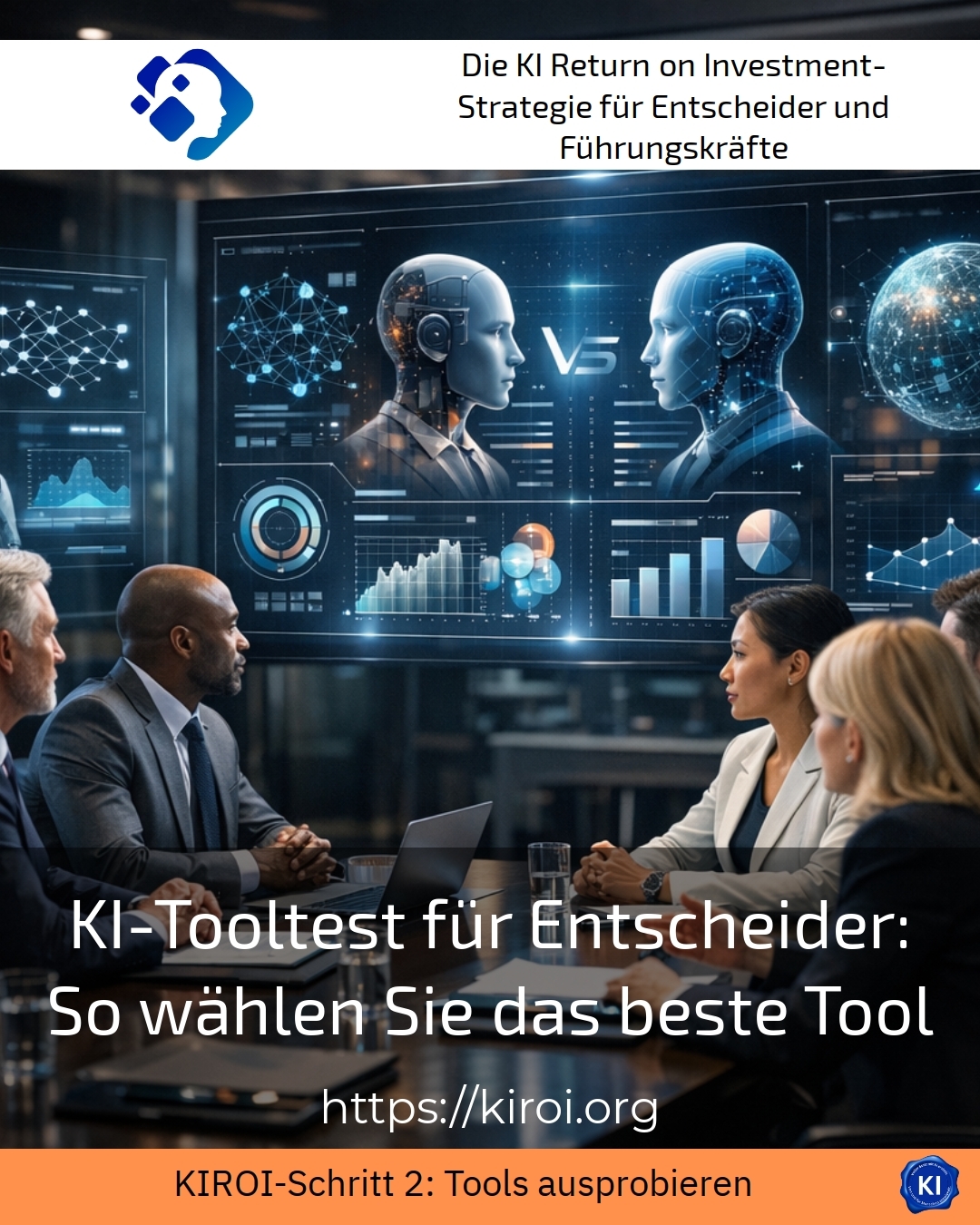
Have you ever wondered why some companies succeed with intelligent systems while others fail despite significant investment? This question concerns executives and decision-makers in almost all industries, as the choice of the right technological solution often determines the success or failure of entire transformation projects. AI Tool Test for Decision Makers This represents a fundamental skill that goes far beyond technical understanding and combines strategic thinking with practical application expertise. In a time when new applications are being introduced to the market almost daily, you as a leader need clear criteria and proven methods to separate the wheat from the chaff and base investment decisions on a solid foundation.
Why systematic AI tool testing for decision-makers has become indispensable
The complexity of the market for intelligent solutions has reached a level that is hardly yet to be penetrated without structured evaluation methods. Many executives report being overwhelmed by the multitude of available options and the often difficultly comparable performance promises of different providers. Therefore, you need a clear evaluation framework. This framework must take into account both technical and economic aspects as well as organizational aspects. Experience shows that companies that decide too quickly here often have to make costly mistakes and waste valuable time.
In retail, for example, leading companies rely on intelligent inventory management systems that can predict demand and generate automatic order suggestions. At the same time, large retail chains use automated customer service solutions that process requests in real time and continuously learn. In the area of price optimization, sophisticated systems are now available that analyze competitive prices and can propose dynamic price adjustments. This diversity of application possibilities makes it clear why a thorough selection process is so crucial.
Best practice with a AIROI customer
A medium-sized retail company with over 50 stores faced the challenge of selecting the right partner from more than 20 different providers of intelligent retail systems. The management had initially looked at various demos without a clear methodology and was subsequently more confused than before. As part of our AIROI support, we developed a structured evaluation catalog with weighted criteria that took into account both the technical integration capability into existing systems as well as the user-friendliness for store employees. The company was particularly concerned with the issue of data sovereignty and the transparency of the algorithms used. Through this systematic approach, the selection of originally 20 candidates was reduced to three finalists, who were then tested in a controlled pilot project in selected stores. The result was a well-informed decision based on measurable results and supported by all stakeholders.
The five pillars of a successful selection process
A professional selection process is based on five fundamental pillars that together form a solid foundation for your decision. The first pillar includes the precise definition of your requirements and goals. Many companies skip this step and look for the best solution without knowing exactly what problem they want to solve. The second pillar concerns the technical evaluation, which includes aspects such as scalability, integration capabilities, and data security. Thirdly, you must analyze the economic framework, meaning that you must consider not only the initial costs but also ongoing costs, training expenses, and potential productivity losses during the implementation phase.
In the field of logistics, the importance of these pillars is particularly evident. Forwarders use intelligent route optimization to reduce fuel costs and shorten delivery times. Warehouse operators rely on automated picking systems with intelligent control that optimize the flow of goods. Additionally, predictive maintenance solutions are found in transportation, which can predict vehicle breakdowns and avoid costly downtime. All of these applications require careful evaluation before investment decisions are made.
Apply practical criteria to the AI tool testing for decision-makers
The fourth pillar deals with organizational fit, that is, the question of whether the chosen solution fits with your corporate culture and the skills of your employees. Often, executives report on projects where technically excellent solutions have failed due to a lack of acceptance within the company. Finally, the fifth pillar concerns the strategic dimension, that is, the question of how the chosen solution fits into your long-term corporate strategy and which development paths it enables in the future. This holistic approach distinguishes the professional selection process from an superficial product evaluation.
Financial service providers, for example, employ intelligent fraud detection systems that can identify suspicious transactions in milliseconds. Insurance companies use automated claims processing to independently handle routine cases and forward complex cases to claims handlers. In the field of investment advisory, there are robo-advisor solutions that automatically adjust portfolios to market conditions. Each of these applications requires a specific evaluation approach that takes into account the industry’s specific regulatory requirements.
Best practice with a AIROI customer
An insurance company focused on property insurance wanted to speed up its claims processing through intelligent automation and at the same time increase customer satisfaction. The original requirements list included more than 150 individual criteria, which made practical evaluation almost impossible. As part of the transruptions coaching support, our team helped to condense these criteria into 25 core aspects and translate them into a clear priority structure. Particular attention was paid to the comprehensibility of the decisions, as regulatory requirements require transparent justifications for automated decisions. The developed evaluation framework was then applied to five preselected providers, each of which had to process standardized test datasets. The results were summarized in a decision matrix that provided the board with a solid foundation for the final selection. The chosen system is now successfully in use and processes approximately 60 percent of all standard damage cases fully automatically.
Avoiding pitfalls and recognizing typical errors
Experience from numerous support project shows that certain mistakes in selection occur again and again and could often be avoided. One of the most common mistakes is focusing on features instead of solving problems. Many decision-makers are easily overwhelmed by impressive feature lists without checking whether these features are actually relevant to their specific application scenario. Another typical mistake is not critically questioning the providers’ references. Often, success stories come from completely different industries or company sizes and are therefore not transferable.
In healthcare, the requirements for data privacy and reliability are particularly high. Clinics rely on intelligent image analysis in radiology to support doctors in diagnosis. Nursing facilities use automated documentation systems that reduce administrative overhead and free up more time for actual care. Additionally, predictive analytics that can assess the risk of certain diseases are found in the medical field. All of these applications require the utmost care in selection and implementation.
The role of pilot projects in the AI tool testing for decision-makers
Pilot projects constitute an essential component of a professional selection process. They allow you to test the performance of a solution under real conditions before committing to a long-term engagement. It is important to define clear success criteria before starting the pilot and to establish measurable metrics. Only then can you objectively assess whether the solution meets your expectations. The duration of a pilot project should be sufficient to obtain meaningful results, but not so long as to waste valuable time.
Manufacturing companies use intelligent quality control with image recognition systems that detect errors faster and more reliably than human inspectors. In manufacturing planning, optimization algorithms are used to adapt production processes in real time and avoid bottlenecks. In the field of predictive maintenance, industrial companies also rely on intelligent systems that monitor the wear of machine components and warn of malfunctions in time. These applications demonstrate the wide range of possibilities in industrial manufacturing.
Best practice with a AIROI customer
A mechanical engineering company with production sites in several countries was looking for a solution for predictive maintenance of its production facilities. The challenge was that the plants came from different manufacturers and used different data formats. As part of our support, an initial requirements analysis was conducted, which also took into account the linguistic and cultural differences at the various locations. Subsequently, three providers were selected for pilot projects, with each provider being allowed to demonstrate its solution at a different location. The pilot phase lasted three months each and was accompanied by an interdisciplinary team that documented both technical and organizational aspects. The direct comparison of the three solutions under comparable conditions was particularly valuable, revealing significant differences in practical usability. The final decision was in favor of a provider that, although it did not have the lowest costs, offered the best integration into the existing system landscape.
The human element in the selection process
Technology alone never determines the success of a project. The human component plays at least as important a role as the technical capabilities of the selected solution. Therefore, from the very beginning, you should involve the future users in the selection process and take their concerns seriously. Often, employees report concerns about being replaced by intelligent systems, even though the reality is usually different. Well-implemented solutions relieve people of routine tasks and create space for value-added activities.
In human resources, intelligent systems are used for applicant management, which analyze resumes and suggest suitable candidates. Companies use automated onboarding processes to offer personalized learning paths for new employees. Organizations are also relying on intelligent systems in the area of employee development, which identify skill gaps and recommend appropriate training. These applications demonstrate how intelligent technology can support human resources work.
My AIROI Analysis
The systematic selection of intelligent systems represents one of the most important competencies for executives in the coming years. My experience from numerous support projects shows that success and failure in the implementation of new technologies rarely stem from the technology itself. Rather, it is a lack of preparation, unclear objectives, and a lack of employee involvement that lead to project failure. The structured selection process, as I have described in this article, provides you with a framework to avoid these typical pitfalls.
What seems particularly important to me is the realization that the AI Tool Test for Decision Makers It should not be a one-time event, but a continuous process of evaluation and adaptation. Technology is developing rapidly, and solutions that seem optimal today may already be outdated tomorrow. Therefore, I recommend my clients regular reviews of the systems used and an open attitude towards new developments. At the same time, I warn against too frequent system changes, as these can cause significant costs and overload the organization.
The AIROI methodology has proven to be a valuable compass in practice, guiding companies through the complexity of the available options. It does not replace the final decision by humans, but creates the foundation for informed and understandable decisions. If you face similar challenges, I look forward to accompanying you on this journey and providing the insights that will help your company make the right choice. The future belongs to those who set the right course today.
Further links from the text above:
[1] The AIROI strategy for businesses
[2] Bitkom Artificial Intelligence Guide
[3] McKinsey State of AI Report
For more information and if you have any questions, please contact Contact us or read more blog posts on the topic Artificial intelligence here.








 Deutsch
 English (UK)