
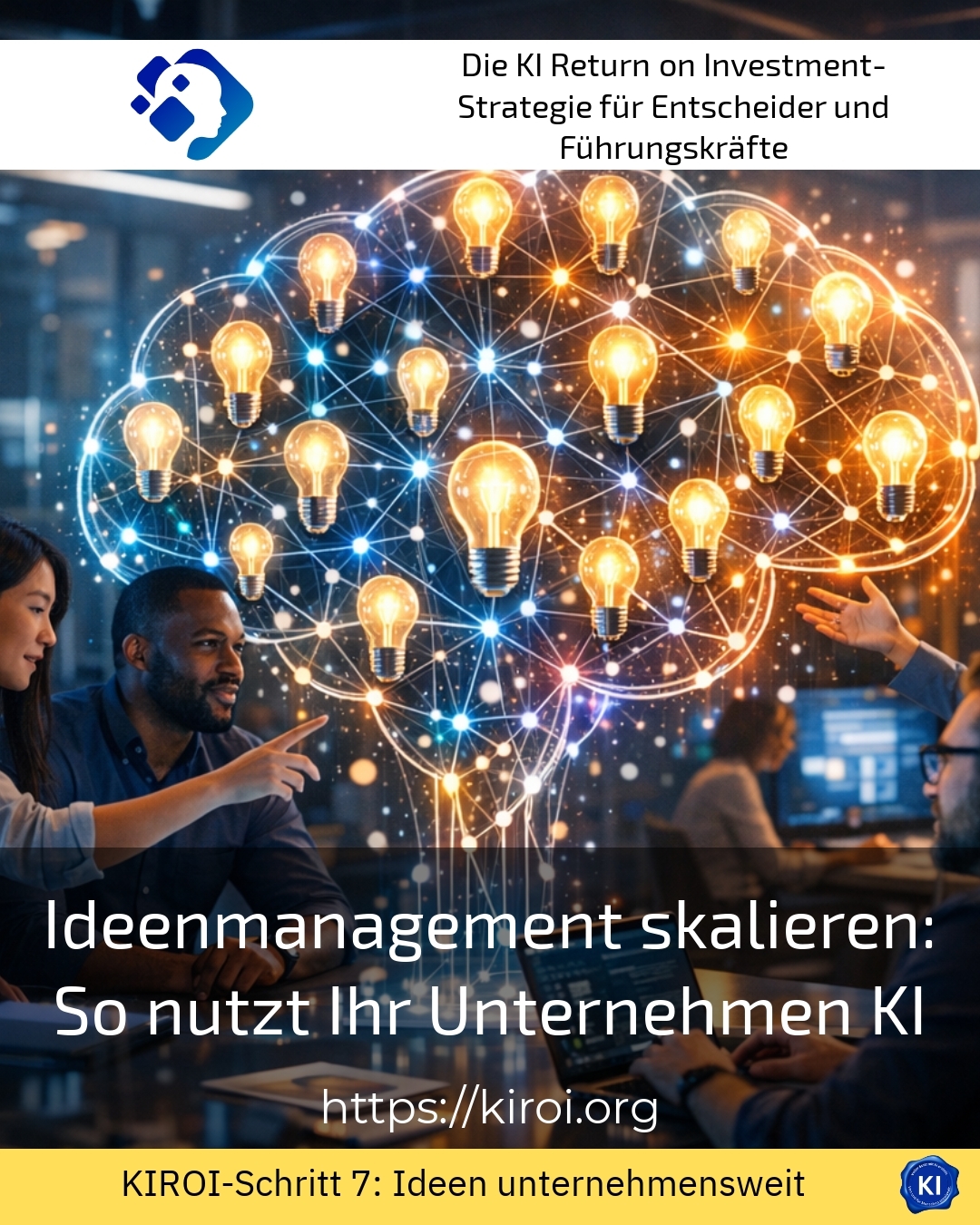
How do some companies manage to turn thousands of employee ideas into real innovations, while others get lost in chaos?
This question has been on the minds of executives and innovation managers for years. Today, the answer lies in the intelligent combination of human creativity with machine processing power. When organizations harness this combination, they can create new and innovative products and services. Scaling ideas management If companies want to innovate, they inevitably run into limitations of traditional methods. While small teams can still manually sort and evaluate their proposals, this quickly becomes a mammoth task with growing structures. This is where artificial intelligence as a transformative force comes into play, accelerating processes and opening up entirely new possibilities for idea development.
Understanding the challenge of the growing flood of ideas
Companies are now gathering more improvement suggestions than ever before in their history. Employees submit ideas via digital platforms. Customer feedback flows into innovation processes. Partners and suppliers contribute external perspectives. This diversity is fundamentally valuable, but it places significant demands on the processing.
For example, a medium-sized machine manufacturer receives over 500 suggestions from its production every month. A financial services provider processes thousands of customer suggestions at the same time. Technology companies struggle with the flood of feature requests from their users. Without intelligent support, valuable insights are lost because employees are simply overwhelmed.
Manual screening requires enormous time resources. Expert experts have to read and evaluate each individual submission. Categorization and prioritization often take place according to subjective criteria. Similar ideas are often processed multiple times because duplicate entries are not detected. This leads to inefficiencies that slow down the entire innovation process.
Best practice with a AIROI customer
An international automotive supplier with over 15,000 employees faced a critical challenge in the area of continuous improvement. The company had built up a considerable volume of ideas over the years, but the processing time for individual proposals averaged eight weeks. This delay frustrated dedicated employees waiting for feedback and led to a declining participation rate. As part of a transruptive coaching process, we analyzed the existing processes together and identified key bottlenecks. The introduction of an AI-based screening system enabled the automatic pre-classification of more detailed ideas according to subject areas and potential benefits. This allowed subject experts to focus their time specifically on promising proposals, while routine inquiries were automatically answered. The processing time decreased to under two weeks within six months, and the submission rate increased by 40 percent. Employees reported increased motivation because their contributions received faster recognition.
Scaling idea management through intelligent automation
Artificial intelligence offers diverse approaches for optimizing innovation processes. Natural Language Processing enables the automatic understanding and categorization of text submissions. Machine Learning identifies patterns in historical data and predicts success probabilities. Semantic analyses identify thematic connections between different proposals.
For example, a trading company uses AI algorithms to detect duplicates in its proposal management system. A pharmaceutical company relies on automatic sentiment analysis for research ideas. An energy provider uses cluster analyses to pool similar optimization proposals from different locations.
The technology takes time-consuming routine tasks off the table and creates space for creative work. Employees can focus on the substantive evaluation. Executives receive consolidated decision-making bases. Innovation managers keep an overview of the overall portfolio. This creates a system that optimally combines human strengths and machine capabilities.
Practical application areas for AI-supported idea processing
The applications of artificial intelligence in innovation management are diverse and relevant across industries. Automatic tagging significantly reduces the documentation effort. Intelligent routing systems direct suggestions to the right departments. Predictive Analytics estimates the potential return on investment of individual ideas.
In the manufacturing industry, AI systems support the evaluation of process improvements. In the service sector, algorithms analyze customer feedback for innovation potential. In logistics, machine learning models identify optimization opportunities in complex supply chains.
The ability to recognize patterns across large amounts of data is particularly valuable. This allows trends to be identified early on. Weak signals from various sources are condensed into relevant insights. Relationships between seemingly unrelated suggestions are made visible.
Best practice with a AIROI customer
A leading insurance company wanted to fundamentally modernize its existing proposal system while also improving its Scaling ideas management, To integrate all business areas. The previous solution was based on an outdated system with manual workflows and fragmented Excel lists. In the transruptions coaching process, we jointly developed a vision for an AI-powered innovation ecosystem. First, we implemented a pilot with automatic text recognition and categorization, which sorted incoming ideas into predefined topic clusters. Initially, the employees were skeptical, but the time savings quickly convinced them. Especially the function for identifying similar suggestions from other departments sparked enthusiasm, as it revealed previously unknown synergies. Two business areas thus independently discovered optimization potential in the claims process, which could be implemented jointly. The resulting savings exceeded the investment in the new system significantly already in the first year.
Human creativity and machine intelligence combine
Despite all the enthusiasm for technological possibilities, the human being remains at the center of successful innovation. AI supports and accelerates, but does not replace creative thinking. The best results are achieved where both components work in harmony. This interplay requires conscious design and continuous adaptation.
A chemical company uses AI-generated insights as inspiration for development teams. A media house uses algorithmic trend analyses as the basis for editorial creative sessions. A retailer combines customer data analysis with employee workshops for product development.
Employee acceptance plays a crucial role in success. Transparent communication about the functioning of AI systems dispels fears. Trainings empower employees to effectively use new tools. Feedback loops enable continuous improvement of the algorithms used.
Scale implementation strategies for sustainable success in idea management
The introduction of AI-based innovation systems requires a thoughtful approach. Step-by-step implementation reduces risks and enables early learning experiences. Pilot projects in selected areas provide valuable insights for the later rollout. Change management accompanies the cultural change within the organization.
A telecommunications provider began with a Proof of Concept in its customer service department. An industrial company initially tested the solution in a single facility before it was rolled out globally. A financial institution started with the product development department as a flagship project.
Technical integration into existing IT environments deserves special attention. Interfaces to existing systems must be planned. Data protection requirements must be taken into account from the outset. Scalability of the infrastructure ensures long-term usability.
Best practice with a AIROI customer
A medium-sized family business in the metal processing sector faced the challenge of modernizing its traditional improvement process. Over the decades, the company had built a successful proposal system, but with increasing employee numbers, it reached capacity limits. As part of the transruptive coaching, we supported the management in the strategic realignment. Together, we defined criteria for selecting suitable AI tools and developed a roadmap for implementation. Particularly important was the involvement of long-standing idea coordinators, whose expertise contributed to the configuration of the algorithms. The hybrid solution now combines automatic preprocessing with human expert evaluation in a seamless workflow. Acceptance among production workers is high, as the system is perceived as support rather than a replacement. The number of implemented improvements increased by 65 percent in the first year.
Performance measurement and continuous optimisation
The effectiveness of AI-based innovation systems must be systematically reviewed [1]. Metrics such as processing time, implementation rate, and employee satisfaction provide important insights. Regular analyses identify improvement potential in processes and algorithms. Benchmarks enable comparison with best practices from other organizations [2].
A consumer goods manufacturer tracks the correlation between AI evaluation and actual implementation success. A technology company measures time savings through automatic categorization per department. A healthcare company analyzes the quality of machine recommendations through expert reviews.
Feedback from users forms an essential basis for further development. Employees know the practical challenges best. Their feedback is incorporated into the adaptation of workflows. Iterative improvement replaces one-time implementation with continuous evolution [3].
My AIROI Analysis
The integration of artificial intelligence into innovation processes marks a turning point for organizations of all sizes and industries. Those who today Scaling ideas management Wanting to find powerful tools for dealing with growing complexity in modern AI solutions. The technology enables filtering out the most valuable insights from the flood of suggestions and their targeted further development.
From my consulting practice, I know that the success of such projects depends heavily on the support provided. Technology alone does not solve organizational challenges. Rather, a holistic perspective is needed that takes into account people, processes, and systems alike. Transruptive coaching offers exactly this integrative approach.
Clients often report initial skepticism towards automated assessment systems. These concerns are understandable and should be taken seriously. Through transparent communication and gradual implementation, resistance can usually be reduced. Experience shows that employees accept AI support when they see the practical benefits.
My recommendation therefore is: Start with manageable pilot projects in open-minded areas. Gather experience and document successes. Use positive examples as a catalyst for broader acceptance. And do not hesitate to seek external guidance when internal expertise is lacking. The path to a scalable innovation culture is a journey, not a one-time transformation – and this journey is worth it.
Further links from the text above:
[2] Gartner: Artificial Intelligence Research
[3] Harvard Business Review: Innovation Management
For more information and if you have any questions, please contact Contact us or read more blog posts on the topic Artificial intelligence here.







 Deutsch
 English (UK)