
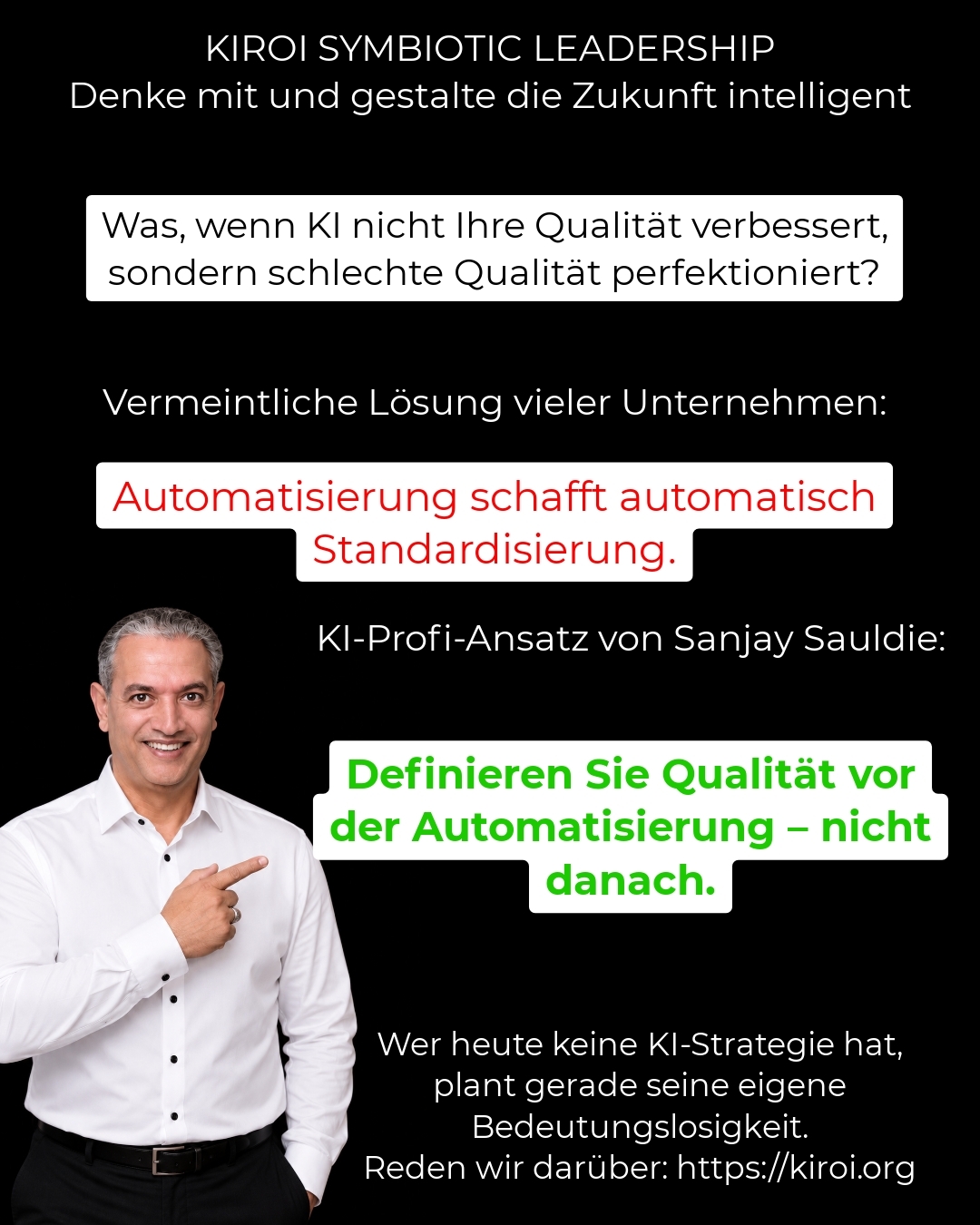
What actually happens when your carefully implemented automation solution fails to deliver the hoped-for improvements, but instead reproduces existing weaknesses in your processes with impressive precision and scales what should never have been scaled?
This question is currently occupying numerous decision-makers in manufacturing companies. They have invested in modern technologies. They expected efficiency gains. Instead, they are experiencing how their systems are perfecting mediocre standards at a high level. The situation is reminiscent of a photocopier that reproduces a faulty original print a million times over. The result is technically flawless, but problematic in content. This is precisely where the concept comes in Quality before automation that enables a fundamental shift in perspective and supports companies in placing their digital transformation on a solid foundation.
The illusion of automatic improvement through intelligent systems
Many manufacturing leaders operate on a seductive assumption. They believe that the introduction of intelligent systems automatically leads to better results. This assumption frequently proves to be a fallacy. For example, a medium-sized automotive supplier implemented an automated quality control system for stamped parts. The system worked precisely and quickly. However, it adopted the previous tolerance limits, which had grown historically and had never been systematically reviewed. The result was sobering, because the system reliably detected defects, but only those it had been taught to recognise.
A similar pattern can be seen with a manufacturer of precision tools, which automated its order processing and production planning. Lead times fell measurably. At the same time, however, complaints increased because the system interpreted customer specifications according to the same incomplete criteria as the clerks had previously. The technology had not improved existing practice, but accelerated it. The approach Quality before automation would have required an initial fundamental analysis of the existing processes here.
This phenomenon is particularly evident with a manufacturer of industrial valves. The company relied on predictive maintenance and trained its system using historical machine data. However, this data originated from a time when maintenance intervals were determined based on empirical experience rather than systematic analysis. Consequently, the system optimised suboptimal maintenance strategies, thereby reproducing inefficiencies at the highest technical level.
The common approach of average businesses to standardisation
Average manufacturing companies often follow a similar pattern. They view automation as a means of standardization. At first glance, this perspective appears logical and comprehensible. For example, a mechanical engineering company standardises its quotation generation using automated configuration systems. The quotations look uniform. They are produced more quickly. However, the underlying calculation logics remain unexamined and often reflect historical habits.
A materials handling equipment manufacturer automated its documentation processes. Every system was given automatically generated operating manuals. The system worked reliably and consistently. However, it also adopted the phrasing and structures of previous manually created documents, which had never been reviewed for comprehensibility and legal certainty. Standardisation was carried out on the basis of a standard that had never itself been defined.
The situation is similar for a manufacturer of packaging machinery. The latter implemented a system for automatic spare parts identification and ordering. The system reduced search times considerably. However, it was based on a spare parts classification that had evolved over decades and exhibited numerous inconsistencies. Automation did not make these inconsistencies visible, but rather cemented them in a technically sophisticated system.
Why the conventional way systematically fails
The reason for this recurring pattern lies in a fundamental flaw in thinking. Companies confuse digitalisation with optimisation. They assume that transferring a process into a digital system automatically improves that process. A foundry digitised its quality inspection and was now automatically recording measured values that had previously been noted down manually. The data quality actually improved. However, the question of which measured values were actually relevant in the first place and which limit values seemed sensible was never asked.
A machine tool manufacturer automated its production planning. The system optimised sequences and machine allocation based on historical data. However, this data contained numerous inefficiencies that had arisen from organisational constraints. The system learned these inefficiencies as the normal state and henceforth reproduced them with mathematical precision.
Best practice with a AIROI customer
A medium-sized manufacturer of hydraulic components approached us with an initially unspecific concern, which, however, proved to be symptomatic of many businesses of its scale. The company had invested considerable funds in the automation of its quality assurance and was nevertheless confronted with rising complaint rates, which posed a significant puzzle for the management and led to internal tensions between departments. Our analysis as part of transruption coaching revealed a complex web of historically grown tolerance limits, undocumented exception rules and informal agreements between production and quality assurance. The automated system had adopted all these inconsistencies and was now applying them consistently, as a result of which it systematically overlooked errors that experienced inspectors had previously detected intuitively. Within the framework of our support, we first defined together with the company what quality actually meant for its specific products and customers and how this definition could be made measurable and operationalisable. Only after this fundamental clarification did we adapt the automation systems accordingly, thereby achieving a reduction in complaints of more than forty percent within nine months, while at the same time significantly increasing the efficiency of quality inspection.
The AIROI approach: defining quality before automation
The AIROI methodology addresses precisely this issue through a consistent change of perspective. It puts the question of quality understanding at the beginning of every automation project. This seemingly simple reversal of the usual order has far-reaching consequences for the entire implementation process and the later results.
A drive technology manufacturer used this approach when introducing a new Manufacturing Execution System. Instead of digitalising existing processes, the company first defined what optimal throughput times, minimum setup times and maximum machine utilisation meant in concrete terms. This definition was not based on historical data, but on a systematic analysis of actual capabilities and requirements. The principle Quality before automation thus enabling a genuine transformation rather than a mere digitisation of the status quo.
An industrial gearbox manufacturer proceeded in a similar way. Before implementing an automated process monitoring system, the company worked with us as part of a transruption accompaniment process to analyse which process parameters were actually relevant to quality. This analysis brought to light surprising insights, as some previously intensively monitored parameters proved to be of little significance, whereas other previously neglected factors had a considerable influence on product quality.
Practical implementation of the upstream quality assurance approach
The concrete implementation of this approach requires a systematic procedure that has proven its worth and gives companies structured impetus. A manufacturer of pumps and compressors began with a comprehensive stakeholder analysis. They surveyed not only internal departments, but also customers, service partners and suppliers regarding their quality expectations. The results deviated significantly from the quality criteria assumed internally and enabled a completely new prioritisation.
As part of our mentoring, a company from the surface technology sector developed a quality catalogue that encompassed not only technical specifications, but also procedural and communicative aspects. This catalogue served as a reference for all subsequent automation decisions and ensured that the systems used actually supported the defined quality objectives.
A manufacturer of measurement technology combined this approach with a systematic error analysis. Before any systems were implemented, the company investigated all quality problems from past years and identified their root causes. This analysis revealed patterns that would have been reproduced if existing processes had simply been digitalised, and enabled targeted improvements.
Best practice with a AIROI customer
A long-established family-run business in the field of special-purpose machinery was faced with the challenge of modernising its design processes and making them more efficient, without losing the specific expertise that the company had built up over decades and which contributed significantly to its market success. The management had initially pursued the plan to introduce a system designed to analyse existing designs and generate optimisation suggestions, which at first glance seemed promising. However, our joint analysis within the framework of transruption coaching showed that the existing designs contained numerous implicit design decisions whose backgrounds were undocumented and which an automated system would not be able to comprehend. We supported the company in first explicating this implicit design knowledge and recording it in a structured quality framework that encompassed technical as well as aesthetic and functional criteria. Only on this basis was the system implemented; it now genuinely promotes quality because it knows what quality means in the specific context of this company and which criteria must be taken into account in design decisions. The designers frequently report that the system supports and enriches their work, rather than replacing it or steering it in questionable directions.
The organisational dimension of the quality focus
The AIROI approach requires more than technical adjustments. It demands an organisational realignment that is frequently underestimated. An industrial robot manufacturer realised this when automating their assembly lines. The technical implementation went smoothly. The real challenge lay in developing a shared understanding of quality between engineering, production and service, which could serve as the foundation for automation.
A medical technology company had to discover that different departments had different ideas about what makes a high-quality product. R&D emphasised technical innovation. Production focused on process stability. Sales prioritised customer satisfaction. These differing perspectives first had to be harmonised before meaningful automation was possible. The principle Quality before automation helped to integrate these different perspectives.
A process engineering manufacturer used the AIROI approach to establish cross-departmental quality workshops. These workshops created a shared understanding and identified numerous areas for improvement that would not have been recognised without this preliminary work. The subsequent automation built on this common foundation and was perceived by all participants as sensible and supportive.
Long-term benefits of a solid quality foundation
Investing in upfront quality definition pays off many times over. A packaging machinery manufacturer reports significantly reduced rework efforts following implementation because the system was based on the right criteria from the very beginning. An industrial furnace manufacturer was able to shorten the time-to-market for new product variants because the quality criteria were clearly defined and the system could be trained accordingly.
A plastics processing company now also uses the documented quality definitions for supplier selection and customer acquisition. The clarity regarding its own understanding of quality enables more precise communication and builds trust with business partners, which has led to measurable improvements in cooperation.
My AIROI Analysis
Experience from numerous projects in the manufacturing industry reveals a clear pattern that leaders facing similar decisions should be aware of. Companies that introduce intelligent systems without a prior definition of quality frequently experience disappointment and have to carry out costly corrections afterwards. They automate processes that are not optimal in themselves, thereby scaling problems instead of solutions. This observation repeats itself across all sectors and regardless of company size.
The AIROI approach with its focus on Quality before automation addresses this problem at its root. It forces organisations to ask fundamental questions before technical decisions are made. What does quality mean to us? How do we measure it? Which compromises are acceptable? These questions seem banal, but are surprisingly rarely answered systematically.
Practical implementation requires time and resources that many companies are initially reluctant to invest. The temptation is great to begin technical implementation straight away and address quality issues further down the line. However, as numerous examples show, this approach regularly proves to be costly and frustrating.
Transruption coaching offers leaders structured guidance through this process. It helps to ask the right questions, involve relevant stakeholders and develop a sustainable understanding of quality. On this basis, automation decisions can be made that actually lead to improvements rather than the perfection of mediocrity.
The future belongs to companies that understand that technology is a tool and not an end in itself. They first define what they want to achieve and then select the appropriate tools. This seemingly obvious approach distinguishes successful digital transformations from costly experiments that frequently end in frustration and resignation.
Further links from the text above:
[1] McKinsey: Manufacturing Analytics
[2] Fraunhofer Institute: Industry 4.0
[3] VDMA: Mechanical engineering in numbers
Are you a leader and would you like to learn how you can genuinely introduce AI into your company in a valuable and sustainable way, away from the hype? Take part Contact us or read more blog posts on the topic Artificial intelligence here.











 Deutsch
  English (UK)