
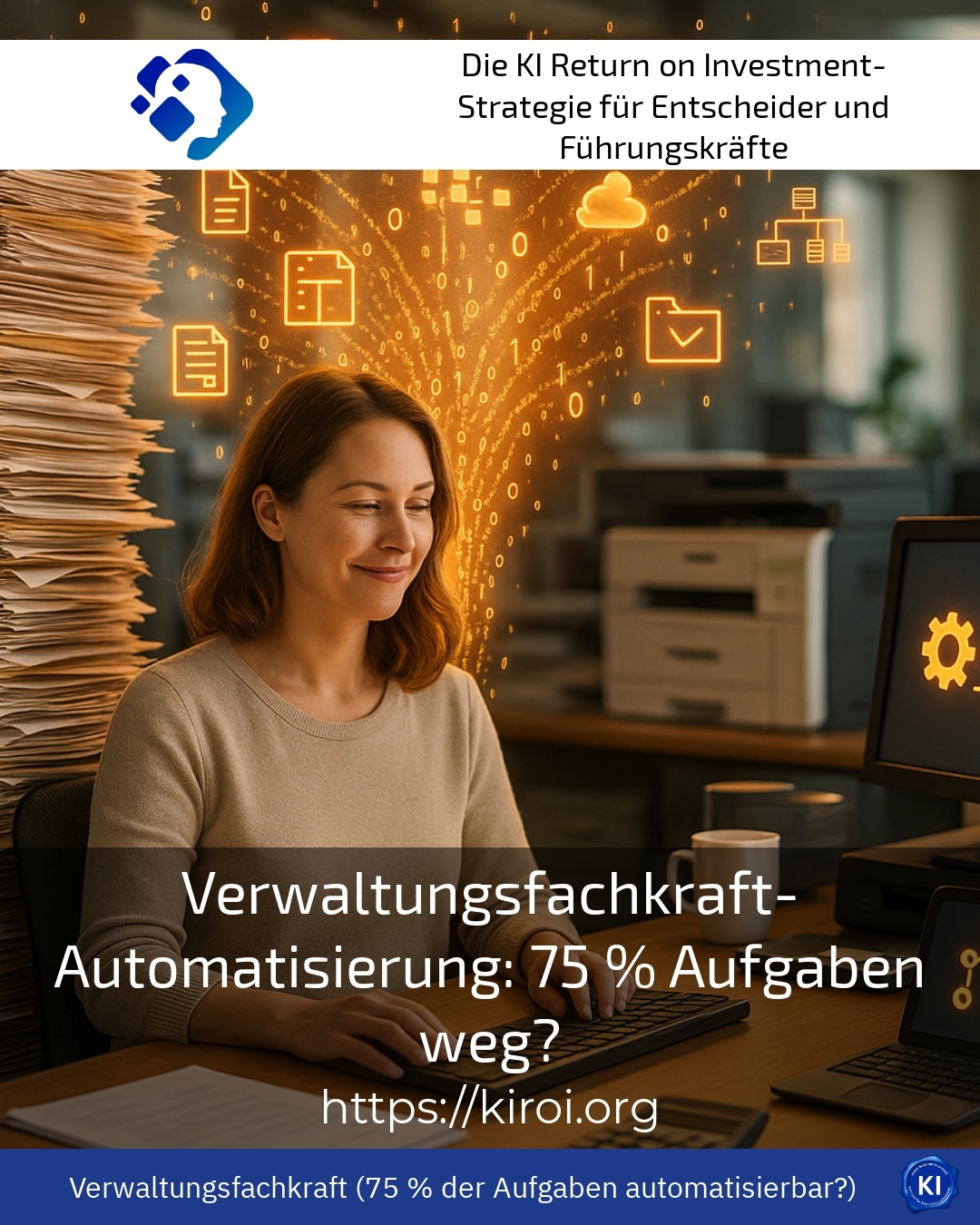
Will three out of four tasks in your office soon be done by machines – and what does that mean concretely for your professional future if you process files, check applications and coordinate citizen requests every day? This question is currently occupying hundreds of thousands of specialists in German offices, authorities and administrative institutions, because the Administrative automation: 75 % tasks gone? is no longer a dystopian vision of the future, but a concrete development that is already bringing about noticeable changes to everyday working life today and raising fundamental questions about skills development, job security and personal reorientation.
The basis for these far-reaching forecasts is provided, among other things, by analyses from the Institute for Employment Research, whose interactive tool at https://job-futuromat.iab.de/ shows in detail which job profiles can be substituted and to what extent. If you work in this field yourself and are wondering how you can proactively deal with these changes, the AIROI seminars offer well-founded support during this transformation – you can find all current dates at https://risawave.org/de/live-events-mit-sanjay-sauldie/ [2], where you will receive inspiration for your individual path.
What does administrative automation specialist mean concretely in everyday work?
The daily work in town halls, district offices and ministries traditionally consists of a multitude of recurring processes. Recording resident registration data is just as much a part of this as processing building permits. The review of social benefit applications also takes up a lot of time. These routine activities follow clear rules and defined procedures. Exactly this makes them particularly suitable for algorithmic systems. A case worker in the residents' registration office, for example, spends a significant amount of time entering changes of address. This task can be largely taken over by digital self-service portals. Citizens enter their data themselves. The system automatically checks for plausibility and completeness.
A similar picture emerges at the vehicle registration office, as hundreds of applications are processed here daily that follow a standardised pattern and are therefore predestined for automated processing routes, where only exceptional cases still require human intervention. The processing of certificates of good conduct also follows fixed protocols. Here, automated database queries are already supporting the process significantly. The allocation of appointments in citizen service offices is also increasingly running via intelligent online systems. These recognise requests and assign suitable time slots.
Best practice with a AIROI customer
A medium-sized municipal administration in southern Germany was faced with the challenge that staffing levels in the processing of housing benefit applications were becoming increasingly thin, whilst at the same time the number of incoming applications was rising continuously and processing times were lengthening, which led to dissatisfaction among citizens. As part of the AIROI support, a detailed analysis of the existing processes was carried out first. In doing so, the team, together with the employees, identified those activities that were repetitive. These were furthermore prone to human error. Subsequently, a strategy was developed in which the affected employees were not replaced. Instead, they were given the opportunity to undertake further training. Their new tasks lay in accompanying the cases of complex application situations. There, human judgement was indispensable. Following the transformation, the employees frequently reported that they now found their work more meaningful. They were able to focus more strongly on the individual needs of the applicants. Digital systems largely took over pure data entry automatically.
Administrative automation and its impacts on various sectors
Procedures in registry offices are also changing fundamentally. The registration of births and deaths is based on standardised forms. Digital systems can automatically pre-fill these forms. They pull together relevant data from existing registers. However, the human factor remains important for verification and individual case decisions. Unusual naming conventions still require professional expertise. Advising couples before marriage also remains a human task.
In the field of trade supervision and regulatory offices, a differentiated picture emerges. Routine business registrations can be digitised to a large extent. The review of documents is partially automated. However, on-site inspections still require trained personnel. The assessment of unclear situations also requires human judgement. Social welfare offices are likewise experiencing a transformation in their way of working. Simple application processing is supported by algorithms. However, complex family constellations require personal consultations. The emotional component of social work remains irreplaceable.
Actively seize the opportunities of transformation
The AIROI strategy helps professionals to see these changes not as a threat, but as an opportunity for professional development. In the seminars, participants are given practical tools for change and develop skills that machines cannot replace. In a building authority, for example, professionals can redefine their role, moving from repetitive checks to advisory functions. They guide clients through complex approval processes, and their experience becomes a valuable point of reference for citizens.
Financial administration is experiencing similar shifts in job profiles. Automated systems are increasingly taking over the plausibility checks of tax returns. They identify anomalies and flag suspicious cases. The administrative officers then focus on these flagged processes. They contribute their expertise in cases of unclear circumstances. As a result, the overall quality of audits is increasing significantly. Municipal finance departments are increasingly using analytical tools for budget planning. Forecasting models assist with financial planning. However, strategic decision-making remains reserved for human experts.
Best practice with a AIROI customer
A district office in eastern Germany implemented comprehensive digital application management for driving licence matters and found that employees initially reacted with significant reservations to this change, fearing they would become redundant and no longer be able to contribute their many years of professional experience. As part of the AIROI support, intensive workshops were carried out. These helped employees identify their individual strengths. They recognised areas where human competence remains irreplaceable. These included, for example, advising learner drivers with special needs. Clarifying complicated conversion cases also continued to require expertise. Cooperation with driving licence authorities in other countries remained a human task. After the transformation process was complete, employees frequently reported increased job satisfaction. The monotonous part of their work had decreased significantly. They were able to concentrate on more demanding tasks. Their expertise was perceived as valuable by the citizens.
Developing future skills for the administrative automation specialist
Immigration authorities are facing particular challenges in the context of digitalisation. Residence title procedures follow complex legal requirements. Automated systems can assist with preliminary checks. They identify missing documents and point out formal deficiencies. However, the personal interview and individual case assessment remain essential. Empathy and intercultural competence are required here. Machines cannot replicate these abilities.
In school administration offices, work is changing fundamentally through digital registration procedures. Parents can register their schools for their children online. Allocation is partly algorithm-backed according to defined criteria. Yet hardship cases still require human decisions. The advising of families in special life situations remains personal. Youth welfare offices use digital tools for the documentation of their work. But the core of their activity – the accompaniment of families – is profoundly human. Here it becomes particularly clear: technology supports, but does not replace.
Practical strategies for career transition
HR departments are themselves experiencing the digital transformation intensely. Applicant tracking systems take over many administrative tasks. The pre-selection of applications is carried out partially automatically. Yet interviews and staff development remain human domains. Accompanying employees in their professional development requires empathy. Conflict moderation and team building cannot be automated. These areas offer opportunities for development for administrative professionals.
The AIROI seminars impart precisely the competencies that are crucial in this transitional phase. Participants learn to realistically assess their own position. They develop strategies for personal further development. Exchanging views with others in the same situation creates valuable perspectives. Audit offices are increasingly using data analysis tools. Automated systems identify anomalies in booking processes. However, interpreting these findings requires experience. Auditors bring their contextual knowledge to the analysis. They understand the specific characteristics of individual departments. This knowledge continues to make them indispensable.
Best practice with a AIROI customer
A municipal data centre providing IT services to several smaller local authorities recognised early on that the increasing automation of administrative processes would also impact its own workforce, and decided to proactively invest in the skills development of its employees. As part of the AIROI support, a comprehensive transformation programme was developed. This took into account both technical and social aspects of the change. Employees were given the opportunity to acquire new skills. They learned to act as bridge-builders between technology and people. Training in change communication proved particularly valuable. Employees were subsequently able to guide others through the transformation. They became internal multipliers for the digital shift. This new role significantly strengthened their professional self-image. Team satisfaction increased measurably.
My AIROI Analysis
The analysis of current developments shows a nuanced picture. A significant proportion of administrative activities can indeed be automated. This particularly affects repetitive, rule-based processes. However, the remaining tasks are gaining in importance as a result. They require genuinely human skills such as empathy and judgement. The challenge lies in actively shaping this development. Professionals should not passively endure the change. Instead, they can prepare themselves specifically for new requirements.
The AIROI strategy offers a proven framework for this. It supports identifying individual strengths. It helps to recognise and work on areas for development. Change thus becomes an opportunity rather than a threat. A realistic view of one's own situation is important here. Not all tasks will disappear. Many, however, will change fundamentally. The willingness to continuously develop further becomes the decisive success factor.
Experience from numerous support processes shows that professionals who engage with the transformation at an early stage benefit in the long term. They actively help shape their professional future. They develop skills that will still be in demand tomorrow. The path there requires courage and openness. The AIROI seminars provide a secure framework for this. Participants receive inspiration and concrete tools. They network with others who are having similar experiences. This exchange is often just as valuable as the technical content itself.
Further links from the text above:
[2] AIROI seminars – live events with Sanjay Sauldie
For more information and if you have any questions, please contact Contact us or read more blog posts on the topic Artificial intelligence here.






 Deutsch
 English (UK)