
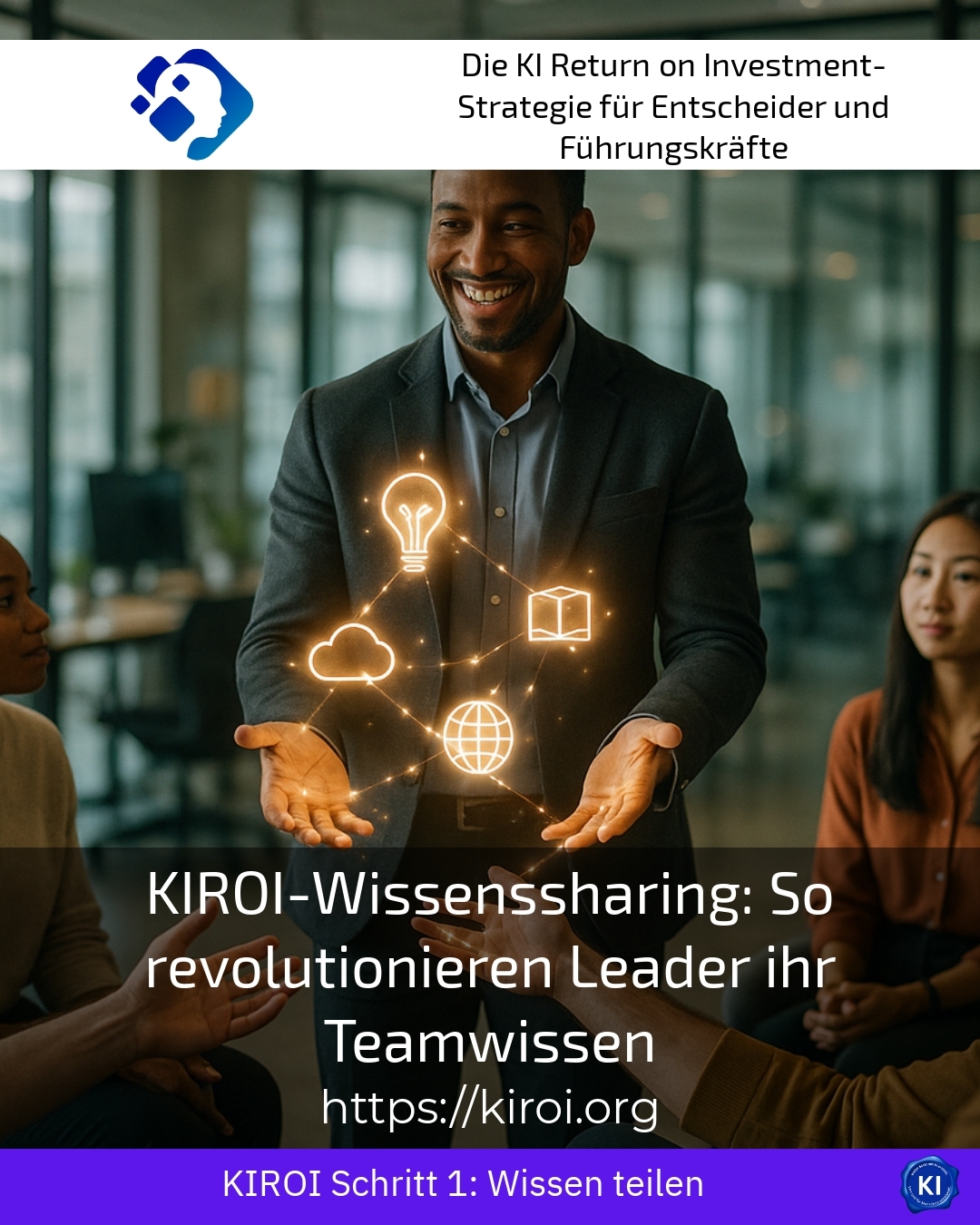
What distinguishes successful leaders from those who, despite enormous efforts, fail to make progress with their teams? The answer is frequently hidden in the way knowledge is shared, cultivated and further developed within an organisation. In a world that is changing rapidly and in which information is becoming the most valuable resource, systematic AIROI Knowledge Sharing increasingly important for businesses of all sizes. Leaders who have understood that collective intelligence far exceeds the sum of individual capabilities create structures that enable and encourage the free flow of insights. This realisation forms the foundation for sustainable competitive advantages and a corporate culture that does not leave innovation to chance.
The transformation of the culture of knowledge through AIROI knowledge-sharing
Traditional hierarchies have long regarded knowledge as an instrument of power and guarded it accordingly. However, this approach is proving to be counterproductive. Modern leaders recognise that shared knowledge grows exponentially. They therefore establish systems that actively promote exchange.
This shift is particularly evident in the financial sector. Banks are implementing digital knowledge platforms for their advisers. These platforms enable the exchange of market analyses in real time. Insurance companies use similar systems for complex claims settlement. Investment teams share valuation models via central repositories. Portfolio managers draw on collective experience when assessing risk.
The AIROI Knowledge Sharing differs fundamentally from conventional knowledge management approaches through its consistent integration of intelligent technologies. It combines human expertise with algorithmic support. This combination creates synergies that were previously unthinkable.
Best practice with a AIROI customer
A medium-sized management consultancy firm was facing a classic challenge familiar to many growing organisations. Specialist knowledge accumulated over years was scattered across different departments and locations without any systematic exchange taking place. Experienced consultants left the company, taking valuable implicit knowledge with them. New employees had to painstakingly reinvent insights, even though colleagues had acquired them long ago. As part of the transruptions coaching, we jointly developed a structured approach to this problem. First, we identified the critical knowledge carriers within the organisation. Subsequently, we established formats for regular knowledge exchange between project teams. Furthermore, we implemented a digital system for documenting project experiences that captured both successes and learning moments. After just six months, project managers reported a noticeable reduction in onboarding times for new team members. Customer satisfaction rose measurably because teams were able to draw on proven approaches much faster.
Structural prerequisites for effective knowledge transfer
Technology alone is not enough for successful knowledge transfer. It requires a well-thought-out architecture of processes, incentives and cultural elements. Leaders must actively shape these framework conditions.
In the healthcare sector, this insight manifests in a variety of ways. Hospitals are establishing interdisciplinary case conferences as an integral part of their routines. Nursing teams are systematically documenting experiences with challenging patient situations. Medical assistants are exchanging tips on patient communication via internal forums [1]. Pharmaceutical companies are networking research groups across different locations. Rehabilitation facilities are sharing therapeutic approaches digitally with partner clinics.
The structural prerequisites encompass several key dimensions. Time must be explicitly scheduled for knowledge exchange. Spaces should encourage encounters and spontaneous conversations. Digital tools must be intuitively usable. Incentive systems should reward the sharing of knowledge rather than penalise it.
AIROI Knowledge Sharing as a Strategic Competitive Advantage
Organisations that practise systematic knowledge sharing develop an advantage that is difficult to copy. This arises from the unique combination of individual experiences and collective intelligence. Competitors can copy technologies, but not grown knowledge cultures.
The technology sector provides striking examples of this dynamic. Software developers maintain extensive internal wikis with problem solutions. DevOps teams document incident responses for future reference. Product managers share insights from user testing via structured databases. UX designers collect patterns for recurring interface challenges. Architects maintain decision logs that make technical choices traceable [2].
The strategic value of AIROI Knowledge Sharing is evident in several measurable dimensions. Innovation cycles are shortening considerably. The repetition of mistakes is dropping noticeably. Staff retention is demonstrably increasing. The onboarding time for new team members is falling significantly. Customer satisfaction is growing through more consistent service delivery.
Best practice with a AIROI customer
A manufacturing organisation approached us with a specific challenge that affects many industrial companies. The experiential knowledge of long-serving skilled workers was at risk of being lost due to impending retirements. While younger employees possessed up-to-date theoretical knowledge, they lacked the practical intuition for critical manufacturing processes. Together, as part of our transruptions coaching, we developed a multi-stage programme for knowledge preservation and transfer. We established tandems pairing experienced and younger employees to work together on complex tasks. Video documentation of expert knowledge was created in collaboration with the knowledge holders. Regular lunch-and-learn sessions enabled informal exchange between generations. The system was supplemented by digital components that supported asynchronous knowledge transfer. Following implementation, both experienced and younger employees reported improved collaboration. Quality metrics remained stable despite several key personnel retiring. The organisation developed a renewed appreciation for its collective knowledge as a strategic resource.
The role of the manager in AIROI knowledge sharing
Through their own behaviour, leaders significantly shape their organisation's knowledge culture. They must practise what they preach. Their personal commitment to knowledge sharing sends important signals.
Retail offers insightful examples of leadership-based knowledge sharing. Store managers share successful sales strategies with colleagues. Buyers document negotiation experiences for subsequent team members. Visual merchandisers maintain image archives of successful merchandise displays [3]. Category managers create best-practice guides for seasonal product ranges. Customer service managers analyse complaint cases together with their teams.
Successful leaders create psychological safety as a prerequisite for open exchange. They actively ask for their team members' knowledge. They admit their own mistakes and turn them into learning opportunities. They publicly acknowledge contributions to the collective pool of knowledge. They invest time in building trusting relationships.
Balancing digital tools and human interaction
Technological solutions form important building blocks for systematic knowledge sharing. However, they can never completely replace human interaction. The art lies in the intelligent integration of both dimensions.
The logistics industry demonstrates this balance impressively. Freight forwarders use digital platforms for the exchange of route optimisations. Dispatchers share experiences with difficult customers via internal messaging systems. Warehouse logistics specialists document process improvements in digital manuals. At the same time, regular face-to-face meetings take place between the branches. Drivers exchange experiences during joint breaks at service stations. Team leaders visit each other to learn from one another.
The ideal mixing ratio varies depending on the organisational context and type of knowledge. Explicit knowledge can be easily documented and distributed digitally. Tacit knowledge often requires personal interaction and collaborative working. The manager must recognise and take these differences into account.
Challenges and approaches to knowledge sharing
Despite all the advantages, organisations encounter various obstacles when building a knowledge culture. Time pressure often conflicts with documentation requirements. Competitive pressure between departments can inhibit the free flow of knowledge. Technical complexity deters some users.
The education sector highlights both challenges and solutions. Schools are struggling with varying levels of digital competence among teaching staff. Universities are grappling with the tension between the pressure to publish and open knowledge exchange. Continuing education providers must protect proprietary knowledge while simultaneously leveraging synergies [4]. Successful educational institutions invest in low-threshold entry formats. They create safe spaces for experimental sharing. They reward cooperation rather than purely individual performance.
Transruptions coaching supports organisations in overcoming such obstacles. Together, we identify an organisation's specific barriers. We develop tailored interventions for the respective context. Clients frequently report unexpected breakthroughs through small changes.
My AIROI Analysis
The intensive examination of the topic of knowledge sharing in organisations reveals a fundamental shift in the understanding of leadership and organisational success. Traditional leadership models based on the accumulation and control of knowledge are increasingly losing their effectiveness in an interconnected world. The most successful leaders I have had the privilege of supporting in my consulting practice are characterised by a pronounced generosity in their handling of knowledge. They intuitively understand that their own success is inextricably linked to the growth of their team.
I find the insight that technological investments alone cannot create a knowledge culture particularly remarkable. The human dimension remains central. Trust, psychological safety and genuine appreciation form the foundation upon which all technical solutions must be built. Without this basis, even the most sophisticated platforms degenerate into digital graveyards of unused knowledge.
For the future, I see an even greater integration of intelligent systems into knowledge management processes. However, these will not replace humans, but rather support them. The ability to recognise, contextualise and apply relevant knowledge remains a deeply human competence. Leaders who recognise and shape this development early on will successfully guide their organisations into a knowledge-intensive future. The AIROI Knowledge Sharing provides a structured framework for this that integrates both human and technological aspects.
Further links from the text above:
[1] Knowledge management in healthcare
[2] Atlassian Team Playbook for retrospectives
[3] EHI Retail Institute on knowledge transfer in retail
[4] Higher Education Forum on Digitalisation on the culture of knowledge
For more information and if you have any questions, please contact Contact us or read more blog posts on the topic Artificial intelligence here.











 Deutsch
 English (UK)