
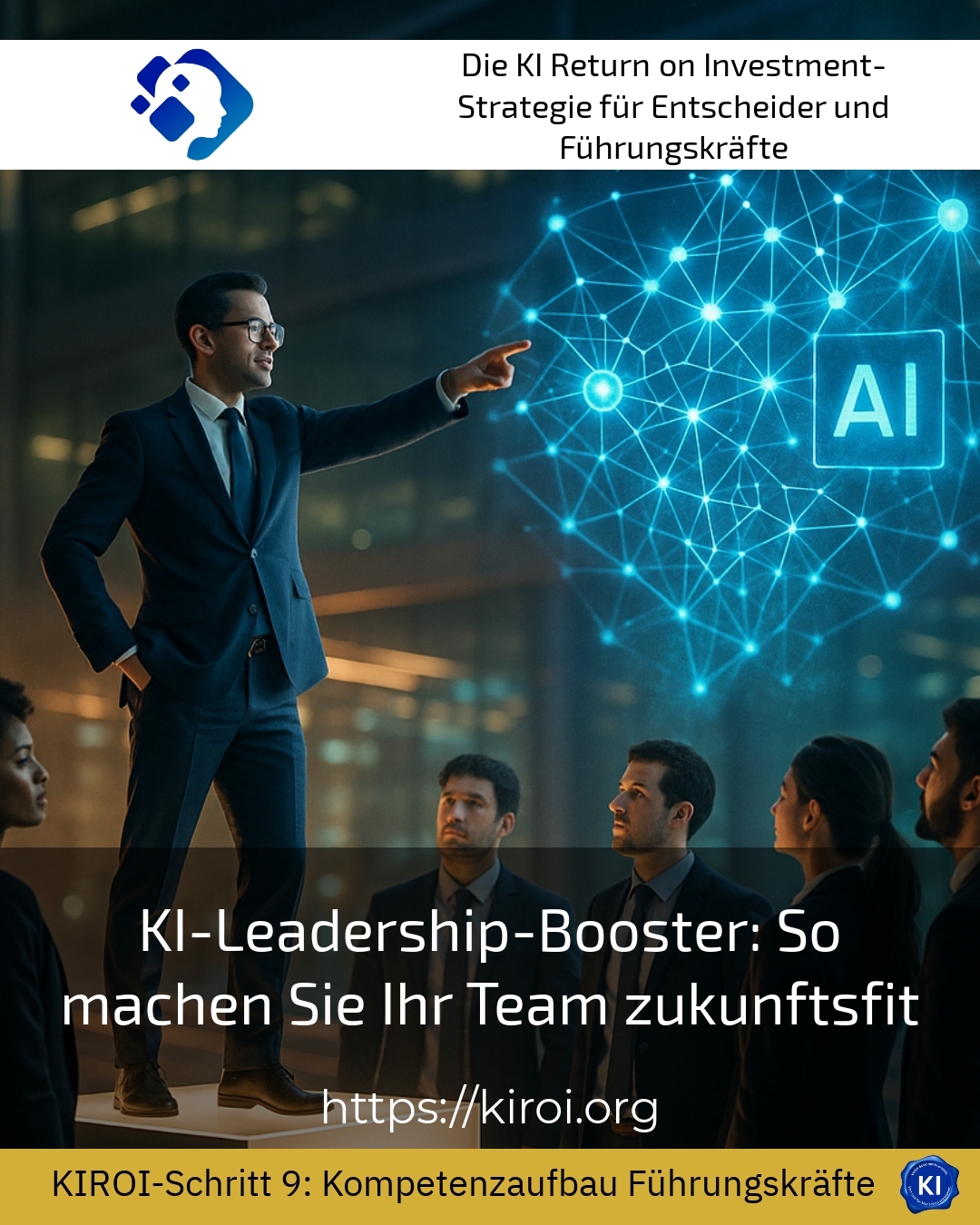
Do you sometimes wonder why some teams seem to handle technological changes effortlessly, while others are literally frozen in their tracks? The answer often lies not in the technology itself, but in the way leadership prepares their teams for transformation processes. AI Leadership Booster It represents a pioneering approach because it systematically links competence development with strategic leadership, thus creating sustainable change-making capabilities. In a time when algorithmic systems are increasingly infiltrating corporate processes, the quality of leadership determines significantly whether organizations perceive this development as an opportunity or experience it as a threat. This paper shows you practical ways that are often reported by clients as being transformative for their professional reality.
Understanding the new leadership reality and actively shaping it
Executives face a special challenge today. On the one hand, they must ensure operational excellence, and on the other, they must prepare their teams for a future whose contours are only gradually becoming clear. This double burden requires new competencies and ways of thinking. Traditional management approaches quickly reach their limits. Integrating intelligent systems into work processes not only changes job profiles but also the entire dynamic between people and machines. To remain relevant as a leader today, you must be able to actively accompany this development.
For example, a medium-sized machine engineering company from southern Germany faced the challenge of modernizing its quality assurance system. The workforce initially reacted skeptically to the announced changes. However, through targeted leadership development, it was possible to reduce fears and spark curiosity. Another example can be found in the logistics industry, where a distribution center wanted to optimize its warehouse management. The shift managers were involved in the process early on and developed their own suggestions for improvement. In the financial sector, a regional bank systematically prepared its customer advisors for new analytical tools. The result was a significantly higher acceptance of technological support.
Best practice with a AIROI customer
An international trading company with several thousand employees approached our transruptions coaching team because management realized that the existing leadership structures were no longer suited to the demands of an increasingly automated work environment. The middle management level showed clear signs of being overwhelmed, and the turnover in key positions was growing alarmingly. Together we developed a customized program that ran over twelve months and included all management levels from team leader level down. The participants first learned to reflect on their own attitude towards technological change and to understand which unconscious resistances they might be transmitting to their teams. In moderated workshops, they subsequently developed concrete communication strategies to prepare their employees for upcoming changes, without inciting fear or raising unrealistic expectations. Working on real case studies from their own company was particularly valuable, as the executives experienced first-hand how their new skills could have a positive impact. After completing the program, eighty percent of the participants reported that they felt significantly more confident in their leadership role and had concrete tools at hand to support their teams through transformation phases.
The AI Leadership Booster as a Strategic Instrument
What exactly makes something effective? AI Leadership Booster Out of the question? At its core, the goal is to empower leaders to make sense of technological developments and apply them to their organizations. This does not mean that every leader needs to become a technical expert. Rather, it is about the ability to ask relevant questions, weigh opportunities and risks, and navigate change processes with their own team. This skill can be developed and trained. Many leaders report that they initially lacked the necessary skills.
In the automotive supply industry, the importance of forward-looking leadership is particularly evident. A manufacturer of precision parts had to fundamentally rethink its production processes. The management board deliberately decided to use the plant managers as multipliers. In the healthcare sector, meanwhile, clinical management faces the task of preparing its doctors and nurses for data-driven decision support. A hospital in North Rhine-Westphalia has established a special leadership development program for this purpose. In retail, where store managers increasingly work with automated ordering systems, the need for future-oriented leadership development is also evident.
Key competencies for leadership in times of transformation
What specific skills do leaders need to make their teams future-ready? The first priority is the ability to self-reflect. Anyone who does not know their own fears and reservations will unconsciously transfer them onto others. Furthermore, a strong communication skill is required, because change processes are always communication processes. Leaders must be able to explain complex issues in an understandable way. At the same time, they need the sensitivity to perceive and respond to emotional reactions of their employees.
One pharmaceutical company has consistently implemented these findings and systematically trained its laboratory managers. The participants practiced role-playing to get skeptical team members on board. At an energy provider, district managers were prepared to accompany the introduction of intelligent grid technology. They learned to make technical connections tangible for their employees. A media company, in turn, sensitized its editorial managers to the use of automated research tools. The focus was on how to ensure journalistic quality.
Identifying and constructively addressing resistance
Every transformation brings resistance. That is human and understandable. Leaders who are committed to the transformation AI Leadership Booster-Approach working with, learning, and not seeing these resistances as a hindrance. Rather, they understand skepticism as a valuable signal. Often, behind resistance lie legitimate concerns or important clues about potential weaknesses in the change process. Those who take these signals seriously and act upon them gain valuable allies. At the same time, the quality of the desired change improves.
In the insurance industry, a large network of brokers has gained this experience. The initial rejection of new analysis systems by experienced consultants contained important insights. These insights led to adjustments that improved the final result. A construction company reported similar experiences with the introduction of digital construction site documentation. The polishers knew best which functions were practical in practice. In the restaurant business, where cash registers are becoming increasingly intelligent, the value of participatory implementation processes was also evident.
Best practice with a AIROI customer
A third-generation family business in the textile industry sought support from our transruptive coaching because an ambitious digitalization project had stalled. The technical implementation was already well advanced, but the workforce increasingly refused to participate. Our analysis revealed that while the executives were technically highly qualified, they lacked the tools to address emotional resistance. In intensive coaching sessions, we worked with the department heads to better understand the perspectives of their employees. We developed conversation formats where concerns could be openly expressed without negative consequences. The executives learned to distinguish between factual criticism and emotional resistance and developed different strategies for both situations. The creation of so-called bridge-builder teams proved particularly effective, in which technology-savvy and more skeptical employees worked together on concrete application cases. This measure led to the project gaining momentum again after about four months and surpassed the originally intended goals. The management later reported that this experience had initiated a fundamental change in the corporate culture.
Practical impulses for everyday leadership
How can future-oriented leadership be embedded in day-to-day operations? A proven approach is to establish regular reflection formats. Short weekly team meetings where changes are discussed openly can make a big difference. It is important that leaders themselves demonstrate a learning attitude. By admitting that they do not know everything, they create psychological safety. This safety is a prerequisite for employees to feel confident enough to ask questions and express uncertainties.
A telecommunications company has introduced so-called learning circles where executives from different departments exchange experiences. The transfer of knowledge has proven to be extremely valuable. At a food manufacturer, shift meetings have been expanded to include a dedicated section on technological developments. The employees themselves bring observations and ideas. A logistics company, meanwhile, is experimenting with mentoring pairs where younger and more experienced employees learn from each other.
Sustainable change through continuous support
Transformation is not a project with a beginning and an end. It is a continuous process. AI Leadership Booster-This approach takes into account this finding by focusing on long-term support instead of one-time interventions. Leaders need the opportunity to practice new behaviors and receive feedback. They benefit from regular exchanges with others who face similar challenges. This form of support can take various forms.
In the chemical industry, a model has proven itself in which external coaches accompany the executives over several months [1]. The regular discussions enable timely corrections. A tourism company relies on peer coaching groups in which executives support each other. In the crafts sector, on the other hand, regional networking meetings have established themselves, where business owners share their experiences. This collaborative advice is often perceived as particularly valuable.
My AIROI Analysis
After intensive discussions with numerous transformation projects in a wide range of industries, a clear picture has emerged. The success of technological changes depends largely on the quality of leadership. Organizations that invest early in the development of their leadership create the foundation for sustainable competitiveness. This is not about technical expertise at all costs. Rather, it requires reflective leadership who can realistically assess opportunities and risks.
Our transruptive coaching accompanies companies on this development journey with a holistic approach. We see ourselves as both a catalyst and a sparring partner. Experience shows that external support can provide valuable guidance during transformation phases [2]. Executives often report that the outside perspective helps them recognize and break through established patterns. At the same time, they benefit from proven methods and tools.
The years ahead will show which organizations will master the balance between technological innovation and human leadership. Those who invest in their leadership today gain a decisive advantage. That doesn’t mean the path will be easy. But it does mean that it is a path that is viable if the right steps are taken. We look forward to supporting you on this journey and exploring with you the possibilities that arise for your organization.
Further links from the text above:
[1] Haufe: Successfully implementing coaching in the workplace
[2] Manager seminars: External support in change processes
For more information and if you have any questions, please contact Contact us or read more blog posts on the topic Artificial intelligence here.








 Deutsch
  English (UK)