
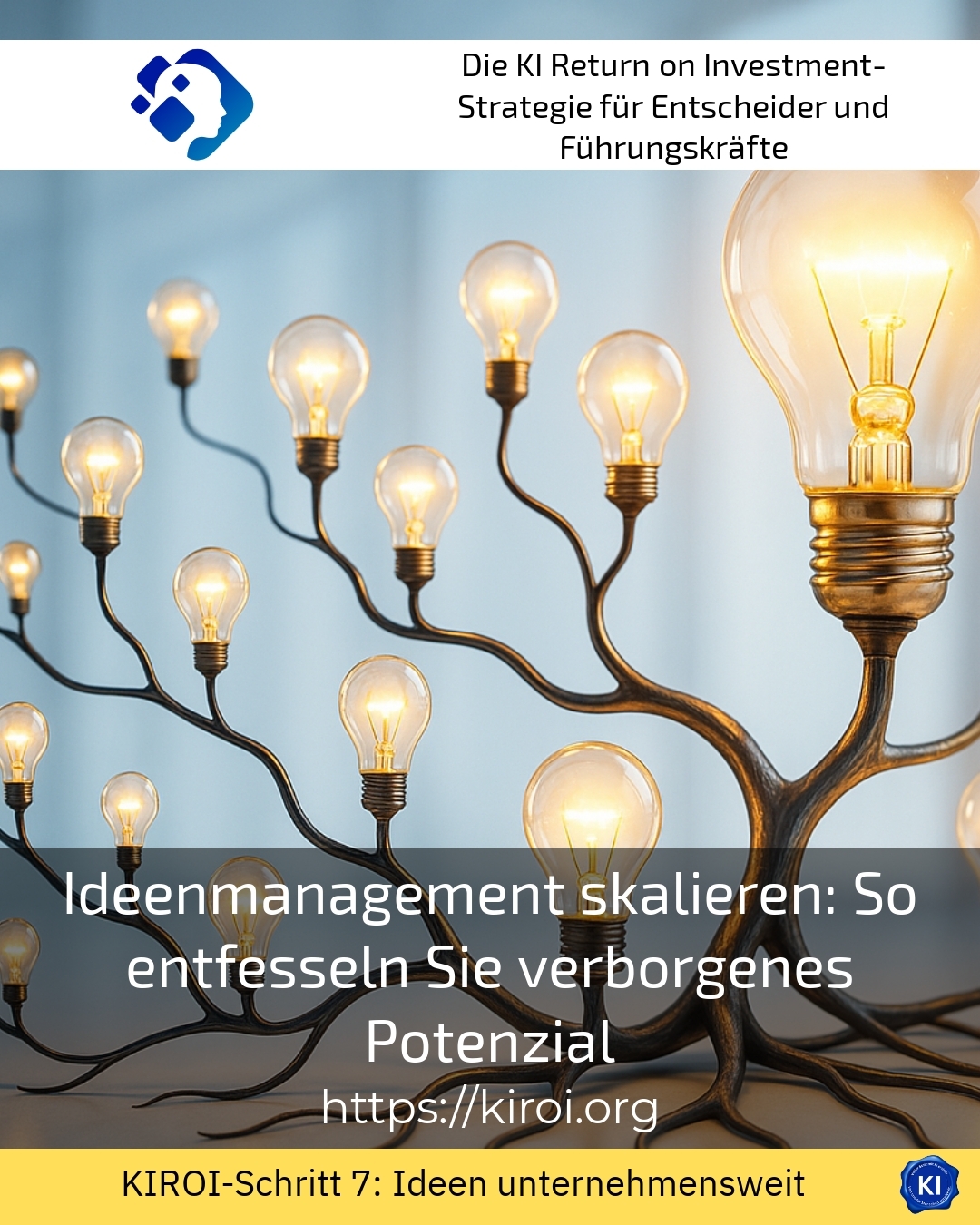
Imagine your company is harbouring thousands of brilliant ideas. These ideas are just waiting to be discovered. Yet without a well-conceived system for capturing and evaluating these creative impulses, they disappear unused into the daily routine. The concept Scaling ideas management therefore increasingly gaining in importance. Organisations are recognising the need to systematically tap into hidden innovation potential. This article shows you how you can unearth this treasure. Transruptions Coaching will accompany you as a competent partner on this exciting journey.
The hidden power of creative impulses in organisations
Every organisation possesses an enormous wealth of knowledge. This knowledge is distributed across all levels and departments. Employees on the ground observe opportunities for improvement in processes every day. Managers recognise strategic opportunities in the market environment. External partners bring valuable external perspectives. The challenge lies in gathering these diverse impulses and making them usable.
For example, a medium-sized mechanical engineering company discovered numerous product improvements through a systematic survey of its service technicians. These technicians knew the weak points of the machines particularly well from their daily work. A logistics company used the observations of its warehouse workers for process optimisation. The savings significantly exceeded all the management's expectations. A financial service provider integrated customer advisors into the development of new products. The result was tailored offers with high market acceptance.
Best practice with a AIROI customer
An international consumer goods company faced the challenge of coordinating innovation impulses from over twenty country organisations. The previous practice of collecting ideas by email led to information loss and frustration among those submitting them. As part of a transruption coaching project, the company developed a structured approach for the systematic capture and evaluation of creative proposals. The introduction of clear evaluation criteria and transparent feedback processes increased participation by more than three hundred percent within six months. The involvement of local champions, who acted as multipliers in their respective regions, proved particularly valuable. These champions not only collected ideas, but also supported their implementation on the ground. Today, the company reports a significantly increased capacity for innovation and shortened development cycles for new products.
Scaling idea management through structured processes
Scaling creative processes requires well-thought-out structures and clear responsibilities. Without these foundations, good approaches get lost in the hustle and bustle of everyday organisational life. Successful companies therefore establish multi-stage evaluation systems for incoming proposals. They define unambiguous criteria for the prioritisation of ideas. In addition, they create transparency regarding the status and progress of every single submission.
For example, an energy supplier implemented a three-stage evaluation process. In the first stage, technical experts checked the feasibility of the proposals. The second stage involved an economic analysis by the controlling department. In the third stage, an innovation committee decided on the implementation priority. In contrast, a retail company used a decentralised approach with regional innovation circles. These circles first evaluated proposals locally and passed the most promising ones on to headquarters. A pharmaceutical company closely linked its innovation programme with strategic planning. This ensured that implemented ideas contributed to the long-term success of the company.
Scale technological support for idea management
Modern technologies can significantly support the process of idea generation and evaluation. Digital platforms enable cross-location collaboration in real time. Algorithms help to identify and merge similar proposals. Automated workflows noticeably accelerate evaluation and approval processes. Nevertheless, the human factor remains crucial for success.
An automotive supplier used artificial intelligence for the pre-qualification of incoming proposals. The system recognised duplicates and automatically assigned ideas to the appropriate departments. An insurance company relied on gamification elements to increase employee participation. Points, leaderboards and virtual awards motivated active participation in the innovation programme. A telecommunications provider integrated its innovation portal directly into existing working environments. Employees could submit ideas without having to leave their usual working environment.
Best practice with a AIROI customer
A leading provider in the field of industrial engineering was looking for ways to better utilise the innovation potential of its globally distributed development sites. The existing structures made knowledge exchange between the different regions considerably more difficult. Together with transruptions-Coaching, the company developed a hybrid model consisting of central coordination and decentralised implementation. Virtual innovation workshops regularly brought together experts from various locations. A specially developed digital platform enabled asynchronous collaboration across time zones. The introduction of cross-functional teams that worked across locations on promising concepts was particularly successful. These teams had their own budgets and decision-making powers for their respective projects. Since then, the company has recorded a significant increase in the number of successful new products and process improvements.
Cultural prerequisites for sustainable innovation
Technology and processes alone do not guarantee success in unlocking creative potential. Corporate culture plays an at least equally important role in long-term success. Employees must feel safe to express unconventional thoughts. Leaders should actively encourage experimentation and view mistakes as learning opportunities. Open communication across all hierarchical levels supports the free flow of ideas.
For example, a software company held regular fail-forward sessions. In these sessions, employees shared failed projects and the insights gained from them. A construction company established a mentoring programme for young innovators within the firm. Experienced managers accompanied promising talent in the development of their concepts. A media group created physical creative spaces that invited informal exchange. These spaces offered tools and materials for spontaneous prototypes and experiments.
Scaling the role of leadership in idea management
Managers significantly shape the culture of innovation through their behaviour [1]. Their active participation in innovation processes signals the strategic importance of the topic. Regular feedback on submitted proposals shows appreciation for the contributors' commitment. Providing sufficient resources for promising projects underlines the seriousness of this commitment.
A technology corporation obliged its executives to take part in monthly innovation reviews. These reviews created transparency regarding the progress of ongoing projects and open decision-making requirements. A healthcare provider integrated innovation targets into the performance agreements of its managers. This created a direct incentive for the active promotion of creative initiatives. A retail company established a buddy system between executives and innovators. These personal partnerships significantly accelerated the implementation of promising concepts.
Measurable successes and continuous improvement
The systematic measurement of innovation activities enables continuous process improvement [2]. Meaningful key performance indicators encompass not only the number of submitted proposals. The implementation rate, the average processing time and the economic benefit also deserve attention. The regular analysis of this data provides valuable insights into optimisation potential.
A chemical company developed a comprehensive dashboard to control its innovation activities. This dashboard visualised the entire funnel from idea submission to successful implementation. A financial services provider conducted regular surveys among the participants of its innovation programme. The feedback helped to identify obstacles and initiate improvements. An industrial company systematically compared its innovation metrics with industry benchmarks. These comparisons provided valuable impetus for the further development of its own programme.
Best practice with a AIROI customer
A medium-sized precision engineering company wanted to fundamentally modernise its existing suggestion scheme and take it to a new level. The previous practice was limited to a physical suggestion box and sporadic awards for individual suggestions. As part of a support process by transruptions-Coaching, the company first analysed the existing barriers to active employee participation. It then developed a holistic approach that took technical, organisational and cultural aspects into account. The introduction of a user-friendly digital platform significantly simplified the submission and tracking of suggestions. Accompanying communication measures clearly conveyed the importance of the programme for the company's success. The training of managers in the constructive handling of innovation suggestions rounded off the programme. Today, the company boasts a vibrant culture of innovation with high participation across all departments and hierarchical levels.
Scaling ideas management into practice
The practical implementation of a scalable innovation system requires a step-by-step approach. Pilot projects in selected corporate divisions enable experience to be gathered within a manageable scope. This experience feeds into the design of the company-wide rollout. The early involvement of key stakeholders ensures the necessary support for the project.
A food manufacturer initially launched its innovation programme in product development. The insights gained there helped to adapt the concept for other areas. A logistics service provider chose a bottom-up approach with voluntary innovation ambassadors from the workforce. These ambassadors carried the programme into their respective teams and locations. A mechanical engineering company combined internal innovation activities with open innovation approaches. The involvement of customers, suppliers and research institutions significantly expanded the creative potential [3].
My AIROI Analysis
The systematic tapping of creative potentials in organisations represents one of the greatest opportunities for sustainable competitive advantages. My experience from numerous accompanying projects shows that successful programmes always rest upon three pillars. The first pillar is formed by well-conceived processes and suitable technological tools to support the flow of ideas. The second pillar encompasses a conducive corporate culture that values creativity and enables experiments. The third pillar consists of committed leaders who actively support and exemplify innovation activities.
Particularly frequently, clients report initial difficulties in overcoming established thought patterns and behaviours. The transformation towards an innovation-friendly organisation requires patience and persistence from all participants. Quick wins through the visible implementation of promising proposals can provide valuable momentum here. At the same time, companies should have realistic expectations regarding the speed of cultural change.
Transruptions-Coaching supports organisations in finding their individual path to the systematic use of creative potentials. The combination of strategic consulting, practical implementation support and change management expertise effectively supports the entire transformation process. Every company brings its own prerequisites and challenges that require a tailored approach. The examples presented in this article show that the effort is worthwhile and measurable results are achievable.
Further links from the text above:
[1] Harvard Business Review – Innovation Leadership
[2] McKinsey – Innovation Insights
[3] Fraunhofer – Open Innovation approaches
For more information and if you have any questions, please contact Contact us or read more blog posts on the topic Artificial intelligence here.










 Deutsch
  English (UK)