
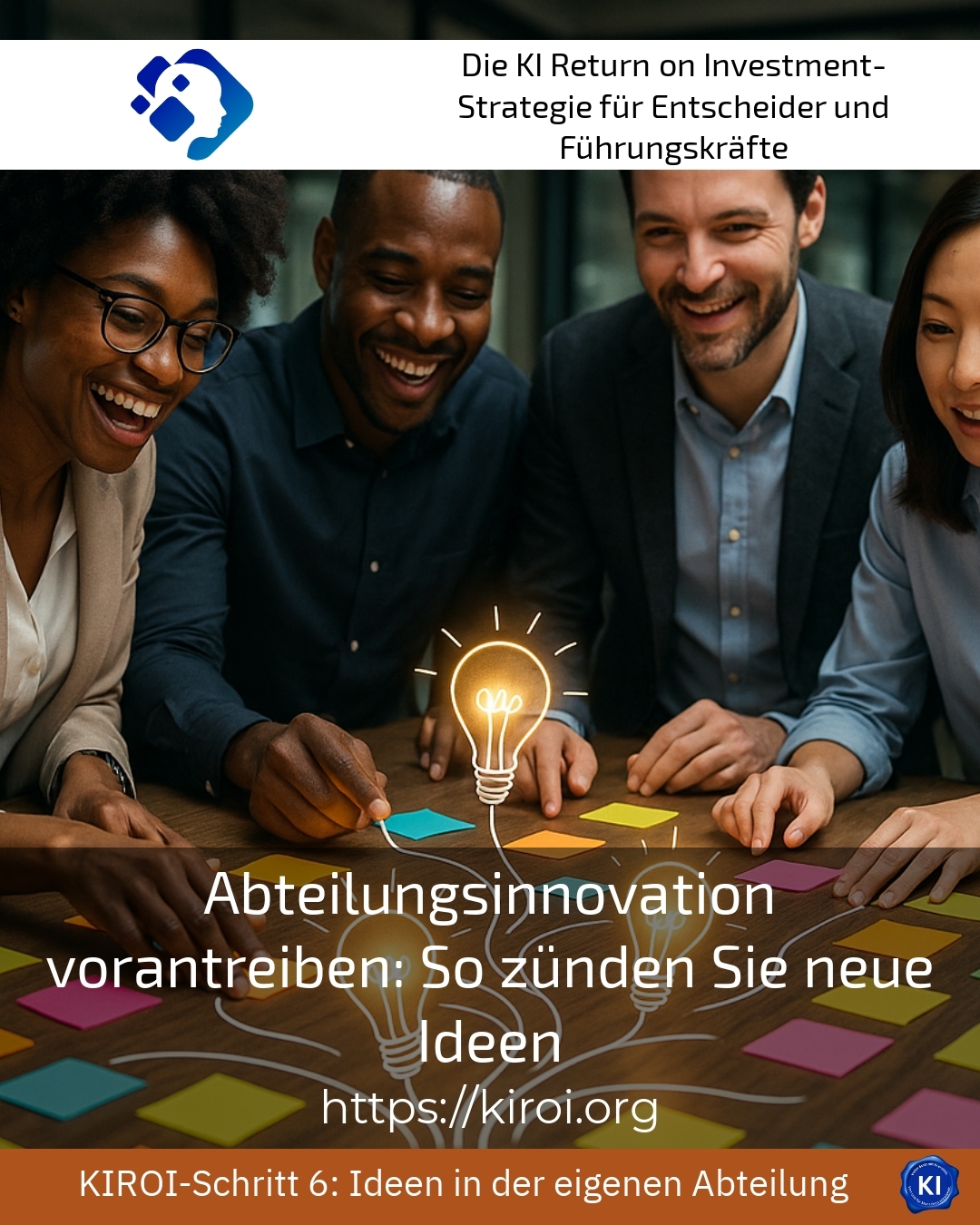
Imagine your department suddenly develops ideas that change the entire company. This scenario might sound utopian, but it's more tangible than you think. The secret lies in driving targeted departmental innovation, which systematically unleashes new impulses. Many leaders face the challenge of kick-starting creative processes. They are looking for ways to break down rigid structures. Clients often report the same hurdles. There's a lack of time, courage, or the right methods. Yet, this is precisely where a fundamental change begins. In this article, you'll learn how to unlock hidden potential. You'll discover practical approaches that are already proving effective in many companies.
Why departmental innovation is more important than ever today
The business world is changing at a rapid pace. Technological developments, changing customer needs, and new competitors present companies with challenges. Therefore, the systematic development of new ideas is gaining importance. A department that stands still quickly loses touch. At the same time, completely new opportunities arise from creative impulses. Retail companies, for example, are using digital customer experiences [1]. They create personalised shopping experiences through data-driven analysis. Banks, in turn, are focusing on automated advice processes. These developments clearly show how important fresh ideas are. Insurance companies are also experimenting with new claims settlement procedures. They are noticeably shortening processing times and increasing customer satisfaction.
Many leaders come to us with similar issues. They report stalled processes and a lack of creativity. Employees are hardly contributing any suggestions anymore. The fear of making mistakes is paralysing the entire team. This is precisely where transruptions-coaching supports the guidance of projects. It provides impulses that open up new ways of thinking. Experience shows that small changes can have a big impact.
Best practice with a AIROI customer
A medium-sized retail company found itself in a critical situation. The product development department had not produced any new concepts for months. Management realised that traditional meetings were not delivering solutions, so the company opted for guided transformation. Initially, we jointly analysed the existing communication channels. This revealed that hierarchical structures were blocking creative impulses. Employees were afraid to voice unconventional suggestions. We therefore introduced open brainstorming sessions without pressure to evaluate. Additionally, we established a digital suggestion system with anonymous submissions. The results surprised everyone involved in the long term. Within three months, twelve feasible product ideas were generated. Three of these are already in the customer testing phase. The head of department reports a completely changed working atmosphere. Employees are now actively contributing and taking responsibility. This example impressively demonstrates the power of systematic guidance.
Understanding the Psychological Foundations of Creative Processes
Creativity is not the product of chance, but follows certain patterns. The brain requires specific conditions for innovative thoughts. Stress and time pressure are counterproductive. They activate the survival mode and block creative areas. Conversely, relaxation and psychological safety promote new connections [2]. Forward-thinking companies strategically exploit these insights. For example, a logistics company introduced creative breaks. Employees were allowed to experiment freely for thirty minutes each day. The results far exceeded all expectations. A pharmaceutical group established special thinking rooms without technical equipment. Groundbreaking research approaches are now regularly emerging there.
Social dynamics also play a crucial role. Teams with high psychological safety generate more ideas. They experiment without fear of negative consequences. An automotive supplier also recognised these connections. They trained managers in a culture of appreciating mistakes. Since then, the number of suggestions for improvement has been steadily increasing.
Methods for driving department innovation in practice
Various techniques support the systematic development of new ideas. Design Thinking is one of the best-known approaches worldwide. This method consistently focuses on the user's perspective. A telecommunications provider used it to redesign its customer hotline. Waiting times decreased while satisfaction ratings increased. Brainstorming variants such as the 635 method effectively structure creative sessions. In this method, six people write down three ideas each in five minutes. These are then further developed by others. An energy provider used this technique to develop sustainable tariffs.
The Osborn checklist encourages rethinking through targeted questions. It asks, for example, what could be combined, adapted, or eliminated. A food manufacturer significantly optimised its packaging processes using this. SCAMPER, as an advanced variant, offers even more impetus. A machine manufacturer completely revolutionised its maintenance concepts with it.
Best practice with a AIROI customer
An insurance company wanted to fundamentally transform its claims department. Processing customer inquiries took an average of fourteen days. Customers regularly complained about a lack of transparency in the process. Management therefore sought innovative solutions. In joint workshops, we first identified all the bottlenecks. The employees themselves recognised the biggest problem areas. They independently developed suggestions for digital support tools. One team proposed an automated initial assessment of simple claims. Another designed a real-time status tracker for affected customers. Implementation took place in agile sprints over several months. Today, the average processing time is only five days. Customer satisfaction increased by over thirty percent, according to internal measurements. Particularly noteworthy is the changed attitude of the employees. They now see themselves as active shapers of their work processes. This development shows how support through transruption coaching enables sustainable change.
Creating structural prerequisites for sustainable idea development
Creativity requires not only mental but also organisational freedom. Rigid hierarchies often stifle innovative approaches at the outset. For this reason, many companies are fundamentally rethinking their structures. One chemical company established cross-departmental project teams. These teams collaborate independently of traditional reporting lines. A media company introduced so-called innovation labs [3]. Here, employees experiment with future-oriented technologies. A construction company organised regular hackathons. In short periods, teams develop prototype solutions.
The spatial design also has a significant impact on creative processes. Open meeting zones demonstrably promote spontaneous idea exchange. A software company deliberately designed its offices as a creative landscape. Different zones optimally support different work modes. Quiet retreat areas allow for concentrated thought in silence. Communication areas encourage lively exchange between colleagues.
The role of leadership in driving departmental innovation
Managers significantly shape the creative culture of their departments. Their behaviour signals whether new ideas are welcome. Micromanagement and excessive control are inimical to innovation. Instead, teams need trust and autonomy. A consumer goods manufacturer retrained its managers accordingly. They learned to ask questions instead of dictating answers. The results permanently astonished the entire management team. A financial services provider established a reverse mentoring program. In this scheme, younger employees coach experienced managers. In this way, fresh perspectives flow into strategic decisions.
The role of leadership as a role model should not be underestimated. Those who do not dare to break new ground themselves can hardly expect others to do so. A technology company therefore introduced innovation challenges for managers. These managers must regularly present and implement their own improvement ideas.
Best practice with a AIROI customer
A family business with a rich tradition in the furniture industry recognised the need for action. The younger generation was just taking over full management. They wanted to modernise the company culture gently but sustainably. Product development in particular needed to become more agile and creative. The existing workforce initially reacted sceptically to the changes. Many employees had been working according to tried-and-tested methods for decades. We openly addressed these concerns in accompanied dialogue sessions. The experience of long-serving employees was explicitly valued. At the same time, we demonstrated opportunities for new approaches. A culture of respectful experimentation gradually developed. Today, generations work together on innovative furniture concepts. The combination of traditional craftsmanship and modern design impresses customers. Sales in the premium segment rose significantly. The workforce identifies more strongly with the company. This transformation proves that tradition and progress are compatible.
Using Digital Tools as Catalysts
Modern technologies are opening up entirely new possibilities for creative processes. Collaboration platforms connect teams across locations and time zones. An international corporation is using such tools for global idea competitions. Employees on all continents submit suggestions. Artificial intelligence now assists in evaluating ideas [4]. It reliably identifies patterns and promising concepts. A retail company is already using corresponding systems productively. Virtual reality makes it possible to test ideas without physical prototypes. An architecture firm uses it to convincingly visualise building concepts for clients.
Digital whiteboards are increasingly replacing traditional moderation walls in workshops. They enable asynchronous collaboration over several days. A consulting firm uses them to efficiently coordinate complex strategy projects. Mind-mapping software visually structures complex thoughts appealingly. An engineering firm uses it to document development processes seamlessly and comprehensibly.
Identifying and constructively addressing resistance
Change processes often provoke resistance that must be taken seriously. These reactions are human and understandable. Employees worry about their skills and positions. Managers fear a loss of control or added burdens. Transruption coaching sensitively supports these very transitional phases. It helps to name fears and address them constructively. A mechanical engineering company experienced massive resistance during a reorganisation. Through moderated dialogues, many blockages gradually dissolved.
Not all resistance is destructive or hindering. Some critical voices point to real problems. A pharmaceutical company learned to accept such objections as valuable hints. The quality of decisions demonstrably improved as a result. A retailer established formal channels for constructive criticism. Employees can voice and discuss concerns there anonymously.
My AIROI Analysis
Systematically fostering creative processes in departments is not a luxury. Rather, it is a strategic necessity for future-proof companies. The examples presented impressively illustrate the potential that can be unlocked. A holistic approach that considers multiple levels is crucial here. Psychological safety forms the foundation of all creative development. Without it, ideas remain unspoken and potential unused. Structural frameworks must create scope for experimentation. Leaders act as role models and enablers simultaneously.
Digital transformation opens up new opportunities and possibilities. Modern tools support collaborative idea development across all boundaries. At the same time, the change requires sensitive support for people. Resistance and fears deserve attention and respectful handling. Transruption coaching positions itself here as a reliable partner. It supports companies on their individual path to a more innovative culture. The experience from numerous projects shows that sustainable change is possible. However, it requires patience, consistency and professional guidance. Those who dare to make this investment will be rewarded with engaged teams. They will benefit long-term from a wealth of ideas and increased competitiveness.
Further links from the text above:
[1] Harvard Business Review – Innovation Insights
[2] Psychology Today – Creativity and Psychological Foundations
[3] McKinsey – The Eight Fundamentals of Successful Innovation
[4] Forbes – Artificial Intelligence in a Business Context
For more information and if you have any questions, please contact Contact us or read more blog posts on the topic Artificial intelligence here.







 Deutsch
  English (UK)