
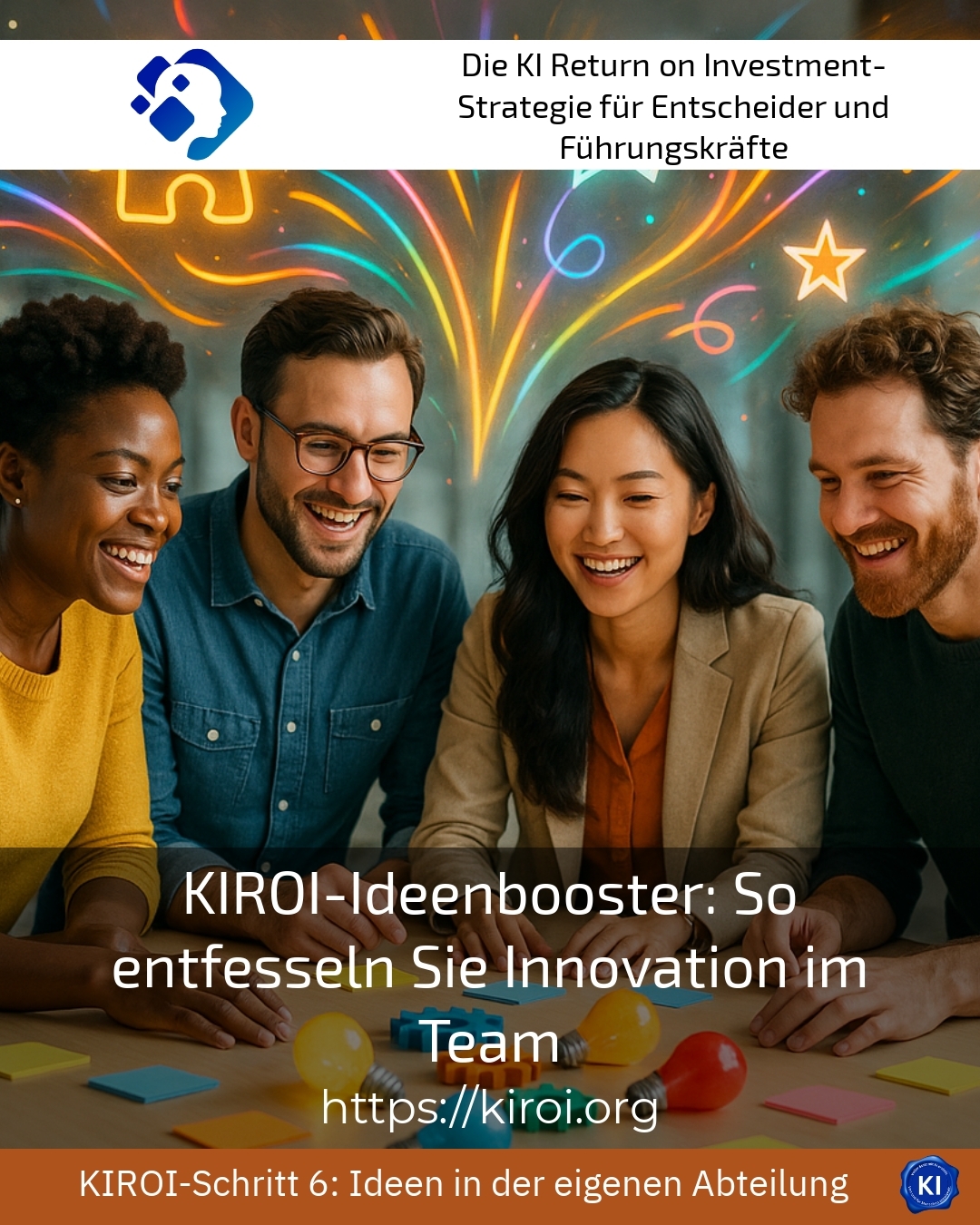
Imagine your team could come up with groundbreaking ideas every month. The KIROI-Idea Booster makes precisely that possible. In a time when stagnation means regression, companies are looking for ways to unleash creative potential. This is not about individual flashes of genius. It's about systematic innovation that has a lasting impact. Many leaders report that their teams suffer from a lack of ideas. At the same time, unimagined creative resources lie dormant in every department. The key lies in the right methodology and support. This is precisely where a structured approach comes in, making creativity measurable and reproducible.
Why classic brainstorming methods often fail
Traditional creativity techniques are reaching their limits in many companies. This isn't due to a lack of willingness from those involved. Rather, a structured framework for sustainable idea development is often missing. In the automotive industry, for example, development teams are struggling with immense pressure to innovate. They need to simultaneously drive forward electromobility, autonomous driving, and digital services. A supplier of drive components faced precisely this challenge. Their engineers were working at their breaking point, but new concepts weren't emerging.
We encounter similar situations regularly in mechanical engineering. Technical thinking often dominates creative approaches here. A manufacturer of industrial robots recognised that its product development had stagnated. Competition from Asia was rapidly catching up. Traditional meetings no longer brought breakthroughs. Comparable patterns are also evident in the chemical industry. Although research teams work highly professionally on improving existing products, genuine innovations rarely emerge from rigid laboratory structures.
The reason for these blockages lies deeper. Hierarchical structures significantly hinder the free flow of ideas. Employees do not dare to voice unconventional suggestions. They fear negative evaluations from superiors or colleagues. Furthermore, there is often a lack of time for genuine creative work. Daily business consumes all available resources. This leads to innovation backlogs, which can jeopardise competitiveness in the long term.
The KIROI Idea Booster as a Systematic Innovation Driver
A considered approach to fostering innovation takes into account both psychological and organisational factors. The KIROI-Idea Booster It combines structured methodology with creative freedom. Transruption Coaching supports teams in transforming their way of working. The aim is to create spaces where innovation can flourish. These spaces are to be understood not only physically but above all mentally.
In the aviation industry, a component manufacturer was able to achieve remarkable progress through this approach. Its development department generated more patentable ideas within one quarter than in the entire previous year. The key lay in the combination of guided creative sessions and free experimentation time. Similar successes were seen with a medical technology manufacturer. New product concepts for minimally invasive surgery emerged there. The ideas did not come from management, but from technicians on the production floor.
A medium-sized company from the packaging industry also benefited from this systematic approach. It developed sustainable packaging solutions that are now industry standard. The innovations arose from cross-departmental workshops with structured moderation. Sales employees contributed customer requests, while technicians checked feasibility. This combination of different perspectives proved to be particularly fruitful.
Best practice with a KIROI customer A global manufacturer of precision tools approached us because their innovation pipeline was nearly empty. Management had already taken various measures, but a breakthrough remained elusive. As part of the Transruption Coaching, we first analysed the company's existing creative processes. We found that although ideas were being generated, they were systematically talked to death in committees. We established a protected space for initial idea development, which excluded so-called killer phrases. Additionally, we introduced a digital idea management system that allowed for anonymous suggestions. Within six months, the number of submitted innovation proposals had tripled. Even more significant, however, was the marked improvement in the quality of the ideas. Three of these suggestions directly led to new product lines, which are now core business. Employee satisfaction in the affected departments increased tangibly. The company won a prestigious innovation award within its industry and successfully positioned itself as a technology leader.
The Five Pillars of Effective Idea Development in Teams
Successful innovation promotion relies on several interconnected elements. Firstly, psychological safety within the team is a fundamental prerequisite. Employees must be allowed to make mistakes without fear of reprisal. One electronics manufacturer established "Fail-Forward" sessions for this purpose. In these sessions, failed projects were analysed, and valuable insights were gained. This culture of constructively examining mistakes unleashed enormous creative energy.
Secondly, teams require dedicated time for creative work outside of day-to-day business. One plant constructor reserved every Friday afternoon for his engineers' innovation projects. The results significantly exceeded all management expectations. Thirdly, diversity of perspectives is crucially important. A pharmaceutical company specifically invited employees from outside their field to development workshops. The external perspective brought surprising solutions for complex formulation problems.
Fourthly, structured methods significantly support the creative process. The KIROI-Idea Booster offers a proven framework here. It combines techniques such as Design Thinking with industry-specific adaptations. Fifth, the consistent pursuit of promising ideas is essential. A textile machinery manufacturer set up an innovation fund for this purpose. Employees could apply for budgets for prototypes there and further develop their concepts.
Practical implementation of the KIROI idea booster concept
Implementing a systematic innovation approach requires careful planning and patience. Clients often report initial resistance within their organisations. Some leaders fear a loss of control over the direction of development. Others see creative time as a wasted resource. Transruption coaching can provide valuable impetus and address resistances here.
A manufacturer of agricultural machinery began with a pilot project in one department. The positive results convinced the initially sceptical managers of the concept. The company then gradually rolled out the approach to further areas. A producer of industrial adhesives chose a different path. They started with a company-wide ideas competition as the initial spark. The best suggestions received budgets for further development and public recognition.
The construction industry also offers interesting application examples for systematic innovation promotion. A prefabricated house manufacturer integrated tradespeople directly into its development processes. Their practical experience led to significantly more assembly-friendly designs. The construction time per house was measurably reduced. A building materials manufacturer used a similar approach for sustainable material development. It involved architects and building contractors early in the innovation process.
Best practice with a KIROI customer A specialist in industrial measurement technology approached us with a specific problem. Despite highly qualified engineers, they were unable to expand their product portfolio in a meaningful way. The employees felt their creativity was restricted by strict quality requirements. As part of our support, we developed a phased model for the innovation process. In the first phase, all ideas were explicitly allowed, even seemingly unrealistic ones. Only in later phases were the necessary quality criteria applied. This separation of idea generation and evaluation had a liberating effect on the teams. We also trained internal facilitators who could independently lead creative sessions. The company also established a mentoring programme for promising idea generators. Experienced developers supported younger colleagues in refining their concepts. Within eight months, four marketable product ideas emerged from this process. Collaboration between departments also improved noticeably.
Typical challenges and how teams overcome them
The introduction of new innovation processes regularly brings with it certain hurdles. Many companies underestimate the time required for genuine cultural change. A printing press manufacturer initially experienced frustration among its teams. The hoped-for breakthroughs did not materialise immediately. Only after about nine months of consistent application did clear successes emerge.
A further challenge lies in integrating innovation and day-to-day business. An industrial software provider solved this through clear time allocations. Ten percent of working time was mandatorily reserved for innovation projects. Managers had to respect and protect these times. Measuring innovation success also presents many companies with problems. A manufacturer of hydraulic components developed a multidimensional key performance indicator system for this purpose [1].
The energy industry demonstrates particularly impressively how important continuous innovation has become. Municipal utilities must fundamentally transform their business models. To achieve this, a municipal provider established cross-departmental innovation circles. Employees from engineering, sales, and customer service collaboratively developed new services. The combination of different expertise proved to be the key to success.
The role of leaders in fostering innovation
Leaders significantly influence whether innovation thrives or is stifled within a company. On the one hand, they must create room for manoeuvre, and on the other, they must provide direction. The KIROI-Idea Booster therefore explicitly involves the leadership level. Clients often report that this is precisely where the greatest leverage lies.
A foundry experienced a remarkable transformation of its leadership culture. The management began to publicly discuss its own undeveloped ideas. This role model encouraged employees at all levels to experiment. A manufacturer of plastic packaging went even further. It delegated innovation budgets directly to team level. The teams decided for themselves which ideas they wanted to pursue.
The food industry also provides insightful examples of innovation-promoting leadership. A producer of baking mixes regularly invited employees to an idea lunch with management. Numerous product innovations emerged from this relaxed atmosphere. A beverage manufacturer even set up an innovation kitchen. There, employees could practically test and refine their own recipe ideas [2].
My KIROI Analysis
The systematic promotion of innovation in teams represents one of the greatest challenges in modern corporate management. My analysis of numerous client projects clearly shows that a successful innovation culture is not a matter of chance. It arises from the conscious design of framework conditions, processes, and leadership behaviour. The KIROI Idea Booster offers a structured framework for this, which has proven itself across industries.
Particularly important to me is the realisation that technical tools alone do not create innovation. People develop ideas, not software or methods. Therefore, any approach to fostering innovation must put people at the centre. This means creating psychological safety and defending creative freedom. At the same time, teams need direction and feedback so they don't end up in unproductive arbitrariness.
Transruptions coaching can offer businesses valuable support in this complex task. It aids both strategic direction and practical implementation. The industry examples described show that no company is too big or too small for systematic innovation promotion. What's crucial is a genuine will for change and the readiness to see setbacks as learning opportunities. Those who cultivate this attitude will become industry innovation leaders in the long term.
Further links from the text above:
[1] Innovation controlling and key performance indicators for measuring success
[2] Innovation Management: How Leaders Can Foster Creativity in the Workplace
For more information and if you have any questions, please contact Contact us or read more blog posts on the topic Artificial intelligence here.











 Deutsch
  English (UK)