Are your employees already on the right side of the digital revolution, or are they in danger of being left behind?
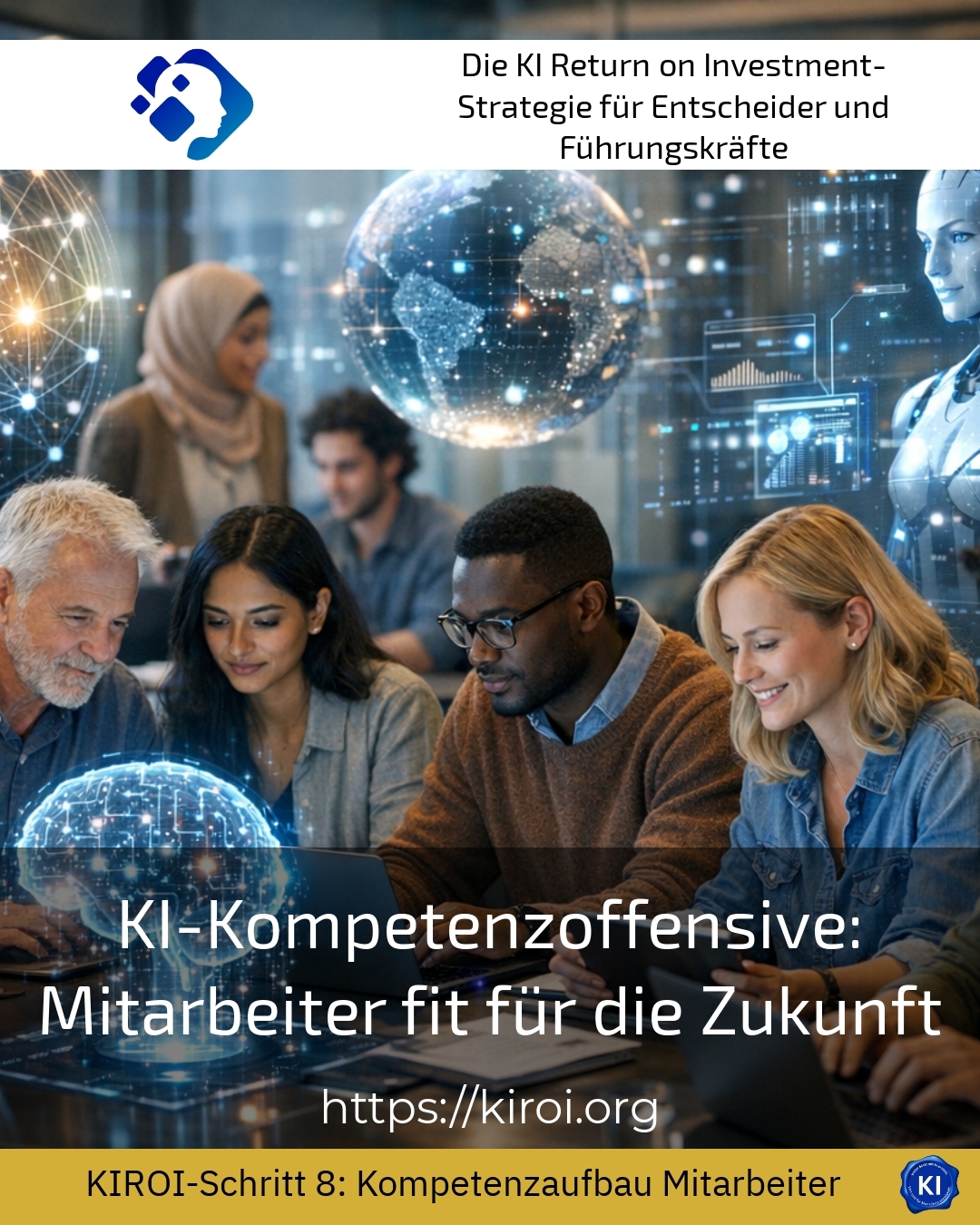
This question concerns executives and human resources managers in almost all sectors of the economy, because technological transformations have developed an unprecedented dynamism and traditional qualification profiles may become obsolete within a few years. AI competence offensive: Employees prepared for the future It is more than just a buzzword; it describes a fundamental change in the way companies must prepare their workforce for upcoming challenges. In this article, you will learn what concrete measures organizations can take to sustainably strengthen their teams while remaining competitive. We focus on tried-and-tested approaches that have already proven their effectiveness in numerous projects.
Why the AI competence offensive is crucial now
The digital transformation has reached a speed in recent years that is simply overwhelming many companies, which is why a systematic training initiative has become indispensable. Employees in the logistics industry often report that automated warehouse systems have fundamentally changed their work processes. At the same time, employees in the financial sector are experiencing that algorithmic decision-making complements or partially replaces traditional consulting services. In healthcare, intelligent systems are already supporting diagnosis and treatment planning.
These developments clearly show that qualifications need to be continuously adapted. Companies that invest early in further training create a sustainable competitive advantage. This involves not only technical expertise but also the ability to handle new tools creatively. Manufacturing companies in the automotive industry have shown how a structured approach to this challenge can look like. Insurance companies, in turn, have recognized that the combination of human expertise and machine support enables entirely new service qualities. Retail companies are using intelligent forecasting systems to optimize product flows and more accurately predict customer needs.
The strategic dimension of employee development
Qualification initiatives should never be viewed in isolation, but always in the context of the overall corporate strategy, because only in this way can sustainable results be achieved. Transruptions coaching helps organizations create this connection and create individual development paths. Clients often report initial uncertainties, which however can be transformed into productive curiosity through structured support.
In the energy industry, for example, network operators have recognized that their employees need new skills in data analysis. At the same time, classic engineering qualifications must remain relevant and be linked to modern approaches. Telecommunications companies face similar challenges because customer service is increasingly being supplemented by automated channels. And in the manufacturing sector, the networking of machines is fundamentally changing the requirements for skilled personnel.
Best practice with a AIROI customer
A medium-sized company in the mechanical engineering sector faced the challenge of preparing its service technicians for the use of intelligent diagnostic tools. The average tenure of employees was over fifteen years, and many of the staff initially reacted skeptically to the innovations. Together with the Transruptions coaching team, a phased development program was designed that combined technical training with change management elements and provided employees with ample space to ask questions and raise concerns. Particularly important was the realization that long-standing experience and new knowledge do not represent opposites but can enrich each other, which is why experienced technicians were included as multipliers. The results after six months showed a significantly increased acceptance of the new tools, and service operations could be conducted more efficiently because problem causes were identified more quickly. Furthermore, employees reported an increase in job satisfaction, as they no longer felt like passive recipients of technological changes but rather active creators of change. This project illustrates how a well-thought-out qualification strategy not only expands professional skills but also positively influences the corporate culture.
Practical approaches for the AI competence initiative: Employees prepared for the future
Implementing a sustainable qualification initiative requires a differentiated approach that takes into account both the needs of the company and the individual learning styles of employees. Experience from numerous projects shows that a mix of different learning formats is particularly effective [1]. In-person training offers the advantage of direct exchange and the immediate clarification of understanding questions. Digital learning platforms, on the other hand, enable flexible, self-directed learning.
In the pharmaceutical industry, companies have had positive experiences with so-called learning labs, where employees can try new technologies in a protected environment. Banks are increasingly adopting tandem models, in which technically skilled young professionals work alongside experienced relationship managers. Logistics service providers are experimenting with gamification approaches to increase motivation during training sessions.
The role of leaders in the transformation process
A successful competence initiative begins at the top of the company, because leaders significantly shape the learning culture of an organization through their behavior. When supervisors themselves demonstrate a willingness to develop, it also motivates their teams. It is important to accept mistakes as part of the learning process.
Retail companies report that store managers play a key role in introducing new cash register systems with intelligent features. In hospitals, the acceptance of new documentation systems depends heavily on the attitude of the chief physicians. And in architectural firms, project management often determines whether innovative planning tools are actually used or left unused.
Transruptions coaching helps leaders reflect on and develop their own digital competence [2]. It is also about developing an attitude that sees change as an opportunity. Many clients report having a “Aha!” moment when they realize how technological tools can enrich their work.
Overcoming obstacles and using resistance productively
Every change initiative faces resistance, and this is completely normal and even valuable, because criticism often points to real problems that would otherwise be overlooked. In the AI competence initiative: employees prepared for the future play an important role in such feedback. For example, customer service employees express concerns that automated systems could undermine personal advice. Administrative staff fear that their long-standing experience could be replaced by algorithms.
These concerns deserve to be taken seriously. They offer points of entry for constructive dialogue. In the media industry, newsrooms have learned that technical tools can free journalists from routine tasks without compromising the creative core of their work. Tax consulting firms are using automated audit routines to free up more time for complex advisory services. And in the restaurant industry, digital ordering systems allow staff to focus more on guest service.
Best practice with a AIROI customer
A service company in the field of business consulting aimed to familiarize its analysts with modern evaluation tools, but encountered significant resistance within the experienced workforce, who feared that their methodological knowledge would be undermined. Transruptive coaching accompanied the company in developing a participatory approach in which employees themselves could define which use cases were particularly relevant to their daily work. Through this involvement, a sense of co-creation emerged that significantly reduced initial reservations and led to a high acceptance of the new tools. Particularly noteworthy was that some of the initially most skeptical employees later became the most enthusiastic advocates of the changes, because they recognized how the technology could enhance their expertise rather than replace it. The project lasted eight months, and in the end the company was able to record a measurable increase in project quality and a reduction in processing times. This case illustrates impressively how important it is to involve those affected and not to design change processes beyond the heads of the employees.
Sustainable anchoring of learning processes
One-time training often fails to have an impact, which is why a permanent integration of learning routines into the work routine should be pursued in order to ensure sustainable competence development. In the aviation industry, continuous training has been standard for decades, and this mentality can be applied to other industries as well. Software companies practice regular internal knowledge exchange formats where employees learn from each other.
Construction companies have begun integrating weekly short courses on digital planning tools into their project meetings. Law firms are experimenting with lunchtime sessions on new research tools. And in the hotel industry, seasonal refresher courses are offered to keep staff familiar with current booking systems [3].
My AIROI Analysis
The systematic development of competencies for a technologically driven work environment is not a one-time task, but a continuous process that requires strategic foresight and operational acumen alike. In my opinion, many organizations underestimate the time required for the true embedding of new skills, because rapid success in the corporate world is often valued higher than sustainable development. Transruptive coaching can provide valuable impetus in this regard, but it does not replace the individual’s own responsibility for their professional development.
What seems particularly significant to me is the realization that technological and human competencies do not represent opposites but can mutually reinforce each other when the right conditions are created. Companies that involve their employees as active agents of change achieve significantly better results than those that impose changes from above. At the same time, realistic expectations are important, because not every initiative will be immediately crowned with success.
The examples presented from various industries show that there is no one-size-fits-all approach; individual solutions must be found. What works in mechanical engineering cannot be applied directly to the financial sector. Nevertheless, there are overarching success factors: the involvement of those affected, support from senior management, and patience to allow learning processes the necessary time. These principles should guide any qualification initiative.
Further links from the text above:
[1] McKinsey Insights on personnel development and learning strategies
[2] Harvard Business Review on leadership skills in the digital age
[3] World Economic Forum on the Future of Work
For more information and if you have any questions, please contact Contact us or read more blog posts on the topic Artificial intelligence here.






 Deutsch
 English (UK)