
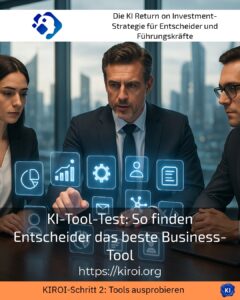
Structured testing of tools is a crucial step for all decision-makers who want to find suitable solutions in the digital world. In step 2 of the proven AIROI process, this approach helps to systematically test software and digital tools. This allows decision-makers to gain valuable insights into which tools meet their own requirements and effectively support their daily work.
Testing tools as a key to informed decisions
The process of testing a tool always begins with a precise analysis of the company's specific requirements. Only then follows the selection of suitable tools, which are then tested in real or simulated environments using clearly defined use cases. This ensures an objective assessment and avoids incorrect decisions that could lead to frustration later on.
In manufacturing companies, for example, digital early warning systems are being tested that predict potential machine failures. This helps to avoid downtime and keep production stable. Marketing departments select and test tools that enable automation or support competitive analysis in order to specifically optimise their own strategy. Office technicians analyse automation programmes that integrate seamlessly into existing office environments while also meeting security requirements.
A comprehensive tool test always considers not only the technical functions but also the user-friendliness and compatibility of the software with existing systems. Only in this way can digital tools be found that are not only used, but also impress in everyday use and sustainably support processes.
Best Practices: How to successfully test tools in practice
Success in tool testing hinges on a systematic and iterative approach. Decision-makers should plan the testing cycle, allow sufficient time for testing and adjustments, and involve future users early on in the process. This provides valuable feedback on usability and real-world application.
In manufacturing, for example, various AI-based diagnostic tools were tested to optimise maintenance planning and reduce machine downtime. In marketing, an SEO tool focused on competitor analysis helped a medium-sized company identify keyword gaps and thereby improve visibility. In office organisation, automation tools assisted in testing contract management, with easy integration into existing IT systems being a particularly decisive factor.
BEST PRACTICE with one customer (name hidden due to NDA contract) In a technical services company, an SEO tool was specifically tested as part of a tool trial. The precise identification of competitor and keyword gaps led to sustainable improvements in digital positioning and significantly supported the further development of the team's strategy.
How to overcome challenges in tool testing
A common difficulty is focusing purely on technical functions without adequately considering user feedback. This can result in tools being rarely used in everyday life, despite good functionality. Therefore, involving users is essential for success.
Likewise, snap decisions carry risks. Continuous testing, with multiple test cycles and adjustments, often yields valuable insights and prevents undesirable side effects. Finally, interfaces and compatibility with existing systems must be thoroughly checked before testing to avoid later integration problems.
Testing tools as a sustainable companion for digitalisation projects
Testing tools is more than just a technical check. It's a dynamic process that creates transparency and involves all relevant specialist areas. This allows decisions to be made on a sound basis. From logistics and marketing to customer service: practical examples show how targeted testing optimises existing processes and facilitates the introduction of new solutions.
In logistics, AI-supported demand forecasting and route optimisation, for example, significantly increase efficiency. In marketing, automation tools help to roll out personalised campaigns more effectively. In customer service, chatbots are proving their worth, with their continuous improvement in the testing process ensuring better user-friendliness.
My analysis
Testing professional tools in the second step of the AIROI process offers decision-makers structured and holistic support in software selection. It combines technical evaluation with user perspectives and process integration. This allows for the identification of tools that effectively support the daily workflow while simultaneously safeguarding investments through targeted testing. With a clear focus, practical examples, and iterative cycles, companies can make their digitalisation projects significantly more successful.
Further links from the text above:
Tool test in AIROI step 2: How decision-makers get started
Tool Test in AIROI Step 2: How Decision-Makers Find the Best
Testing tools: How to succeed at step 2 of the AIROI process
Tool Tests for Decision Makers: How to Succeed with AIROI Step 2
AIROI - Step 2 - Trying out AI tools efficiently
For more information and if you have any questions, please contact Contact us or read more blog posts on the topic Artificial intelligence here.










 Deutsch
  English (UK)